
QVC Inc’s Chapter 11 Filing Reshapes Its Multi-Channel Video Commerce Model Amid Financial Pressures
QVC’s recent Chapter 11 bankruptcy filing and operational consolidation highlight critical inflection points in its business model and growth strategy in the evolving video commerce sector.
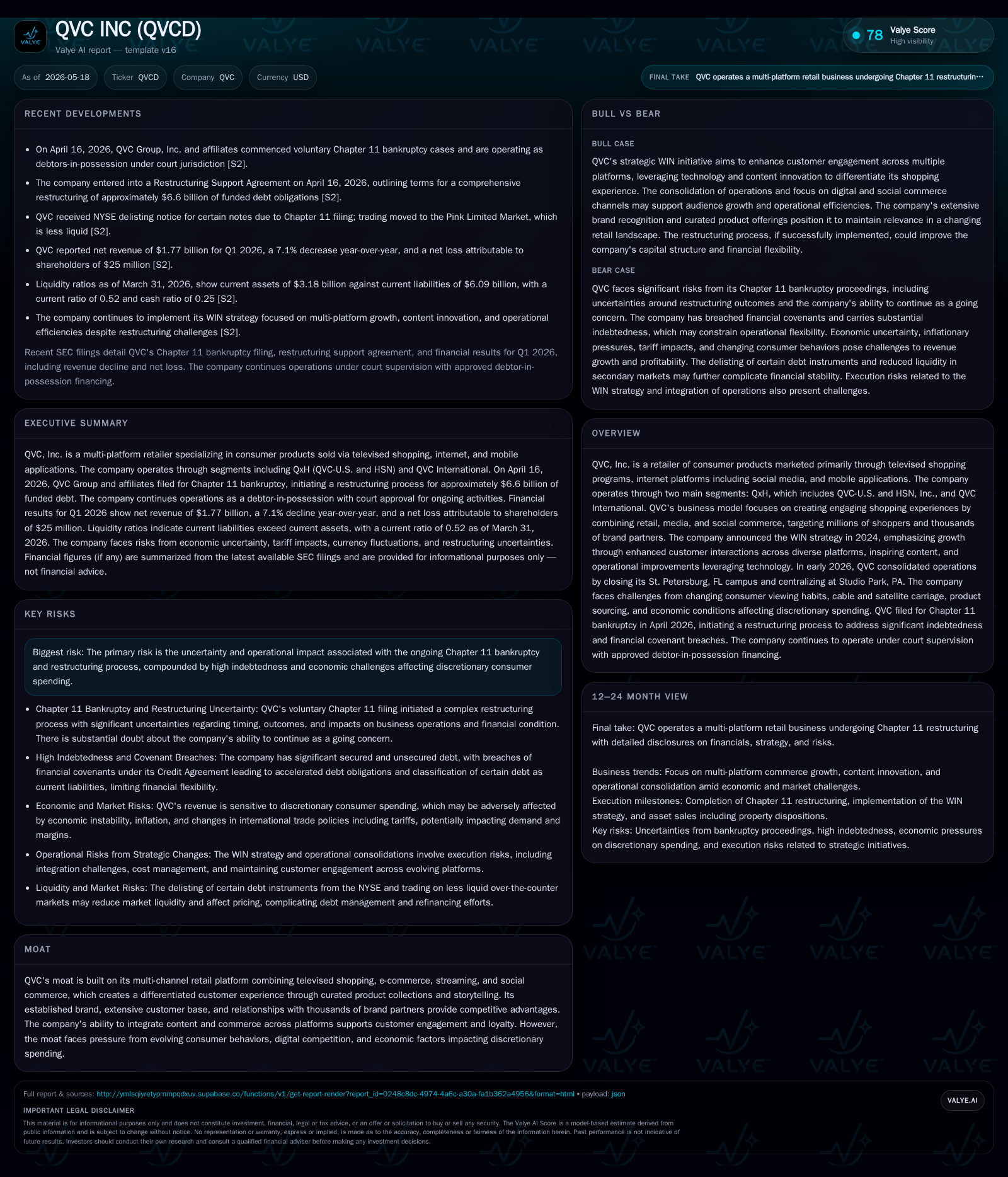
In Q1 2026, QVC, Inc. commenced Chapter 11 bankruptcy proceedings, accelerating obligations under its debt instruments and raising substantial going concern doubts. The company reported a $44 million decline in Adjusted OIBDA year-over-year, reflecting ongoing challenges including restructuring costs and shifting consumer behaviors. Strategically, QVC is advancing the WIN strategy—focusing on enhanced customer engagement across digital platforms and streamlined operations—while consolidating physical operations by closing its St. Petersburg campus. The company’s multi-channel platform combining televised shopping, e-commerce, social commerce, and streaming remains uniquely positioned but is under pressure from digital competitors and changing viewing habits. Liquidity is supported by over $1.4 billion in cash but constrained by restrictive covenants and a noncompliant net leverage ratio. Execution of the court-approved restructuring plan will be essential to stabilize capital structure and sustain growth amid economic uncertainties impacting discretionary demand.
Recent Operating Update: Chapter 11 Filing and Financial Implications
On April 16, 2026, QVC Group, Inc., including its subsidiary QVC Inc., filed voluntary petitions for Chapter 11 bankruptcy in the U.S. Bankruptcy Court for the Southern District of Texas [S2][S3][S21]. This filing immediately accelerated all outstanding debt under QVC's Credit Facility, multiple series of Senior Secured Notes (notably the 2067 and 2068 Notes), and unsecured exchangeable debentures [S2][S20]. Enforcement actions on these debt instruments are automatically stayed due to the bankruptcy proceedings.
QVC continues to operate its business as a debtor-in-possession adhering to court orders with approved "first day" motions allowing normal operations to continue uninterrupted [S2]. Although cash and liquidity remain sufficient—with cash, cash equivalents, and restricted cash totaling approximately $1.417 billion as of March 31, 2026—significant concerns have emerged regarding QVC's ability to continue as a going concern without successful reorganization [S2][F1]. The company's adjusted operating income before depreciation and amortization (Adjusted OIBDA) fell $44 million compared to Q1 2025 across both its domestic (QxH) and international segments [S7].
Business Model: Multi-Channel Video Commerce with Integrated Content
QVC operates a merchant-retailer business focusing on consumer products distributed primarily through live televised shopping alongside robust digital platforms including websites, mobile applications, social media channels (TikTok, Instagram), streaming devices (Roku, Apple TV), and virtual MVPDs such as Hulu + Live TV [S1][S21].
The firm reports two major segments: QxH (covering U.S.-focused brands including QVC-U.S. and HSN) and QVC International (operational chiefly in Japan via joint venture with Mitsui & Co., Germany, UK, Italy). Revenue derives from product sales driven by engaging storytelling formats—a blend of curated collections showcased live or on-demand that facilitates customer discovery beyond transactional e-commerce [S1]
Revenue mechanics involve:
- Customers purchasing directly during televised programming windows or via digital touchpoints
- Brand partners supplying products that benefit from integrated marketing exposure
- Pricing influenced by product mix shifts toward higher-margin categories through WIN strategic efforts
- Volume sensitive to cable carriage agreements, platform adoption trends, and overall consumer discretionary spending [S10]
Margins are affected by operational scale efficiencies at consolidated production facilities; since early 2025 QVC halted operations at St. Petersburg campus concentrating content creation at Studio Park Pennsylvania location to optimize cost structures [S10][S21]. The company also incurs significant capital expenditures (~$170–$190 million annually) related to technology enhancement supporting omnichannel integration [S1].
Industry Structure and Competitive Position
QVC is a pioneer in video commerce—a retail-media hybrid combining live shopping television with digital platforms—offering an experience distinct from traditional brick-and-mortar stores or standalone e-commerce retailers. It curates a niche heavily reliant on storytelling-driven sales which fosters brand loyalty among millions of engaged consumers.
Competitive pressures come from diverse directions:
- Pure-play online marketplaces expanding direct-to-consumer capabilities with superior logistics.
- Streaming services coupled with shoppable media formats gaining share among younger demographics favoring on-demand viewing.
- Cable/satellite carriage volatility impacts reach given cord-cutting trends.
- Social commerce ecosystems that blend influencer marketing with instant purchasing options.
Despite headwinds, QVC's moat rests on:
- Established multi-channel distribution infrastructure spanning linear TV plus advanced digital assets.
- Deep partnerships with thousands of brand suppliers enabling tailored localized assortments internationally.
- Integration capabilities marrying content creation workflows across platforms for seamless user conversion. However, legacy format reliance coupled with emerging digital disruptors strains pricing power and customer retention.
Growth Drivers
QVC's path toward growth hinges largely on execution of its WIN strategy initiated in late 2024:[N19]
- Wherever She Shops: Expanding presence across social media platforms and streaming devices to capture consumers migrating away from traditional TV.
- Inspiring People & Products: Enhancing content quality through storytelling that differentiates offerings amidst commoditized online inventories.
- New Ways of Working: Leveraging technology investments for operational agility including predictive analytics for product assortment and personalized customer engagement.
Increased penetration in international markets leveraging local sourcing teams may unlock incremental revenues though geopolitical trade uncertainties impose risks [S9]. Asset monetization initiatives such as sale of remaining St. Petersburg properties by end-2026 aim to provide additional capital inflows [S2][S10].
Digital revenue growth depends on consumer adoption rates via mobile apps or social commerce channels; sustained cable distribution is vital to maintaining broad reach especially among older demographic segments less digitally native [S10]. Overall demand appears structurally challenged by shifting consumption patterns rather than purely cyclical economic factors.
Risks / Watchpoints / Growth Constraints
Chapter 11 Bankruptcy Proceedings Risks:
- Extended duration under court supervision could impair supplier confidence or restrict innovation investments.
- Uncertainty over final restructuring terms can prolong management distraction increasing employee attrition risks.
- Potential devaluation or elimination of existing equity interests threatens stakeholder alignment.[S1][S19]
Financial Constraints:
- Cash flows must prioritize interest payments limiting reinvestments.
- Downgrades by rating agencies increase future borrowing costs or collateral demands [S4][S6]
Market Dynamics:
- Competition from digitized shopping experiences challenges relevance, - Consumer discretionary cutbacks amid inflation limit volume growth, - Dependency on cable/satellite operators presents carriage risk impacting reach, - Legal contingencies such as prior settlements or investigations add uncertainty [S1]
What to Watch Next
Key near-term milestones include:
- Progress against Plan milestones outlined in the Restructuring Support Agreement concerning debt exchanges, equity issuances post-bankruptcy emergence [S22],
- Completion of asset sales notably remaining St. Petersburg assets expected within 2026 calendar year [S2],
- Trends in Adjusted OIBDA relative to restructuring expense recognition during ongoing reorganization,
- Developments around carriage negotiations or changes in platform distribution mix affecting audience reach,
- Updates on operational metrics such as active customer counts across digital platforms,
- Potential changes in dividend policies post-emergence considering liquidity constraints.[S21]
Financial Profile Snapshot (Latest Quarter)
QVC ended Q1 2026 with $1.417 billion in total cash resources concentrated largely in AAA-rated money market funds [S2][F1], providing a cushion against near-term operational needs despite strained liquidity ratios (current ratio ~0.52) indicating working capital tightness [F1]. Total debt obligations are accelerated due primarily this year given covenant defaults related to net leverage exceeding thresholds forcing classification as current liabilities [F1][S20]. Capital expenditures totaled $38 million during the quarter reflecting ongoing investments in television distribution rights and technology infrastructure supporting digitization efforts [S2]. Operating activities consumed $98 million of cash reflecting EBITDA declines exacerbated by restructuring impacts recorded in prior periods [S7]. Dividend payments from overseas joint venture (QVC-Japan) totaled $8 million during the quarter paid to partner Mitsui & Co Ltd [S2]. Restrictions on additional indebtedness limit financial maneuverability until emergence from bankruptcy is complete.
This analysis synthesizes SEC filings through May 15, 2026 () providing an integrated view without investment research views or advice. It reflects disclosed financials alongside strategic context inherent to multi-channel retail media companies adapting amid structural shifts toward streaming commerce amid significant balance sheet restructuring risks.
Disclaimer: This is research-only, informational analysis and not investment advice. It may include AI-generated interpretation and general industry context. Always verify important details using primary sources.

Comments