
QVC’s Post-Bankruptcy Strategy: Can Digital Innovation and Operational Changes Reverse TV Sales Decline?
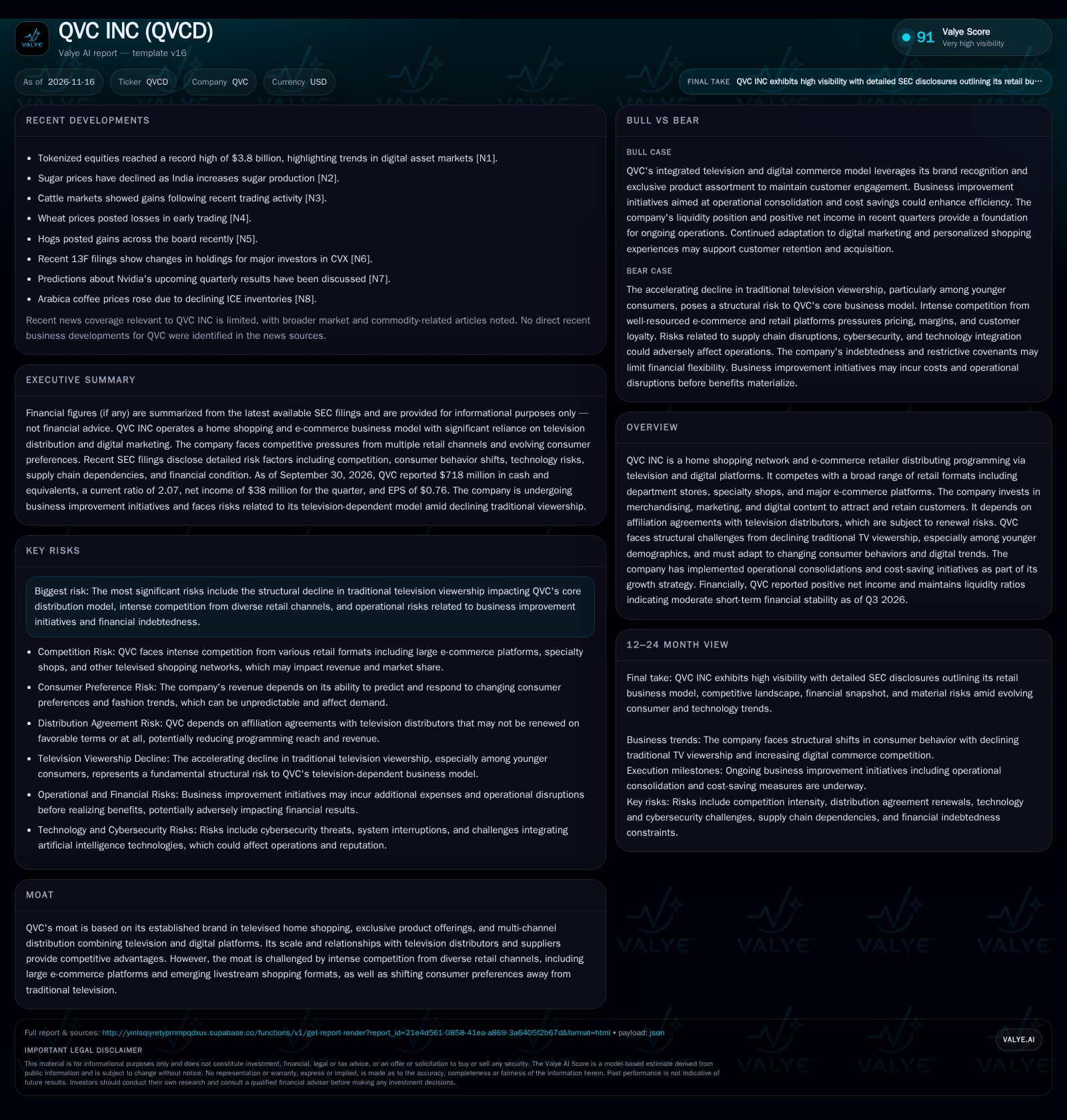
QVC Inc. is navigating a pivotal transition as its legacy television-dependent retail model faces accelerating structural decline. While recent operational consolidations and a positive quarterly net income signal near-term stability, the company’s long-term trajectory hinges on its ability to shift consumer engagement to digital channels and manage the risks of heavy indebtedness and expiring distribution agreements.
Its operational reorganization may yield efficiency, but the uncertainties of affiliate renewals, consumer shifts, and competitive intensity pose enduring challenges to the business model’s durability. [S2]
QVC Inc. stands at a strategic crossroads. Its legacy as a television-driven home shopping giant is under existential threat from the rapid migration of retail audiences to digital platforms and the fragmentation of consumer attention. Whether QVC’s recent operational consolidation and digital investments can meaningfully reshape its future remains the pivotal question for investors and management alike. [S2]
Q3 2026 Financial Health Amid Industry Transformation
As of September 30, 2026, QVC reported $718 million in cash and equivalents, current assets of $3.011 billion, and current liabilities of $1.453 billion, resulting in a current ratio of 2.07 and a cash ratio of 0.49. The company posted $38 million in net income for the quarter, with basic and diluted EPS of $0.76. These figures reflect a degree of near-term financial stability, aided by ongoing business improvement initiatives such as operational consolidation and reorganization. However, QVC’s dependence on television distribution—through agreements expiring between 2026 and 2029—remains a core vulnerability, especially as traditional TV viewership accelerates its decline. The company’s substantial indebtedness, with restrictive covenants and pledged assets, further constrains its maneuverability, making the success of digital transformation and cost-saving efforts critical for medium-term viability. [S2]
Analyzing Revenue Sources, Cost Dynamics, and Transition Economics
QVC’s revenue model is anchored in direct-to-consumer sales of curated merchandise via live television programming and digital platforms. Historically, the business leveraged television’s reach and a loyal, primarily older customer base to drive high-margin impulse purchases. The company’s economics have relied on a blend of variable costs (product procurement, fulfillment, shipping, on-air talent) and fixed costs (content production, technology infrastructure, distribution fees to TV partners). As traditional TV viewership wanes, the economics are shifting: digital marketing spend is rising, and customer acquisition costs may increase as QVC competes in a more fragmented online environment.
A critical question is whether QVC can achieve sufficient operating leverage from digital investments to offset the loss of television-driven volume. Digital channels typically offer more granular targeting but may lack the high average order value or conversion rates of the legacy TV audience. If digital engagement lags, QVC risks both margin compression and the erosion of its fixed-cost leverage. Meanwhile, substantial indebtedness and restrictive covenants limit its ability to invest aggressively or absorb prolonged operating shocks. The effectiveness of recent cost-saving initiatives and consolidation efforts will determine whether QVC can maintain profitability as its revenue mix evolves.
QVC’s Position Between Established Legacy and E-Commerce Competitors
QVC’s historical moat has rested on brand recognition, exclusive product assortments, and a multi-channel strategy that melds television and digital commerce. However, these advantages are increasingly challenged by the rise of e-commerce titans such as Amazon and Alibaba, which offer vast selection, aggressive pricing, and frictionless logistics. Specialty retailers and other televised shopping networks—both in the U.S. and internationally—further fragment the landscape.
The most existential threat is substitution: as consumers, especially younger cohorts, shift spending and attention to digital-first platforms, QVC’s television-centric engagement model becomes less relevant. Social commerce and livestream shopping formats, often led by influencers or native digital brands, represent a direct attack on QVC’s core value proposition. While QVC is investing in digital marketing across platforms like TikTok, Alphabet, Meta, Roku, and Amazon Fire, the question remains whether these channels can replicate the loyalty and purchase behavior of its historical audience. The outcome will hinge on QVC’s ability to differentiate its offerings, personalize engagement, and manage customer acquisition costs in this new competitive arena.
Revitalization Through Operational Changes and Enhanced Digital Interaction
A favorable scenario for QVC would see its operational consolidation and cost-saving initiatives yielding material margin improvements, freeing up resources for digital transformation. If the company can successfully migrate its customer engagement from television to digital platforms—leveraging data-driven personalization, exclusive merchandise, and seamless e-commerce experiences—it could stabilize or even grow its revenue base despite the decline in TV viewership.
Confirmation of this upside would come from sustained digital sales growth, improved customer retention metrics, and evidence that digital channels are capturing a younger demographic. A smooth renewal of major TV distribution agreements on favorable terms would provide a near-term buffer, while successful integration of AI-driven personalization or live digital events could signal a viable pathway to long-term relevance. Conversely, if digital initiatives fail to scale or if cost savings are offset by revenue attrition, this scenario would be falsified.
Sustained Decline with Efforts to Cultivate Alternative Growth Paths
The most plausible near-term outcome is a managed decline of QVC’s core television business, partially offset by incremental gains in digital commerce. In this scenario, operational improvements help preserve margins, but revenue pressure persists as TV audience fragmentation accelerates and customer acquisition costs rise in digital channels. The company maintains positive net income and liquidity in the short run, but growth is elusive and market share gradually erodes to larger e-commerce platforms and nimble digital-native competitors.
Evidence supporting this scenario would include stable or modestly declining revenue, continued positive net income, and gradual shifts in the revenue mix from TV to digital channels. Signs of deteriorating distributor relationships, rising churn, or inability to attract younger consumers would further confirm that QVC remains on a defensive footing, struggling to reinvent its business model at the pace required by structural industry changes.
Accelerated Downturn Triggered by Distribution Failures and Digital Setbacks
The most adverse outcome for QVC would be a confluence of negative events: failure to renew key television distribution agreements, persistent underperformance in digital channel adoption, and operational disruptions from cost-cutting or technology integration missteps. Such a scenario could see a sharp drop in reach, revenue, and customer loyalty, exacerbated by restrictive debt covenants that limit strategic responses.
Evidence for this scenario would include a significant, sudden decline in revenue following the loss of a major distributor, negative operating income, or deteriorating liquidity metrics. Early warning signs could also emerge from rising customer acquisition costs, failed digital campaigns, or publicized technology/cybersecurity incidents. If QVC is forced to divest assets, restructure debt, or seek emergency capital, it would confirm that structural headwinds have overwhelmed its adaptation efforts.
Specific Signals Reflecting QVC’s Adaptability and Business Strength
Renewal terms and timing for major TV distributor affiliation agreements, especially those expiring between 2026 and 2029.
Quarterly digital sales growth rates and the proportion of total revenue derived from digital platforms, if disclosed.
Customer retention and churn rates segmented by channel (TV vs. digital), which would help test the impact of channel migration.
Trends in average order value and customer acquisition costs across both television and digital channels.
Progress and costs associated with operational consolidation and business improvement initiatives, with a focus on realized versus projected savings.
Updates on indebtedness, covenant compliance, and any refinancing or asset sales required to maintain liquidity.
Incidence and resolution of cybersecurity or major information system disruptions, given stated technology risks.
Evidence of demographic shifts in the active customer base, particularly growth among younger consumers engaging digitally.
Disclaimer: This is research-only, informational analysis and not investment advice. It may include AI-generated interpretation and general industry context. Always verify important details using primary sources.

Comments