
QVC Group’s Strategic Reset Amid Chapter 11 Restructuring
QVC Group is executing operational consolidations and growth initiatives while addressing significant financial distress through Chapter 11 proceedings.
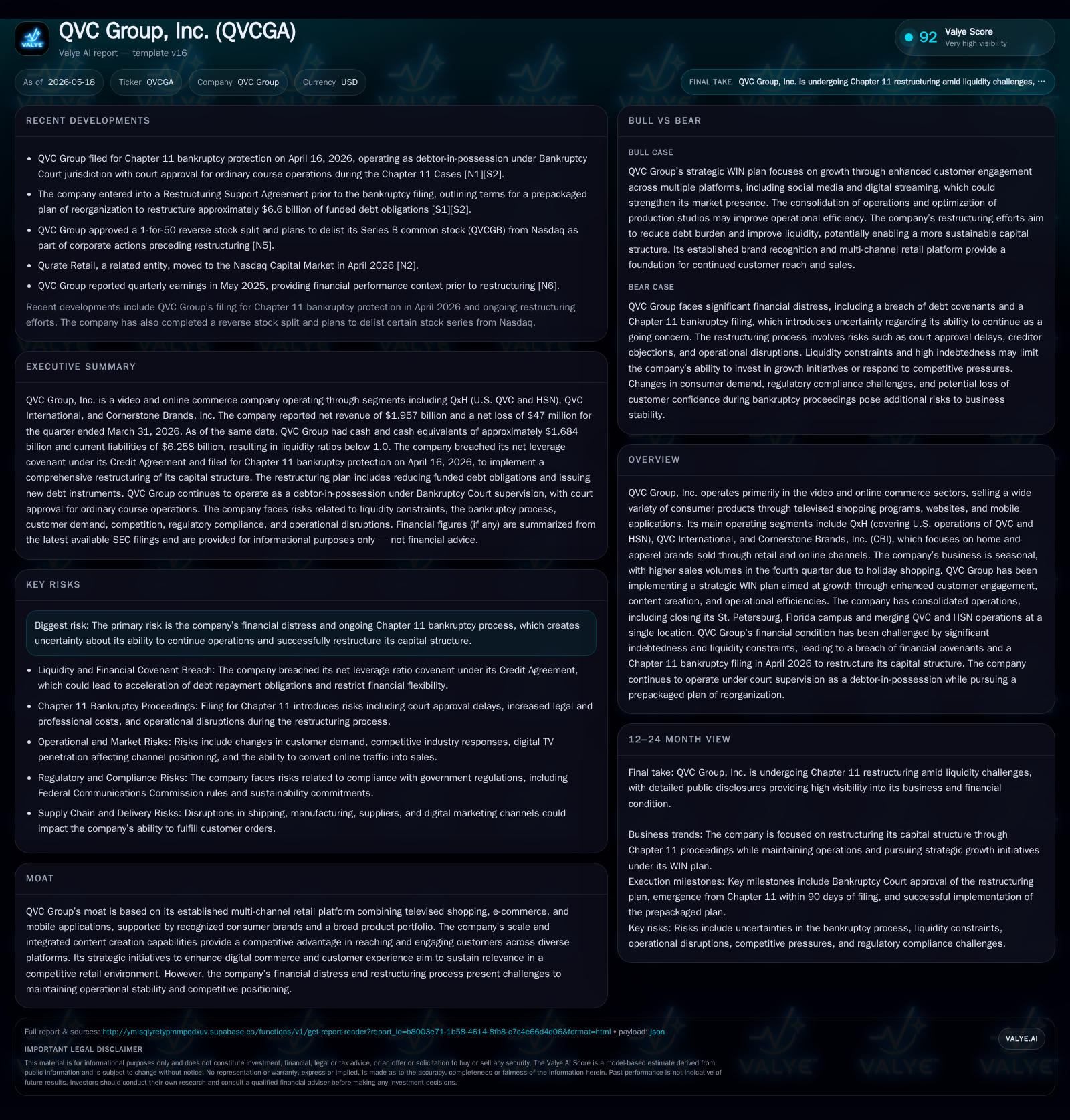
In its latest 10-Q filing, QVC Group disclosed critical operational shifts and a strategic reorganization aimed at stabilizing the business during ongoing Chapter 11 bankruptcy. The company’s core multi-channel retail model, integrating televised shopping and digital commerce through its QxH, QVC International, and Cornerstone Brands segments, underpins its market presence amid restructuring challenges. Growth efforts focus on enhancing customer engagement via the WIN plan and consolidating operations such as merging QVC and HSN platforms. Persistent liquidity pressures and high net leverage pose notable risks but also frame key milestones to monitor including emergence from bankruptcy and execution of growth initiatives.
Latest Quarterly Operating Developments under Chapter 11
QVC Group’s May 2026 10-Q filing offers a detailed window into its operations during Chapter 11 bankruptcy proceedings initiated in April 2026. Despite the financial turmoil, the company continues functioning as a debtor-in-possession with Bankruptcy Court oversight. At quarter end March 31, 2026, QVC maintained $1.68 billion in cash and equivalents but reported current assets of roughly $3.75 billion against current liabilities exceeding $6.25 billion—a current ratio near 0.6 signals tight short-term liquidity pressures exacerbated by accelerated debt due within the next year [S2], [F1].
Management disclosed ongoing restructuring efforts including consolidating teams under the WIN plan designed to grow revenue while controlling costs. The sale process for remaining St. Petersburg properties progressed with two closed sales late-2025 and completion anticipated in calendar 2026 [S25]. Operational consolidation included bringing together the formerly separate QVC and HSN U.S. platforms at one location to streamline workflows.
The company also detailed impairments and restructuring charges incurred during reorganization, reflecting both one-time costs and anticipated recurring savings as part of the broader transformation plan aiming to restore profitability post-bankruptcy.
Business Model and Product Offering Overview
QVC Group operates a multi-channel commerce platform balancing televised shopping content with digital channels—websites and mobile apps—and an extensive product portfolio across consumer goods, apparel, home products, and lifestyle brands. The primary operating segments include:
- QxH: Encompassing U.S.-based QVC and HSN operations delivering live broadcasts paired with ecommerce experiences targeting varied demographics.
- QVC International: Extending video-commerce models across multiple international markets leveraging localized content.
- Cornerstone Brands Inc. (CBI): Managing apparel and home-focused retail brands through wholesale, direct-to-consumer websites, and some physical retail outlets.
Revenue generation relies heavily on content-driven impulse purchasing whereby live presentations create immediate demand combined with digital convenience supporting order placement. Seasonality heavily influences sales volume with Q4 holiday periods historically representing peak demand due to gift shopping behavior.
The strategic WIN plan prioritizes enhancing personalized customer engagement via interactive content creation with the ultimate goal of expanding active user bases on digital platforms while achieving operational efficiencies through organizational realignment [S1], [S25].
Industry Context and Competitive Positioning
Within video-commerce—a niche intersecting broadcasting media with direct retail—QVC Group holds an entrenched position supported by decades-old brand recognition and an integrated platform that combines entertainment with commerce incentives. This model differentiates it from pure ecommerce peers by embedding storytelling directly into the shopping experience across multiple channels.
Competitive dynamics hinge on maintaining relevance against digitally native direct-to-consumer brands proliferating in apparel and lifestyle categories as well as general online marketplaces intensifying price competition. Switching costs appear moderate; customers accustomed to curated video programming may exhibit loyalty but can shift towards more convenience-oriented or lower-cost alternatives.
Supply chain scalability remains a factor given inventory management complexities spanning diverse product lines globally coupled with seasonal inventory spikes.
Overall, QVC Group’s moat rests partly on integrated content-commerce synergy that few pureplay ecommerce rivals replicate efficiently, but financial distress threatens operational stability relative to less leveraged competitors [S1].
Growth Drivers Rooted in Digital Innovation and Content Strategy
Despite near-term restructuring headwinds, the WIN initiative outlines clear internal investment priorities aimed at reviving growth trajectories by leveraging digital innovation:
- Interactive Content Amplification: More sophisticated video programming incorporating real-time customer engagement features aimed at increasing conversion rates.
- Customer Personalization: Utilizing data analytics to target marketing efforts more precisely across platforms improving retention metrics.
- Platform Synergies: Merging QVC/HSN U.S. channels streamlines merchandising cadence enhancing sell-through rates while optimizing cost structures.
- Digital Channel Expansion: Increased emphasis on mobile app capabilities captures growing consumer preference shift toward smartphones for shopping activities.
These initiatives correlate closely with KPIs cited such as unique website visitors, conversion percentages, average sales per customer equivalent—all pivotal signs of consumer traction within segmented markets [S1], [S17], [S25]. Operational cost efficiencies from consolidated corporate structures provide margin support crucial for reinvestment capacity despite constrained liquidity.
Risks and Headwinds Including Financial Distress Considerations
The company's primary challenges center around its highly leveraged capital structure amid ongoing Chapter 11 protection initiated April 16, 2026. Net debt approximates $4.9 billion against total debts exceeding $6.6 billion predominantly secured by company assets at subsidiary levels including QVC itself which faces covenant breaches under existing credit agreements [F1], [S2], [S6], [S11].
This situation restricts dividend capacity upstream from subsidiary cash flows potentially impacting parent-level funding flexibility.
Additional risks include employee attrition driven by uncertainty surrounding bankruptcy outcomes affecting talent retention essential to critical merchandising roles. Competitive erosion also looms if restructuring timelines extend or if market share shifts toward faster-growing e-commerce disruptors.
Supply chain disruptions or increased collateral demands from suppliers further add complexity amid constrained operating capital.
Key Milestones to Monitor Ahead
Looking forward over approximately three months post-April filing date:
- Emergence Timeline: Court approval of reorganization plan expected within about 90 days per public disclosures; successful emergence hinges on creditor agreement votes and final judicial confirmation processes noted in restructuring support agreements [N1], [S3], [S28].
- Liquidity Management: Monitoring continued access to debtor-in-possession financing facilities designed to support daily operations pending emergence is critical.
- Operational Execution: Progress updates on WIN plan rollouts including cost reduction realization from consolidated teams alongside maintaining or growing active user counts will serve as early markers.
- Financial Metrics: Quarterly cadence reporting on adjusted OIBDA margins improvement in post-consolidation periods will offer insight into trajectory stabilization or ongoing pressures.
- Customer Engagement Indicators: Website traffic trends, conversion rates on mobile platforms vs traditional sales channels will reflect effectiveness of revamped content offerings.
Financial Snapshot Supporting Context
As of March 31, 2026, QVC Group's available cash balances stand at about $1.68 billion contrasted with total debt obligations over $6.6 billion recorded at prior year-end December 31, 2025; this results in substantial net leverage approximating $4.9 billion after adjusting for cash holdings [F1]. Current liabilities outstrip current assets producing a working capital deficit reflected in a sub-1 current ratio near 0.6 indicating elevated short-term liquidity risks managed via bankruptcy court protections restricting creditor actions currently [S2], [F1].
Covenant breaches on credit facilities have led to classification of substantial portions of debt as current liabilities which compounds refinancing urgency given maturity schedules concentrated late in calendar year 2026 prior to restructuring filings; absent successful court-supervised reorganization completion, liquidity could become strained materially forcing severe operational curtailments or asset sales [S6], [S10].
This analysis is based exclusively on publicly filed documents including SEC forms and verified news sources up to May 2026 without speculative forecasts or investment research views.
Disclaimer: This is research-only, informational analysis and not investment advice. It may include AI-generated interpretation and general industry context. Always verify important details using primary sources.

Comments