
Real Asset Acquisition Corp. Advances Quantum Computing Business Combination with IQM
RAAQ’s recent filings highlight progress toward merging with IQM, marking a strategic shift from a real assets SPAC to a public quantum computing company.
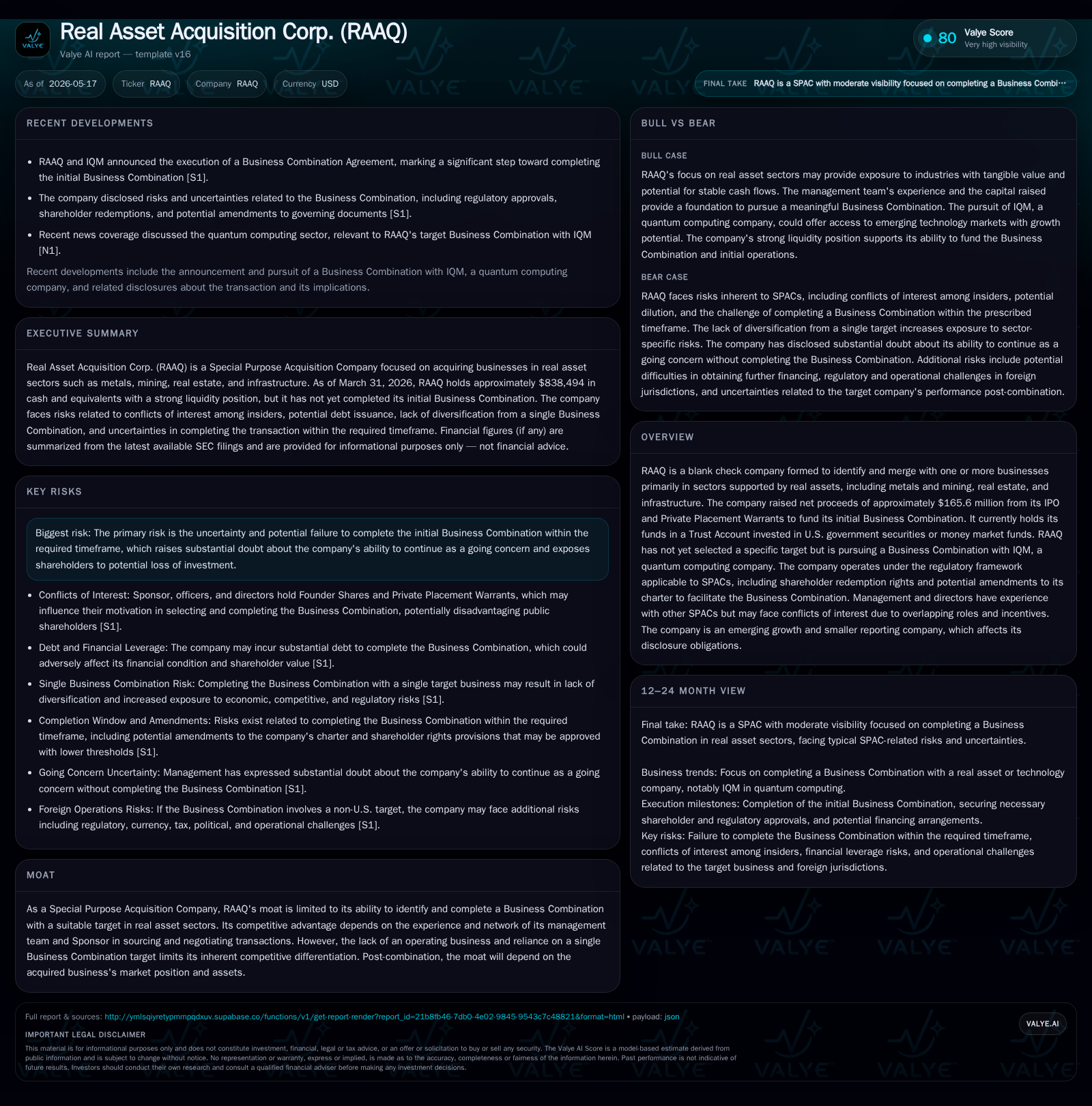
Real Asset Acquisition Corp. (RAAQ) is progressing on its business combination with IQM, a Finnish quantum computing hardware and software developer. The latest 10-Q filing confirms no material changes in risk factors while recent 8-K disclosures detail regulatory filing milestones and shareholder approval preparations. This transaction transforms RAAQ’s profile from a capital-raising shell focused on real assets into an operating entity in the emerging quantum technology sector. Key risks include merger completion uncertainty, potential shareholder redemptions impacting capital, and execution challenges for IQM’s commercialization. Financially, RAAQ maintains $838K in cash and a strong current ratio above 9x as of March 31, 2026, reflecting healthy liquidity ahead of closing.
Recent Operating Update
Real Asset Acquisition Corp. (RAAQ) filed its latest quarterly report on May 15, 2026 [S2], reaffirming its commitment to complete an initial Business Combination within regulatory deadlines without material changes to risk factors since the prior annual filing.
On May 14, 2026, multiple event filings disclosed the execution of a definitive Business Combination Agreement with IQM Finland Oy, a developer of quantum computing hardware and software based in Finland [S3][S4][S10][S12][S14]. This marks a strategic pivot for RAAQ from targeting traditional real asset sectors toward entering the nascent quantum technology industry via the reverse merger process.
The filings also detail IQM's confidential submission and subsequent public filing of a Form F-4 registration statement with the SEC as part of the proxy solicitation process required for shareholder approval. Preparations for an extraordinary general meeting are underway to seek necessary consents from RAAQ’s shareholders.
Business Model Overview
RAAQ was initially formed as a Special Purpose Acquisition Company (SPAC) focusing on acquiring businesses in real asset sectors such as metals, mining, infrastructure, and real estate [S1]. It raised net proceeds approximating $165.6 million through its IPO and concurrent private placement warrants designed to fund an acquisition target.
Prior to consummation of any business combination, RAAQ operates primarily as a capital vehicle holding proceeds in a Trust Account invested conservatively in U.S. government securities or money market funds. It has minimal operating expenses and does not generate revenue until post-merger operations commence.
The selection of IQM as the target signifies RAAQ's transformation into an operating company within the specialized field of quantum computing technology — characterized by high research intensity, long development cycles, and significant technical complexity.
Industry Structure and Competitive Position
Before closing the business combination, RAAQ’s competitive differentiation stems largely from its management team’s SPAC expertise rather than operational capabilities [S1]. The Sponsor controls approximately 25% of issued ordinary shares via Founder Shares that carry voting rights potentially decisive in approving the transaction.
IQM competes in a global landscape marked by significant technological barriers to entry involving advanced physics integration with manufacturing precision. Its competitors include other specialized startups as well as major technology firms investing heavily in quantum research.
The success of the combined entity will depend on IQM's ability to leverage proprietary technology, maintain strong intellectual property protections, forge strategic partnerships with governments and research institutions, and execute scalable manufacturing processes.
Growth Drivers
- Business Combination Completion: Closing unlocks deployment of trust account funds into operating assets tied to quantum technology innovation.
- Commercialization Milestones: Successful scale-up of quantum processor manufacturing and software platform deployments will drive revenue generation.
- Strategic Alliances: Partnerships with governmental bodies or industry consortia can accelerate adoption and provide diversified revenue streams.
- Intellectual Property: Robust patent portfolios underpin competitive moats critical in this technology-driven sector.
- Access to Capital Markets: Post-merger public status facilitates broader financing avenues essential for sustained research and development investment.
Risks / Watchpoints / Growth Constraints
- Merger Execution Risk: Regulatory delays or failure to obtain shareholder approvals could result in deal termination or liquidation scenarios affecting investment value [S1][S2].
- Shareholder Redemption Risk: Public investors may redeem shares during vote processes reducing combined company liquidity available for operations [S4][S10].
- Sponsor Conflicts: Incentives tied closely to deal closure may create misalignment between management/sponsor interests and ordinary shareholders [S1].
- Market Adoption Uncertainty: Quantum computing remains an emerging market with uncertain commercial timelines amid technical challenges [S4][S6].
- Competitive Pressure: Rapid innovation by rivals could erode technological advantages or intellectual property protections.
- Regulatory Environment: Evolving data privacy and cybersecurity regulations could impact technology deployment strategies [S4].
What To Watch Next
- SEC review outcomes and effectiveness of IQM business combination registration statement filings expected mid-2026 [S12].
- Shareholder vote results including redemption levels impacting post-merger cash availability.
- Progress reports from IQM on key technological development milestones following transaction close.
- Any amendments or regulatory waivers affecting transaction timing or structure.
- Market reaction reflecting investor sentiment toward entering quantum computing via this SPAC route.
Financial Profile (Brief)
As reported for the quarter ended March 31, 2026 [F1], RAAQ held $838K in cash equivalents within $924K total current assets against $101K current liabilities resulting in a robust current ratio of 9.11x. These metrics indicate strong liquidity preservation typical for SPACs prior to business combination consummation. Operating income remains negligible given lack of active operations pre-merger.
This conservative financial posture supports ongoing transaction execution while minimizing overhead costs until integration with IQM commences post-closing.
This analysis is based solely on publicly filed SEC documents related to Real Asset Acquisition Corp. It is intended for informational purposes only and does not constitute investment advice.
Disclaimer: This is research-only, informational analysis and not investment advice. It may include AI-generated interpretation and general industry context. Always verify important details using primary sources.

Comments