
Readvantage Corp.: Proprietary Bionic Reading Tech Meets Early-Stage Scale and Liquidity Pressures
Readvantage Corp. is betting on its bionic reading software and API platform to carve a niche in the competitive edtech landscape. While its technology addresses accessibility and reading efficiency, current financial constraints and scaling risks pose immediate challenges to realizing its enterprise ambitions.
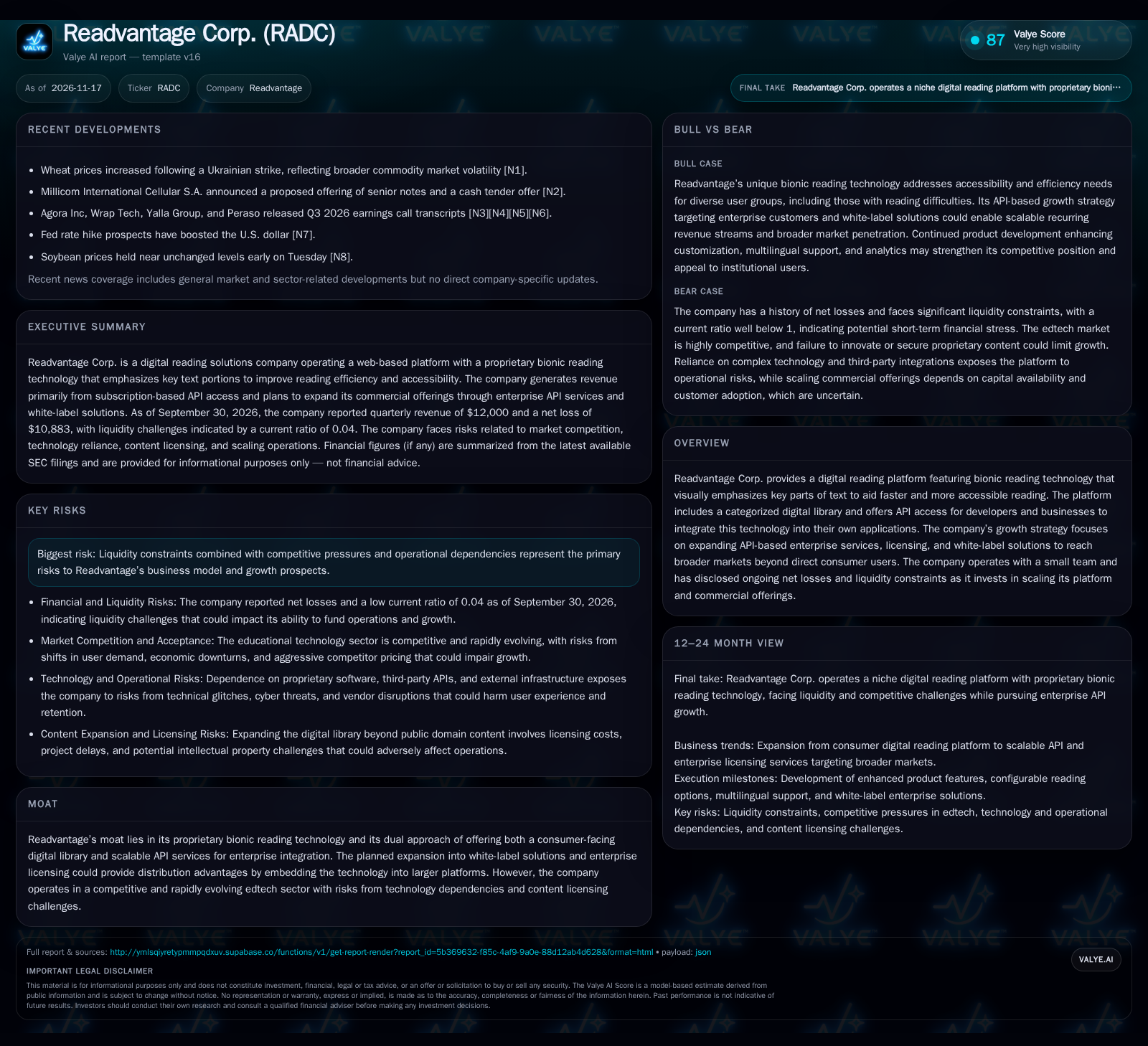
Readvantage Corp. offers a digital reading platform and API built around proprietary bionic reading technology, aiming to serve both consumers and enterprises. Its growth plan hinges on expanding API-based and white-label solutions to institutional markets, but faces execution and funding hurdles amid high sector competition and technology dependencies. Success will depend on both product differentiation and the company’s ability to secure capital and enterprise adoption in the coming quarters. [S1] [S2]
Readvantage Corp., founded in 2023, is leveraging its proprietary bionic reading technology to address accessibility and reading efficiency for a wide range of users—from individuals with learning differences to information professionals. Its digital library and API platform offer differentiated tools, but the company remains in the early stages of commercialization. The next year will likely determine whether its technology can break through as a sustainable business or remain a niche solution. [S1] [S2]
Acute Liquidity Pressure and Early Commercial Traction Define the Current Landscape
As of September 30, 2026, Readvantage reported $12,000 in revenue and a net loss of $10,883 for the quarter, with cash and equivalents of just $481 and a current ratio of 0.04 [S2]. The primary business remains the subscription-based API for bionic reading, with a web-based platform offering a digital library and free reading access. Despite a clearly articulated strategy to expand into enterprise and white-label API services, current revenues reflect only early-stage adoption, and the company has not yet demonstrated material customer uptake beyond initial developer and consumer engagement [S1] [S2].
Unpacking the Economic Model: Subscription APIs, Enterprise Licensing, and the Path to Scale
Readvantage’s core monetization engine is its subscription-based API, offered in tiered plans (API Basic and API Pro), along with plans for enterprise-level and white-label solutions. In principle, API-driven revenue models can provide high gross margins and recurring income if customer adoption scales, especially in B2B or institutional markets. However, such models typically require significant upfront investment in product development, integration support, and customer acquisition—costs that may outpace revenue growth in the early years. The free digital library serves as a user acquisition and brand awareness tool but is unlikely to be a direct revenue driver unless monetized through premium content or services. The economics of white-label and enterprise licensing could be attractive if Readvantage can secure large institutional clients, as these deals often involve multi-year contracts and customization fees, but such arrangements are not yet evidenced in current results [S1].
A critical factor in the subscription API economic model is customer lifetime value (LTV) relative to customer acquisition cost (CAC). For Readvantage, achieving a favorable LTV/CAC ratio depends on the stickiness of its API integration and the frequency with which clients renew or expand usage. Enterprise clients typically demand tailored onboarding and ongoing support, which increases upfront costs but can justify higher subscription fees and longer contract durations. If Readvantage can develop scalable onboarding processes and automated support tools, it may reduce marginal costs and improve unit economics over time. Conversely, failure to streamline these processes could result in disproportionately high churn or slow sales cycles, undermining revenue growth despite increasing sales efforts.
Another dimension influencing profitability is the balance between product development investment and monetization speed. Readvantage’s reliance on proprietary bionic reading technology necessitates continuous R&D to maintain differentiation and compatibility with evolving digital content formats. However, excessive reinvestment without commensurate revenue growth risks exacerbating cash burn. A disciplined approach might involve prioritizing features that directly enhance enterprise integration or user engagement metrics, such as analytics dashboards or multilingual support, which can be monetized through tiered pricing. Moreover, strategic partnerships with content providers or platform integrators could accelerate adoption and reduce go-to-market costs by leveraging established distribution channels.
Positioning Bionic Reading Amidst Edtech Giants and Specialized Accessibility Platforms
Readvantage operates in a highly competitive edtech landscape, contending with both platform incumbents (e.g., large digital library and e-reader providers) and niche accessibility-focused startups. Its proprietary bionic reading format distinguishes its offering, particularly for users with ADHD, dyslexia, or those seeking reading efficiency. However, the underlying risk is that digital reading and accessibility feature sets are increasingly being embedded directly by larger platforms or open-source initiatives, eroding differentiation unless Readvantage’s technology proves demonstrably superior or uniquely integrable. The API strategy opens doors to B2B partnerships, but the company will face competition from both established education technology vendors and specialist API providers in accessibility, document conversion, and content management. The ability to offer configurable, multilingual, and analytics-enhanced solutions could deepen its moat, but ongoing content licensing and technology dependencies may narrow margins or create operational bottlenecks if not managed effectively [S1].
How Successful Enterprise API Adoption Could Unlock Recurring Revenue and Brand Leverage
The most favorable scenario for Readvantage is one where its bionic reading API gains traction among educational institutions, publishers, and corporate knowledge platforms, leading to a pipeline of enterprise contracts and white-label deployments. Under this pathway, evidence would include announcements of multi-year enterprise deals, rising API usage metrics, and a growing share of revenue from B2B channels. Product enhancements—such as advanced configurability, multilingual support, and robust analytics—could strengthen the platform’s value proposition, increase switching costs, and attract integration partners. Over time, the company could see improving operating leverage as recurring enterprise revenues scale faster than fixed costs. Confirmation of this scenario would come from disclosed enterprise customer wins, a material increase in contracted annual recurring revenue (ARR), and a shift in revenue mix toward licensing and API fees. Falsification would be a continued lack of enterprise adoption, stagnant API revenue, or inability to advance beyond pilot projects.
Incremental B2B Gains and Ongoing Cash Burn as the Most Likely Near-Term Trajectory
The most plausible scenario over the next 12-18 months is incremental progress in API adoption, with modest growth in developer and small business users but slow movement into large enterprise contracts. The free library may help sustain user interest and modest organic growth, but is unlikely to materially shift the revenue base. Net losses are likely to persist as investment in product development, marketing, and customer support continues to outpace top-line gains. Evidence supporting this scenario would include gradual increases in API subscribers, slow but steady revenue growth, and periodic product updates. A lack of material financing or customer traction, or any deterioration in technology or content licensing partnerships, would argue for a less favorable outcome.
Liquidity Shortfall and Execution Risks Could Precipitate Disruption or Strategic Reset
If Readvantage is unable to secure additional funding or rapidly accelerate revenue, it could face operational disruptions, forced downsizing, or even a strategic sale of its technology assets. Execution risks are compounded by the need to expand content licensing, maintain technical infrastructure, and support integration partners. Confirmation of this downside scenario would come from missed payroll or vendor payments, abrupt reductions in product development, or disclosures of going-concern risks. Failure to convert pilots into contracts, loss of key technical staff, or competitive displacement by larger edtech or accessibility platforms would further validate this trajectory.
Company-Specific Developments That Will Shape Readvantage’s Thesis in the Next Year
Securing external financing or disclosing new funding arrangements to address immediate liquidity needs.
Announcing or evidencing enterprise API or white-label customer wins, especially multi-year or large-scale contracts.
Demonstrating measurable growth in API usage or paid developer/business subscribers (if disclosed).
Releasing major product upgrades, such as configurable reading intensity, multilingual support, or analytics capabilities.
Expanding the digital library beyond public domain content through new licensing deals or partnerships.
Managing technology dependencies by reducing reliance on third-party APIs or strengthening infrastructure resilience.
Reporting any material changes in team size, key personnel, or board composition (if disclosed).
Addressing or updating on legal, regulatory, or IP-related challenges in content expansion or technology licensing (if any arise).
Disclaimer: This is research-only, informational analysis and not investment advice. It may include AI-generated interpretation and general industry context. Always verify important details using primary sources.

Comments