
Reborn Coffee: Expansion Ambition Meets Early-Stage Financial and Franchise Realities
Reborn Coffee is aggressively pursuing international growth via franchising and licensing, leveraging proprietary coffee innovation and a multi-channel model.
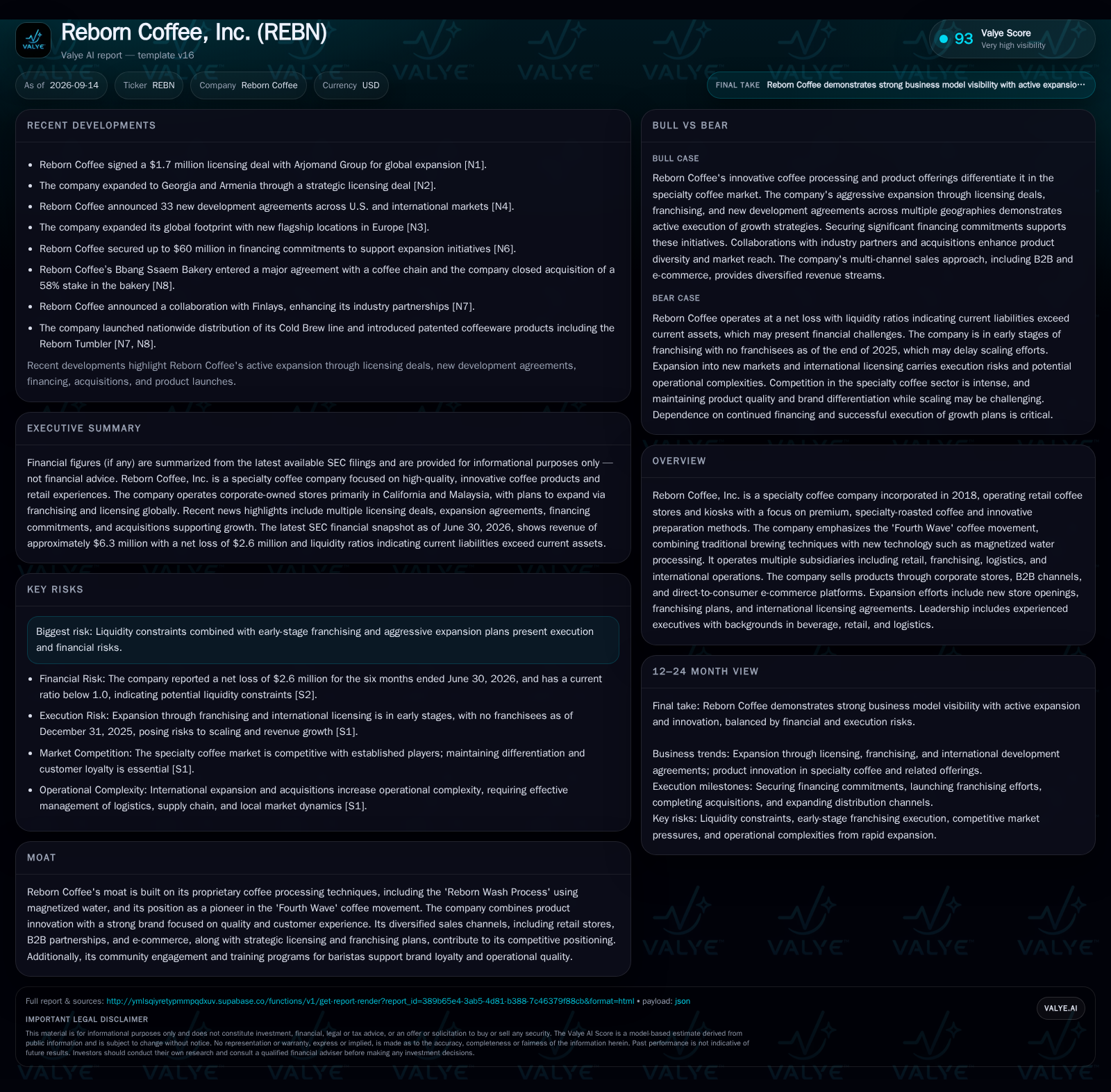
Reborn Coffee is a specialty coffee retailer and innovator with a focus on premium product and customer experience, now embarking on rapid international expansion through licensing and franchising. Despite securing major financing commitments and announcing numerous development agreements, the company remains loss-making, with current liabilities exceeding current assets. The success of its growth strategy will hinge on its ability to execute franchising, manage operational complexity, and address its liquidity position as it seeks to compete against established specialty coffee brands. [S1] [S2] [N1] [N2] [N4] [N6]
Reborn Coffee, Inc. is at a strategic crossroads: it is pursuing an ambitious global expansion built on specialty coffee innovation, proprietary brewing methods, and a nascent franchising platform. The company’s recent moves—including a $1.7 million licensing deal, expansion into new international markets, and dozens of development agreements—signal high growth aspirations.
Expansion Initiatives Collide with Financial Constraints
Reborn Coffee reported $6.3 million in revenue and a net loss of $2.6 million for the first half of 2026. The company reported cash and liquidity metrics for the period; these figures do not by themselves establish operating runway, investment capacity, financial flexibility, or financing capacity. [S2] These liquidity figures highlight the company’s vulnerability as it embarks on an aggressive expansion strategy.
Despite this, Reborn has moved forward with a $1.7 million licensing deal for global expansion, entered new markets in Georgia and Armenia, and announced 33 new development agreements spanning the U.S. and international geographies. [N1] [N2] [N4] The company also secured up to $60 million in financing commitments to back these initiatives. [N6] However, as of year-end 2025, Reborn had not yet signed any franchisees, making the transition from corporate-owned to franchise-driven growth a critical inflection point. [S1]
How the Model Could Scale—And Where It May Strain
Reborn Coffee’s business model combines corporate-owned retail stores, B2B sales, e-commerce, and, prospectively, franchising and licensing. The company’s value proposition hinges on proprietary processing methods—such as its magnetized water 'Reborn Wash Process'—and a focus on premium quality and customer experience. In theory, the transition to franchising and licensing could provide operating leverage: franchise and license fees are typically high-margin, recurring revenue streams that require less capital investment than opening new corporate stores.
However, the economics of franchise rollouts are sensitive to initial adoption, franchisee quality, and the company’s ability to provide ongoing support and enforce brand standards. Early-stage franchising often involves material upfront costs for recruitment, training, and marketing, potentially widening losses before a critical mass of franchisees is achieved. International licensing, while offering rapid footprint growth, can introduce revenue variability and reliance on partner execution.
If franchising ramps successfully, Reborn could transition to a less capital-intensive, higher-margin model. If not, fixed costs and expansion outlays could outpace near-term revenue gains.
Brand and Process Innovation as Differentiators—But Not Moat-Proof
The specialty coffee market is intensely competitive, with established chains, boutique independents, and other 'Fourth Wave' entrants all vying for premium-positioned, experience-driven customers. Reborn Coffee’s moat rests on its proprietary processes—such as the magnetized water wash and cold brew concentrate—and its positioning as a premium, innovative brand. These features may help justify premium pricing and foster customer loyalty, especially if the company can deliver a consistently superior in-store experience.
However, such innovations are not inherently defensible and could be imitated or leapfrogged by better-resourced competitors. The effectiveness of these differentiators will depend on the company’s ability to communicate their value to customers and franchisees, maintain quality standards as it scales, and invest in ongoing product and process innovation.
Reborn’s multi-channel approach (corporate retail, B2B, e-commerce, franchising/licensing) offers diversification, but also exposes the company to execution complexity and the risk of being outpaced by larger, more capitalized specialty coffee chains or local market leaders in new geographies.
Rapid Franchise Adoption and Global Licensing Yield a Scalable Platform
In the favorable scenario, Reborn Coffee succeeds in onboarding a significant number of franchisees in 2026, translating its pipeline of 33 new development agreements into operational locations. Early franchisees achieve profitability, validating the model and attracting additional operators. International licensing partners execute effectively, generating recurring royalty streams and expanding brand presence with minimal capital outlay from Reborn.
Evidence that would confirm this scenario includes a rapid increase in the number of franchised locations, growth in high-margin franchise and licensing revenue, and improved cash flow from operations. Early disclosure of franchisee unit economics—such as average unit volumes, payback periods, and franchisee retention—would further validate the model’s scalability.
If Reborn leverages its $60 million in financing commitments to support franchisee onboarding, marketing, and supply chain investments without diluting existing shareholders or overextending its balance sheet, the company could reach an inflection point where operating leverage drives margin expansion and net income turns positive.
Gradual Ramp and Mixed Execution Define the Next Phase
The most plausible outcome is a measured ramp of franchise adoption, with some but not all of the 33 development agreements translating into operational stores in 2026. Early franchisees may face a learning curve, resulting in uneven unit performance and requiring additional support from corporate. International licensing generates modest initial revenue, but operational and brand consistency challenges slow broader rollout.
Reborn’s revenue grows as new stores open, but operating losses persist due to upfront costs, limited scale efficiencies, and the need to invest in franchisee support and international logistics. The company draws down on its financing commitments to bridge working capital gaps, but its cash position remains thin relative to obligations, making execution discipline and cost control paramount.
Confirmation of this scenario would include incremental growth in franchised units, steady but not dramatic top-line expansion, and continued net losses or only marginal improvements in operating margin. Disclosure of franchisee satisfaction, unit economics, and licensee performance would help clarify the durability of the model.
Liquidity Squeeze and Franchise Stumbles Undermine Expansion
In the adverse case, Reborn Coffee’s franchising and licensing initiatives fail to scale as planned. Development agreements stall, with few franchisees opening stores or achieving profitability. International partners struggle with execution, leading to weak royalty contributions and potential brand dilution. Meanwhile, the company’s thin liquidity position worsens as expansion costs mount and cash burn accelerates.
If Reborn is unable to draw on its $60 million in financing commitments—due to unmet covenants, market conditions, or dilution concerns—the company could face a working capital crunch. This might necessitate asset sales, additional dilutive financings, or retrenchment from certain markets. Persistent losses and inability to demonstrate a path to profitability could erode franchisee interest and damage brand credibility.
Evidence for this scenario would include stalled franchise openings, negative working capital trends, increased short-term borrowings, and management disclosures indicating delays or setbacks in international rollouts.
Milestones That Will Define Reborn Coffee’s Expansion Thesis
The number of operational franchised locations opened in 2026 and the pace at which new franchisees are onboarded.
Growth in high-margin revenue from franchise fees and international licensing, as disclosed in future financial statements.
Trends in cash flow from operations, including any improvement toward operating cash flow breakeven.
Disclosure of franchisee unit economics, such as average unit sales, profitability, and payback period—if disclosed.
The status and drawdown pace of the $60 million in financing commitments—specifically, whether funds are accessed on favorable terms.
International licensee performance, including royalty revenue trends and any early evidence of brand consistency challenges.
Management commentary on execution challenges or delays in franchising and global expansion initiatives.
Disclaimer: This is research-only, informational analysis and not investment advice. It may include AI-generated interpretation and general industry context. Always verify important details using primary sources.

Comments