
RenX Enterprises Pushes Biomass Recycling Leadership Amid Capital Stresses
RenX focuses on strengthening its biomass recycling and logistics operations while managing significant liquidity and going-concern challenges.
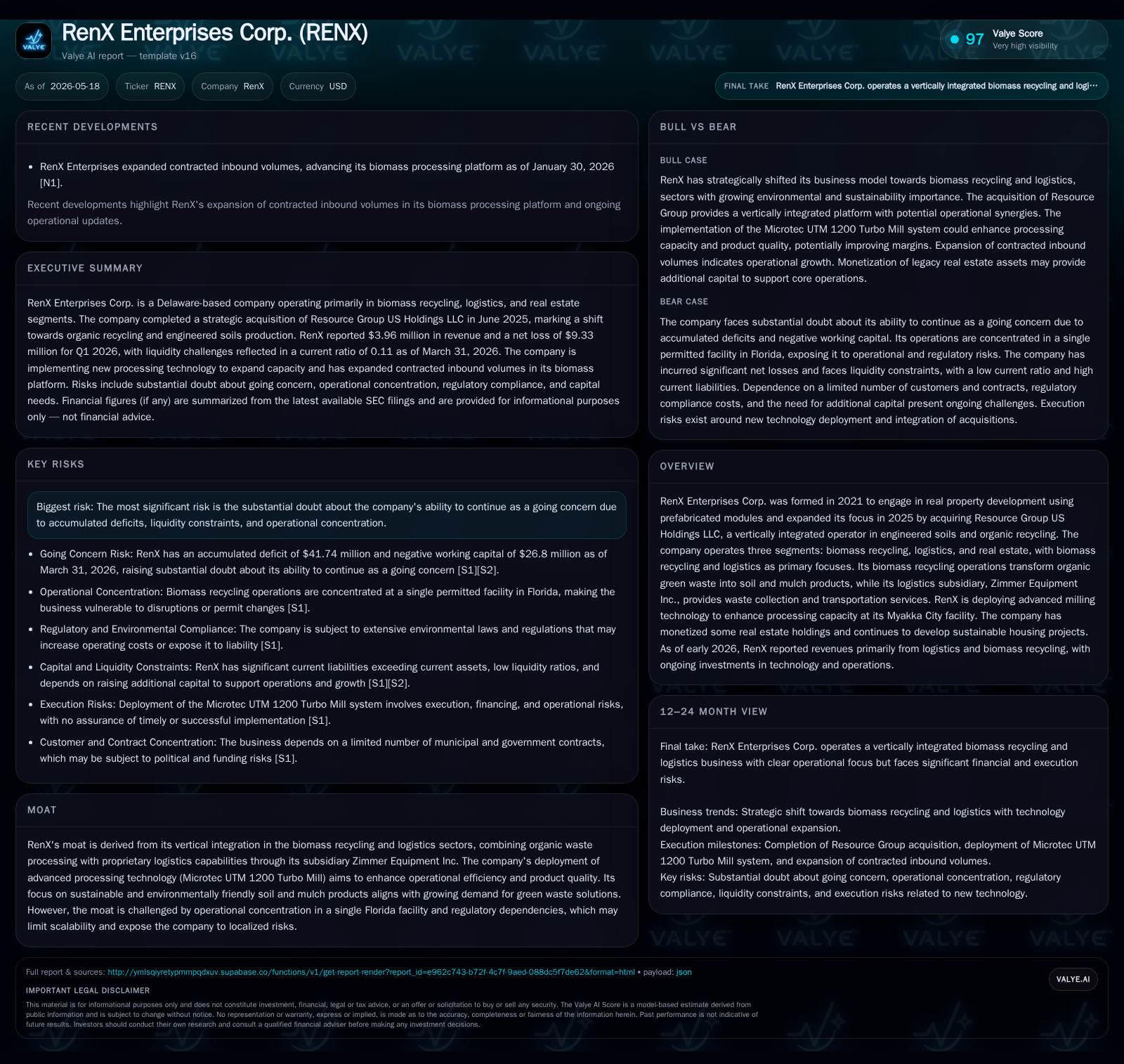
In its latest quarterly report, RenX Enterprises Corp. disclosed ongoing financial distress marked by a substantial net capital deficiency and accumulated losses, prompting a strategic contraction from real estate AI ventures to core biomass recycling and logistics. The company’s business model centers on vertically integrated organic waste processing and specialized logistics services in Florida, enhanced by advanced milling technology that aims to boost operational efficiency and product quality. Despite growth catalysts in sustainable environmental solutions, RenX faces critical risks related to concentrated operations, regulatory dependencies, and cash flow strain that could impede scaling prospects.
Latest Quarter Highlights: Strategic Shift and Financial Challenges
RenX Enterprises Corp.'s most recent Form 10-Q filing for the quarter ended March 31, 2026 reveals deepening financial strain with an accumulated deficit of $41.74 million and negative working capital north of $26.8 million [S2]. These figures underscore the company's admission of substantial doubt regarding its ability to continue as a going concern. The liquidity crunch has been aggravated by reliance on bridge notes, project-level financing structures, alongside equity and debt issuances that have yet to achieve profitable traction.
Strategically, the company reversed course on its investments in real estate-related artificial intelligence (AI) technologies developed in 2023–early 2024 aimed at sustainable housing joint ventures in southern Texas. RenX now prioritizes monetization of select real estate holdings with rising market valuations; proceeds from these sales are earmarked for reinvestment into expanding its core biomass recycling and logistics segments [S2], [S3]. This pivot reflects an effort to consolidate resources around more immediately scalable revenue streams during tight liquidity.
Business Model Breakdown: Integrated Biomass Recycling and Logistics
RenX operates three primary business segments: biomass recycling, logistics under Zimmer Equipment Inc. (ZEI), and real estate development—though biomass recycling and logistics represent the operational core post-2025 strategic shift following the Resource Group acquisition [S1], [S6]. Biomass recycling converts organic green waste collected primarily from landscaping entities, municipalities, golf courses, and community maintenance into environmentally friendly soils and mulches.
Zimmer Equipment Inc., RenX's fully owned logistics arm, leverages a proprietary fleet comprising high-capacity grapple trucks, walking floor trailers, and variable-sized containers optimized for bulk organic waste collection [S6]. This vertical integration offers operational control over inbound feedstock procurement through waste collection contracts alongside distribution flexibility for finished goods—advantages difficult for competitors relying solely on third-party logistics providers to match
Revenue originates from municipal contracts, commercial landscapers, golf courses supplying green waste inputs, plus third-party clients using ZEI's transportation services. Revenues are driven by volumes of green waste processed plus pricing discipline on soil/mulch products tied to quality improvements reflecting advanced milling technology deployment.
Our analysis highlights revenue mechanics sensitive to input collection volumes controlled under multi-year municipal contracts; switching costs emerge from ZEI’s asset specificity including specialized drivers with commercial licenses plus highly tailored refuse equipment financed across multiple lender agreements—adding barriers for potential competitors considering entry or disruption.
Industry Structure and Competitive Context
RenX operates within the engineered soils market segment combined with organic waste management/logistics—a space characterized by strict environmental regulation especially at the state level. Its single processing facility located in Florida hinges entirely upon maintaining permits issued by the Florida Department of Environmental Protection; any revocation or suspension presents an existential threat given lack of geographic diversification [S1], [S18].
The organic recycling sector typically demands heavy capital investment for fleet acquisition combined with operational expertise managing regulatory compliance—a combination RenX meets via Resource Group integration but struggles with due to capital shortages.
Customer concentration risk is pronounced since revenues derive from limited municipal contracts susceptible to political funding cycles. Moreover, limited availability of licensed truck drivers constrains logistics scalability alongside risk exposure if key drivers depart or cannot be swiftly replaced given specialized licensing requirements.
Growth Catalysts: Technology Deployment and Sustainable Development
A principal growth driver is renown deployment of advanced organics processing equipment such as the Microtec UTM 1200 Turbo Mill at RenX’s Myakka City facility designed to elevate processing throughput while producing higher quality soil and mulch blends—an offering that aligns well with increasing market demand for sustainable landscaping materials driven by environmental regulation pressures favoring recycled organics over traditional chemical fertilizers [S1], [S6].
This technology adoption positions RenX ahead of smaller competitors who rely on less sophisticated grinding methods that may compromise product uniformity or capacity throughput—providing a potential pricing premium opportunity via improved product mix.
Strategically exiting less synergistic real estate AI ventures allows greater capital allocation focus towards these core business units fostering operational scale gains while leveraging full-stack capability in waste-to-product lifecycle from collection through processing distribution via vertically integrated channels.
However, this opportunity is tempered by execution risk associated with commissioning new equipment amid financial constraints as well as dependency on stable supply contracts underpinning organic feedstock availability essential for sustained volume growth.
Risks and Constraints: Capital Adequacy and Operational Concentration
RenX’s financial disclosures reveal constrained liquidity that poses meaningful operational risks: total debt approximates $28 million primarily short-term or near-term maturities serviced amid limited cash reserves (cash below $600k), reflected in an extremely low current ratio near 0.11 indicating near-term working capital insufficiency [S2], [F1]. Interest burden exceeds $1 million per quarter, further pressuring cash flow from operations already negative given ongoing investment costs.
Operationally the concentration of all biomass processing activity at one Florida site creates exposure not only to environmental permit revocations but also weather events or infrastructure disruptions without redundancy—a significant bottleneck risk seldom manageable without parallel facilities or diversified geography in this industry segment [S18].
Additional vulnerabilities include dependence on a small number of licensed commercial drivers within their logistics segment; loss or inability to recruit such talent could materially diminish transport capacity adversely impacting revenue generation potential [S1], [S18].
Debt agreements feature restrictive covenants limiting financial maneuverability; recent convertible debenture issuances carry original issue discounts suggesting financing cost elevation reflective of credit risk perception among institutional investors constraining future access to lower-cost funding sources [S2]
Upcoming Milestones and Strategic Watchpoints
Key operational milestones investors should track include ramp-up progress of organics processing capacity linked directly to Microtec mill installation outcomes at Myakka City [S2]. Monitoring volumetric throughput indicators will validate whether technological investments translate into tangible operational improvements
Success in monetizing select legacy real estate holdings is another critical near-term catalyst—asset sales executed where third-party appraisals indicate meaningful appreciation provide necessary capital recyclability supporting working capital replenishment amidst tight liquidity conditions [S2], [S14].
Regulatory developments around permit renewals remain inherently uncertain—the company's ability to maintain compliance uninterrupted impacts not only immediate operating capability but also long-term business continuity given industry regulatory frameworks in Florida underpinning their core business segment [S18].
Lastly management communication concerning refinancing efforts or equity raises within covenant limitations will offer insight into solvency trajectory.
Financial Overview: Liquidity, Debt, and Capital Outlook
As of March 31, 2026, RenX reported total debt approximating $27.96 million against cash equivalents near $13.7 million at quarter-end translating into net debt near $27.95 million with corresponding current liabilities eclipsing current assets by approximately $29.9 million versus $3.19 million respectively; together these factors present a precarious short-term liquidity posture embodied in a current ratio around 0.11—a level signaling large working capital deficits restraining operational flexibility immediately ahead [S2], [F1].
Recent financing includes bridge notes such as a Fourth Cash Advance Agreement with Cedar Advance LLC where weekly withdrawals occur until repayment totaling $750,000 completes highlighting persistent dependence on short-term cash flow advances touching nearly weekly increments [$15,000/week] from receivables monetization structures [S2]. Additionally issued private placement debentures totaling $310,000 priced at an 8% discount underscore elevated cost burdens relating directly to credit risk premiums held by institutional investors contributing additive interest expenses weighing down net profitability further complicating cash flow management efforts currently unsustainable without external recapitalization or asset divestitures closely managed alongside cost controls [S2].
These features collectively emphasize that while RenX maintains operating capabilities centered around vertical integration-driven biomass recycling growth ambitions leveraging proprietary logistics assets—their path toward sustained profitability remains constrained heavily by ongoing financing requirements triggered by substantial accumulated deficits alongside concentrated asset base risks requiring diligent management attention.
This analysis synthesizes public filings as of May 15–18, 2026 without predicting future stock performance or offering investment research views. It aims solely to detail RenX Enterprises Corp.’s recent business developments contextualized within competitive industry frameworks based strictly on filed SEC disclosures.
Disclaimer: This is research-only, informational analysis and not investment advice. It may include AI-generated interpretation and general industry context. Always verify important details using primary sources.

Comments