
RenX Enterprises: Strategic Pivot to Biomass Recycling Confronts Liquidity and Execution Headwinds
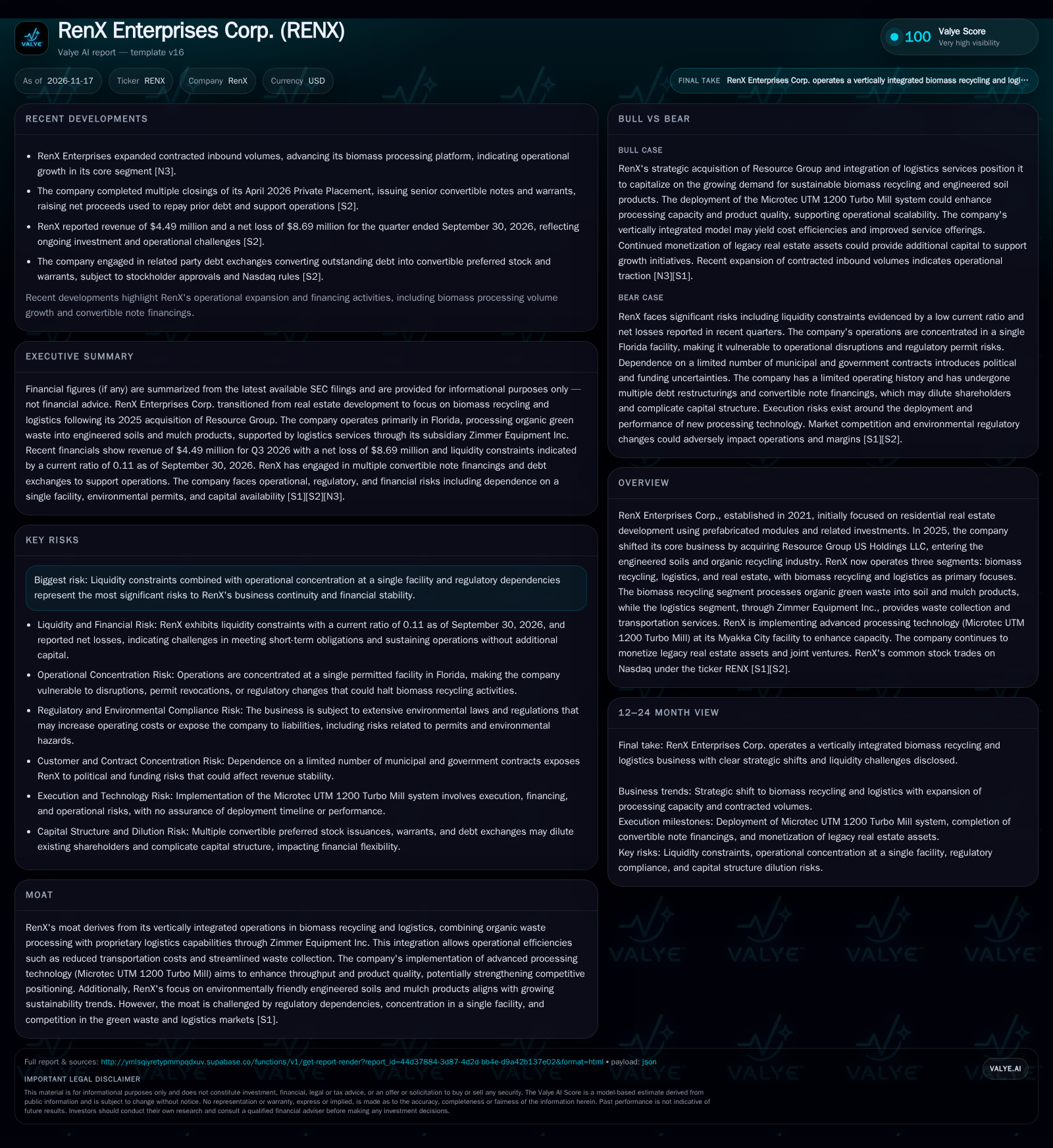
RenX Enterprises has transformed itself from a real estate developer to a vertically integrated biomass recycling and logistics operator.
RenX Enterprises’ shift to engineered soils and organic recycling, supported by the acquisition of Resource Group, has yielded early signs of growth in its biomass processing business. Near-term performance will hinge on successful deployment of new processing technology, the ability to monetize legacy real estate, and access to additional capital.[S1] [S2] [N3]
RenX Enterprises Corp. offers a case study in strategic reinvention: founded in 2021 as a real estate developer, the company has since pivoted sharply into the engineered soils and biomass recycling industry. Its acquisition of Resource Group US Holdings and integration of logistics operations have enabled RenX to establish a vertically integrated platform focused on turning organic waste into value-added soil and mulch products. The next year will test whether RenX can execute on its technology roadmap, secure new capital, and convert growth potential into sustainable economics.
Strategic Realignment and Financial Strain Define the Present
RenX’s 2025 acquisition of Resource Group US Holdings signaled a decisive transition from real estate development to engineered soils and organic recycling as its core business. This move brought with it the integration of logistics operations through Zimmer Equipment Inc., cementing a vertically integrated business model focused on the transformation and transportation of organic green waste.[S1]
The company reported cash and liquidity metrics for the period; these figures do not by themselves establish operating runway, investment capacity, financial flexibility, or financing capacity. [S2]
Despite these pressures, the company has advanced its biomass processing business, as evidenced by a recent expansion in contracted inbound volumes.[N3] The company is also actively deploying the Microtec UTM 1200 Turbo Mill system at its Myakka City facility, aiming to boost processing capacity in 2026.[S1]
How RenX’s Integrated Model Could Unlock Margin—If Scale and Funding Align
RenX’s business now hinges on two primary segments: biomass recycling (processing organic waste into engineered soils and mulch) and logistics (waste collection and transportation through Zimmer Equipment Inc.). Theoretically, vertical integration could drive cost efficiencies by minimizing third-party logistics expenses and capturing more of the value chain. If inbound organic waste volumes continue to rise, fixed-cost leverage from processing infrastructure could improve gross margins, especially as the Microtec UTM 1200 Turbo Mill system comes online.
However, the company’s economics remain under strain. The Q3 2026 net loss highlights that current scale is insufficient to cover operating costs and likely substantial depreciation and amortization tied to facility and technology investments.[S2] Biomass recycling is typically a high-volume, relatively low-margin business, with profitability sensitive to processing volumes, tipping fees, and end-market pricing for soil and mulch. The logistics segment, while offering recurring revenue potential, is capital-intensive, requiring investment in fleet maintenance and personnel. RenX’s ability to monetize legacy real estate assets could provide episodic cash infusions but is not a long-term earnings driver.
The company’s financing approach—reliant on convertible notes, warrants, and debt-for-equity exchanges—suggests ongoing capital needs and may result in shareholder dilution. Without a rapid improvement in operating cash flow or successful asset sales, further external capital will likely be needed to support technology deployment and working capital.
Barriers and Vulnerabilities in the Engineered Soils and Recycling Ecosystem
RenX’s competitive ambition is rooted in the integration of waste processing and logistics, potentially enabling lower unit costs and more flexible service offerings. The adoption of advanced processing technology at its Myakka City facility could yield product quality or throughput advantages if execution is successful. However, the company’s moat is modest and vulnerable to several counterforces.
The engineered soils and biomass recycling sector is regionally fragmented, with competition from established waste management firms, local composters, and public sector operators. Many peers benefit from multi-site footprints, diversified customer bases, and stronger balance sheets. RenX’s dependence on a single permitted facility in Florida exposes it to outsized operational and regulatory risk—any disruption could severely curtail revenue.
Customer concentration is another vulnerability: municipal and government contracts are subject to political, budgetary, and regulatory changes, and losing a major contract could materially impact revenue. Regulatory compliance and permitting are significant hurdles, and environmental law changes could increase costs or restrict operations. While RenX’s sustainability positioning aligns with market trends, these structural risks limit the defensibility of its current competitive position.
Scaling Volumes and Technology Execution Could Drive Operating Leverage
The most favorable outcome for RenX involves a successful ramp-up of contracted inbound waste volumes, with the Microtec UTM 1200 Turbo Mill system delivering on its promised efficiency and throughput gains. If the company can process higher volumes at lower marginal costs, it could shift the economics of biomass recycling toward profitability, especially if end-market demand for engineered soils and mulch remains robust.
Further, if RenX is able to monetize significant legacy real estate assets, these proceeds could bridge liquidity gaps and fund growth without excessive dilution. A series of new or expanded municipal contracts, combined with continued operational execution, would support revenue visibility and potentially improve bargaining power with suppliers and customers.
Evidence supporting this scenario would include sustained sequential growth in inbound waste volumes, successful commissioning and utilization of the new processing system, improved gross margins, and a reduction in net operating losses. Announcements of new contract wins or significant real estate asset sales would further validate the upside case.
Incremental Gains Offset by Structural Headwinds
The most plausible scenario is one of incremental operational progress offset by ongoing financial and operational headwinds. RenX may continue to expand inbound waste volumes and realize modest improvements in processing efficiency as the Microtec system is deployed. Revenue growth from the core biomass and logistics segments may continue, but margin expansion is likely to be gradual given competitive pricing dynamics and fixed-cost absorption challenges.
The company’s capital structure may become more complex, with dilution risk for equity holders. Operational concentration in Florida remains a persistent vulnerability, and any regulatory or permit-related disruptions could quickly unravel progress.
Confirmation of this scenario would be quarterly financials showing stable or slowly improving revenues, continued net losses (albeit possibly narrowing), further capital raises or debt exchanges, and no material expansion beyond the current facility footprint.
Liquidity Shock or Facility Disruption Could Trigger a Crisis
The adverse scenario revolves around a liquidity crunch or operational disruption at the Myakka City facility. Should RenX fail to secure new capital—whether through asset sales, additional convertible financings, or strategic investment—the company may struggle to meet obligations or fund ongoing operations. Given the current ratio of 0.11 and negative cash flow, even minor shocks could precipitate a cash crisis.[S2]
A regulatory setback, such as loss or suspension of the Florida Department of Environmental Protection permit, would halt core operations and could trigger contractual defaults or customer losses. Equipment failure, environmental incidents, or loss of a major municipal contract could similarly threaten revenue continuity. In such a scenario, RenX could be forced into asset sales at distressed valuations, seek restructuring, or face insolvency.
Evidence confirming the downside would include missed debt or vendor payments, negative going concern language in filings, delays or failures in deploying the Microtec system, permit non-renewals, or sharp revenue declines tied to customer or operational disruptions.
Milestones That Will Test the RenX Transformation Thesis
Sequential growth in contracted inbound waste volumes and confirmation of long-term supply agreements, if disclosed, would help test the sustainability of core segment momentum.
Operational deployment and ramp-up efficiency of the Microtec UTM 1200 Turbo Mill system at Myakka City, including throughput and downtime metrics, will be critical for assessing capacity expansion.
Quarterly gross margin trends in the biomass recycling and logistics segments, if disclosed, would reveal whether operating leverage is materializing.
Progress on monetization of legacy real estate assets—including asset sales or joint venture exits—should be monitored as a source of non-dilutive capital.
Status of environmental permits and regulatory compliance for the Florida facility should be watched closely, as any adverse developments could have outsized impact.
New municipal or government contract announcements, as well as renewals or losses of major customers, would provide insight into revenue visibility and concentration risk.
Balance sheet updates on cash, current liabilities, and capital raises—along with any changes in going concern language—are necessary to evaluate financial runway.
Any expansion into additional processing facilities or new geographic markets would signal reduced operational concentration risk and greater scalability.
Disclaimer: This is research-only, informational analysis and not investment advice. It may include AI-generated interpretation and general industry context. Always verify important details using primary sources.

Comments