
Ralph Lauren Corp Builds on Premium Legacy with Solid Fiscal 2026 Momentum
Strong Q3 earnings and fiscal year results highlight Ralph Lauren's brand resilience and operational execution in premium lifestyle apparel.
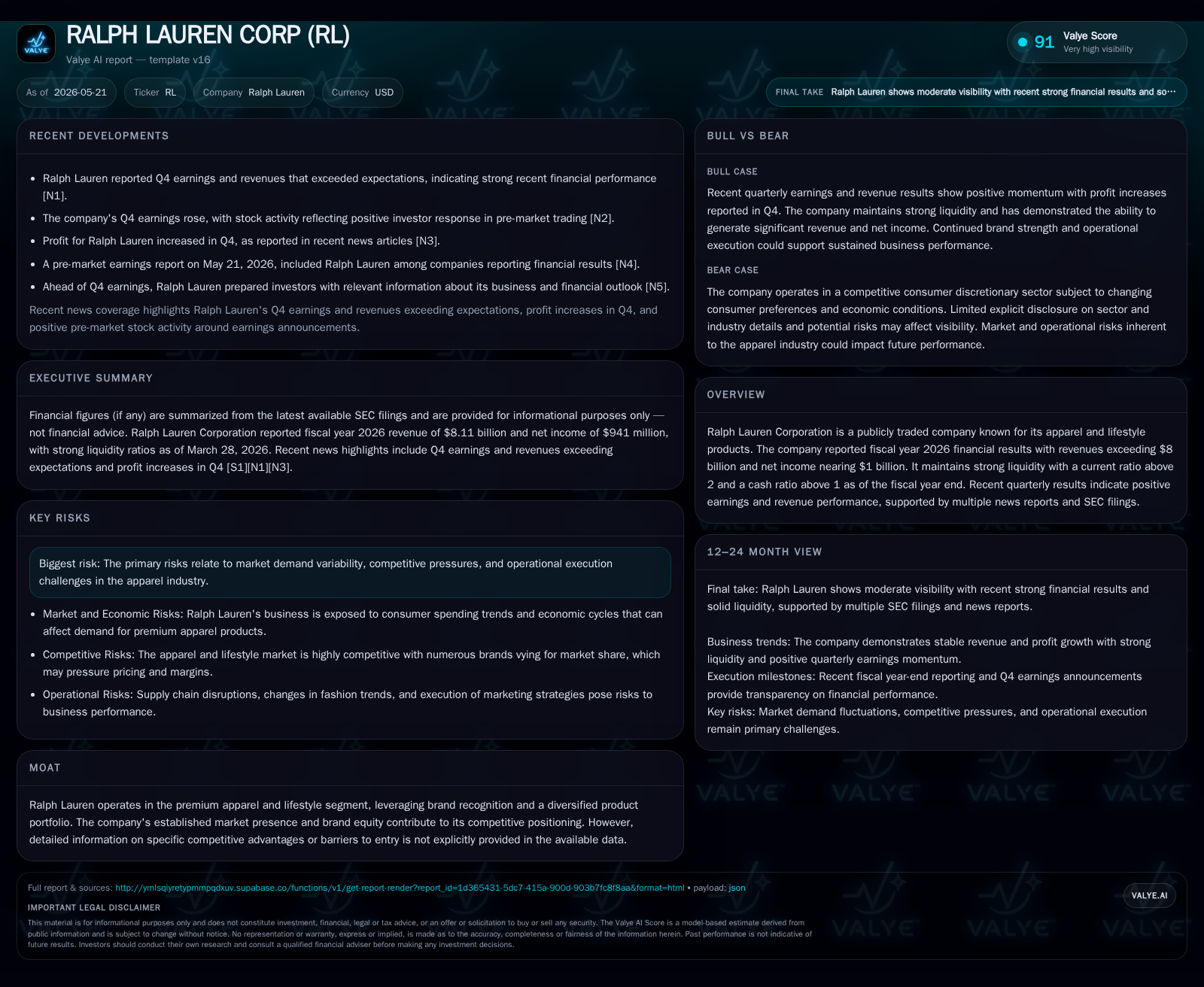
Ralph Lauren Corporation delivered robust revenue and earnings performance in its latest quarterly filing, underpinned by its well-established premium brand. Fiscal year 2026 revenues exceeded $8 billion with net income approaching $1 billion, supported by solid liquidity and a healthy balance sheet. The company's diversified product portfolio and ongoing digital initiatives underpin its competitive edge in a saturated apparel market. However, risks remain tied to market demand fluctuations and intensifying competition.
Q3 2026 Operating Update: Earnings Drive Positive Near-Term Outlook
Ralph Lauren Corporation's latest quarterly filing dated February 5, 2026 ([S2]) revealed continued revenue momentum and strong earnings results that set an optimistic tone heading into fiscal year-end. The company reported annual revenues surpassing $8.1 billion backing up a net income figure nearing $941 million as of March 28, 2026 ([F1]). Quarterly earnings notably beat consensus estimates ([N3]), signaling effective demand capture amid evolving marketplace dynamics. This performance underscores Ralph Lauren's ability to sustain its premium positioning while navigating sector headwinds. Additionally, the company's cash balance stands at approximately $2 billion with a current ratio of about 2.13 ([F1]), reflecting solid liquidity that supports flexibility for strategic investments.
Business Model and Product Quality: Leveraging Brand Equity in Premium Lifestyle Apparel
Ralph Lauren's business model revolves around designing, marketing, and distributing premium lifestyle products primarily focused on apparel across men’s, women’s, and children’s segments ([S1]). Revenue generation largely comes from direct-to-consumer retail sales through owned stores and e-commerce platforms alongside wholesale partnerships. Customers pay a price premium for the brand’s heritage appeal intertwined with quality craftsmanship and a diversified product mix including sportswear, formal wear, accessories, and home goods. This breadth allows Ralph Lauren to address various consumer tastes within the upscale market.
The company leverages brand equity to maintain strong pricing power relative to mass-market competitors. Product differentiation derives from classic styling combined with contemporary innovations in fabric technology and design refinements ([S1]). Its multi-channel distribution strategy—spanning flagship stores on key global high streets to an expanded digital presence—enhances accessibility while fostering customer loyalty. Economic drivers of revenue include volume uplift through new product introductions and geographic expansion complemented by improved price realizations on select categories.
Competitive Landscape and Industry Structure: Differentiation in a Saturated Market
Within the highly competitive premium apparel market, Ralph Lauren faces rivalry from established luxury houses as well as emerging fast fashion players who threaten price erosion ([S1],[N2]). Despite these pressures, Ralph Lauren sustains differentiation via entrenched brand recognition built over decades along with controlled supply chains ensuring product quality standards. Its distribution network balances physical retail locations against accelerating e-commerce adoption—a critical factor given shifting consumer shopping habits.
Switching costs for consumers are generally low in fashion; however, Ralph Lauren benefits from consistent brand loyalty fostered through lifestyle marketing and aspirational positioning. Distribution efficiency continues to be pivotal; thus balancing brick-and-mortar footprint optimization alongside enhanced online user experience remains central to maintaining competitive advantage. Industry commoditization risk persists but is mitigated by the firm's targeted focus on upscale consumer segments less sensitive to economic cycles compared to mass market apparel.
Growth Drivers: Digital Expansion, Product Diversification, and Geographic Penetration
Ralph Lauren's strategic growth agenda hinges on expanding its omni-channel capabilities including bolstering e-commerce sales which have exhibited increasing contributions during recent quarters ([S2]). The company invests in digital technologies that improve customer engagement metrics such as conversion rates through enhanced personalization platforms ([N6]). This push is accompanied by selective store remodels aiming to boost foot traffic conversion.
Product diversification remains another tangible growth lever encompassing seasonal capsule collections aimed at driving higher volumes alongside elevated product mix contributing positively to margin structure ([S1]). Geographic growth particularly targets emerging luxury markets where rising consumer affluence is expanding demand pools.
Operational initiatives also emphasize supply chain agility allowing faster time-to-market which supports capturing trend-driven consumer interest more effectively. Concrete KPIs relevant here include digital sales growth rates quarterly reported plus new retail footprint openings or renovations reaching implementation stages verified either in SEC disclosures or management commentary ([S2],[N6]).
Risks and Constraints: Market Demand Variability and Competitive Pressures
The company explicitly flags risks tied to macroeconomic factors influencing consumer discretionary spending patterns which can cause demand volatility within apparel segments ([S9]). Increased competition introduces margin pressures potentially necessitating promotional activity that could erode pricing power or elevate input costs adversely affecting profitability ([S1],[N13]).
Supply chain resilience remains vital given global logistics complexities impacting inventory flow timing—missteps could result in excess stock or lost sales opportunities. Execution risks related to new product launches or store conversions also represent operational constraints requiring disciplined project management.
Furthermore, the broader industry dynamic includes challenges from fast fashion’s rapid cycle times compelling more frequent capital deployments into design innovation that Ralph Lauren must match thoughtfully without diluting core brand values.
Key Near-Term Watchpoints: Execution Milestones and Emerging Demand Signals
For stakeholders monitoring Ralph Lauren’s upcoming trajectory, validated indicators will be forthcoming quarterly guidance updates where revenue mix trends and profit margin targets provide clarity ([S3]). Tracking progress on digital strategy execution through reported online sales figures alongside metrics like inventory turns will signal whether investment in technology platforms translates into tangible demand uplift.
Marketing campaign effectiveness assessed via customer acquisition or retention statistics will also be instrumental for gauging momentum shifts ([N9]). Additionally, retail channel performances—both physical stores’ same-store sales comparisons and e-commerce conversion metrics—will serve as leading indicators of wider market acceptance of new initiatives.
Management communication during earnings calls will likely highlight progress against strategic priorities such as international expansion plans or sustainability integration efforts which remain qualitative but influential factors affecting investor sentiment ([N11]).
Fiscal Year 2026 Financial Snapshot: Strong Liquidity and Income Support Strategy
Concluding with financial context from fiscal year ended March 28, 2026 highlights Ralph Lauren’s robust balance sheet condition anchored by cash and equivalents nearing $2 billion paired with total current assets well above liabilities resulting in a current ratio exceeding 2 ([F1]). Such liquidity underpins the company's ability to fund growth projects or navigate unexpected market fluctuations without reliance on incremental debt financing.
Net income reaching approximately $941 million corroborates underlying operational efficiencies combined with sustained pricing strategies despite broader sector challenges ([F1]). Total debt reported is minimal relative to cash holdings indicating a net cash position that reduces leverage risk substantially. Operating income surpassing $1.17 billion reflects controlled expense management complementing top-line strength.
This financial profile empowers Ralph Lauren both strategically for reinvestment into core competencies such as digital transformation initiatives and tactically for weathering cyclical apparel sector uncertainties noted earlier.
Disclaimer: This analysis is based solely on publicly available SEC filings and news sources cited. It is intended for informational purposes without any research view or endorsement regarding investment decisions.
Disclaimer: This is research-only, informational analysis and not investment advice. It may include AI-generated interpretation and general industry context. Always verify important details using primary sources.

Comments