
Richmond Mutual Bancorporation: Strategic M&A, Dividend Discipline, and the Challenge of Regional Banking Scale
Richmond Mutual Bancorporation’s Q3 2026 results reveal a bank navigating earnings volatility, regulatory complexity, and the integration of a strategic merger, all while maintaining shareholder dividends and a mixed institutional/retail investor base. The company’s future hinges on its ability to drive profitable growth from recent acquisitions, manage credit risk under CECL, and defend its position amid intensifying regional competition.
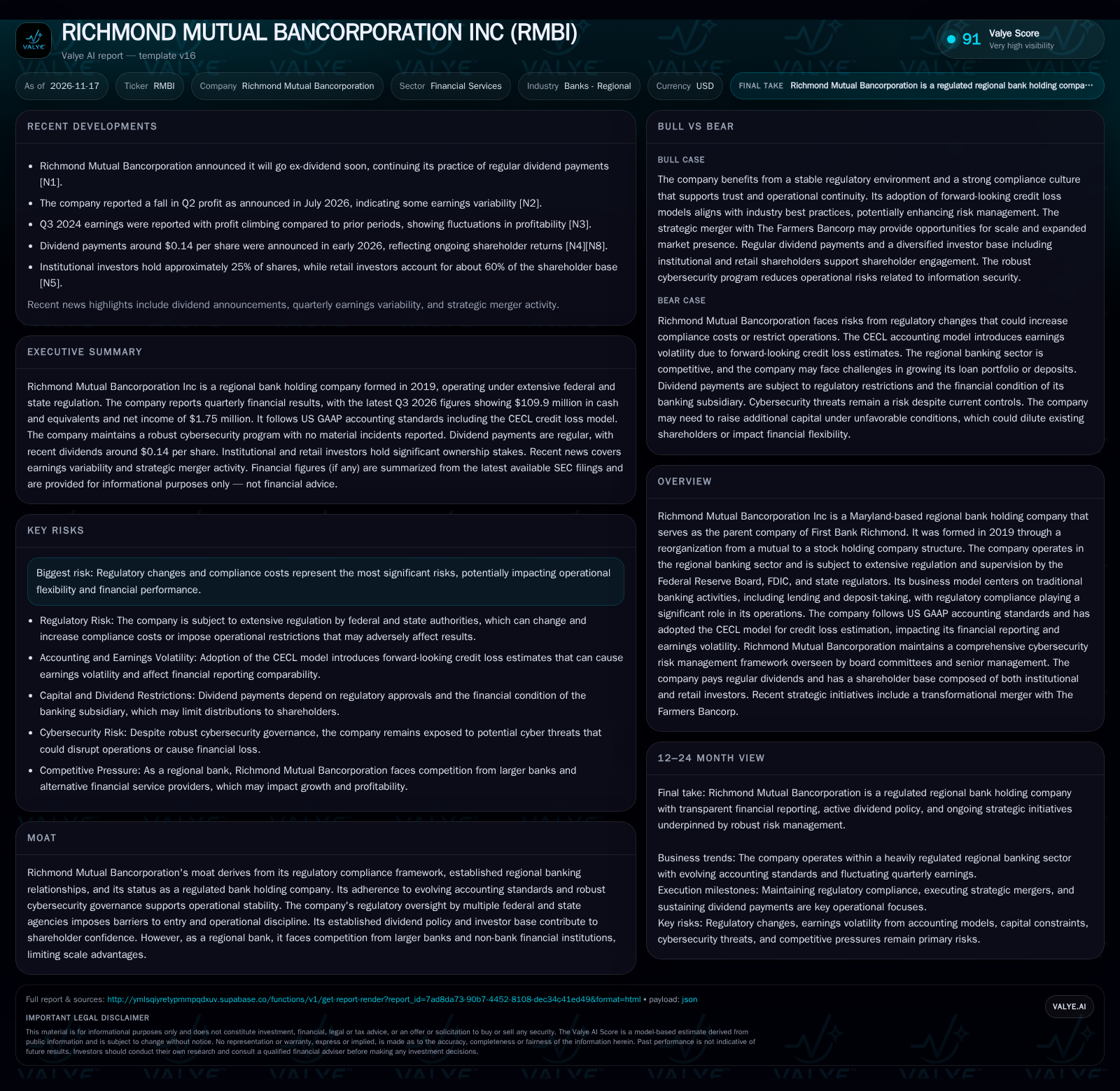
Richmond Mutual Bancorporation recently completed the acquisition of Farmers Bancorp, reporting a Q3 2026 net income of $1.75 million and maintaining regular $0.14/share dividends. The bank faces earnings volatility from CECL accounting and sector competition, but the bargain purchase gain from the merger offers potential for improved scale and profitability if integration is successful. Key uncertainties include sustaining earnings, managing regulatory compliance, and realizing cost and revenue synergies from recent M&A activity. [S2] [N4] [N5]
Richmond Mutual Bancorporation, parent of First Bank Richmond, is at an inflection point following the strategic acquisition of Farmers Bancorp in mid-2026. The bank’s ability to extract value from its recent merger, maintain dividend discipline, and manage risk will be decisive for its future trajectory. [S2]
How Recent M&A and Earnings Volatility Define Richmond Mutual’s Near-Term Landscape
Richmond Mutual Bancorporation completed the acquisition of Farmers Bancorp effective July 1, 2026, issuing approximately 6.25 million shares and recording a $1.6 million bargain purchase gain—highlighting that the deal was struck at favorable terms relative to the acquired net assets. The transaction also incurred $1.2 million in system termination costs, underlining the operational complexities of integration. The cited source reports dividend-related activity; that disclosure alone does not establish dividend-policy continuity, management confidence, or a material constraint on capital flexibility. These facts together frame a company in transition: integrating a sizable acquisition, facing earnings swings (including a Q2 profit decline earlier in the year), and sustaining regular shareholder returns. [S2] [N2] [N4]
Earnings Drivers and the Economics of Scale in Regional Banking
Richmond Mutual’s business model remains anchored in net interest income from lending and deposit-taking, supplemented by fee income and, occasionally, non-recurring items such as the bargain purchase gain from the Farmers Bancorp acquisition. The shift to the CECL model, which requires forward-looking credit loss provisioning, introduces greater earnings volatility—especially in periods of economic uncertainty or post-merger portfolio revaluation. The company’s fixed cost base is likely to rise in the near term due to integration expenses, but successful merger execution could yield operating leverage through branch consolidation, technology rationalization, and broader geographic reach.
The company reported cash and liquidity metrics for the period; these figures do not by themselves establish operating runway, investment capacity, financial flexibility, or financing capacity. The real test will be whether the combined entity can expand its net interest margin and control credit costs amid a competitive and regulatory-intensive environment. [S2] [N4]
The interplay between scale and profitability in regional banking is nuanced, particularly when considering the incremental costs of compliance and technology investments. While larger banks benefit from spreading fixed costs over a bigger asset base, mid-sized institutions like Richmond Mutual must carefully evaluate whether their expanded footprint post-merger justifies the additional complexity. If integration leads to incompatible systems or cultural misalignment, anticipated operating leverage may fail to materialize, resulting in margin compression rather than expansion. Conversely, a disciplined approach to portfolio management and expense control could enhance the bank’s ability to absorb regulatory costs and invest selectively in growth initiatives, thereby reinforcing its earnings stability.
Barriers, Competitive Pressures, and the Limits of Regional Moats
Regional banks like Richmond Mutual benefit from established customer relationships, local knowledge, and regulatory compliance frameworks that can deter less experienced entrants. However, these advantages are increasingly offset by scale-driven cost advantages enjoyed by larger regional and national banks, as well as the technological agility of fintechs and non-bank lenders. The company’s regulatory status provides some moat through operational discipline and trust, but does not fully shield it from competition on rates, digital convenience, or product breadth.
The recent merger with Farmers Bancorp may improve the company's competitive stance by expanding its balance sheet and market presence, but it also exposes Richmond Mutual to integration risks and the need to harmonize credit cultures, systems, and customer bases. The bank’s ability to retain acquired customers and realize anticipated synergies will be a key determinant of whether the deal strengthens or dilutes its competitive position. [S1] [S2]
The competitive dynamics facing regional banks are increasingly shaped by the dual pressures of digital transformation and customer expectations for seamless omnichannel experiences. Richmond Mutual’s ability to leverage its local market knowledge must be complemented by investments in digital platforms that rival those of larger competitors and fintech entrants. Failure to do so risks erosion of deposit and lending relationships, particularly among younger demographics who prioritize convenience and speed. However, the bank’s regulatory standing and community ties may provide a foundation for trust and personalized service that digital-first competitors struggle to replicate. The challenge lies in balancing these strengths with necessary technological agility to maintain relevance in a rapidly evolving landscape.
If Integration Yields Cost Synergies and Enhanced Market Share
A favorable outcome would see Richmond Mutual seamlessly integrating Farmers Bancorp, achieving meaningful cost reductions through branch overlap elimination, technology streamlining, and unified back-office functions. If the merged loan portfolio performs as expected under the CECL model, with no major credit shocks, the bargain purchase gain could be a harbinger of sustained accretive earnings. Expanded scale could also allow for improved pricing power on deposits and loans, and enable the company to better absorb regulatory and technology investments.
This scenario would be confirmed by sequential improvement in net interest margin, reduction in non-interest expense as a percentage of assets, and stable or rising dividend coverage ratios. Evidence of deposit and loan growth in the combined footprint, alongside steady credit quality metrics, would further validate this upside pathway.
Navigating Integration While Managing Credit and Margin Headwinds
The most plausible outcome is that Richmond Mutual experiences a choppy but manageable integration of Farmers Bancorp, with modest cost savings and incremental revenue synergies offset by ongoing expenses and some customer attrition. Earnings will likely remain volatile due to CECL provisioning, macroeconomic uncertainty, and competitive rate pressure from larger banks and fintechs.
If disclosed, metrics such as efficiency ratio stabilization, loan loss reserve trends, and customer retention rates would further support this base case.
When Integration Risks, Credit Losses, or Deposit Outflows Overwhelm
On the downside, Richmond Mutual could face unforeseen integration challenges—such as higher-than-expected system conversion costs, cultural clashes, or significant customer defections. If the acquired loan book underperforms or if macroeconomic deterioration leads to a spike in credit losses under the CECL model, earnings could come under severe pressure. Additionally, if rising rates or competitive offers trigger material deposit outflows, the bank might be forced to sell securities at a loss or seek costly external funding.
Confirmation of this negative scenario would be a sharp drop in quarterly net income or a swing to loss, dividend suspension or reduction, and disclosures of elevated non-performing loans or outsized merger-related expenses. Early warning signs could include rising loan charge-offs, declining deposit balances, or negative trends in regulatory capital ratios.
If integration challenges persist, Richmond Mutual could face a protracted period of elevated expenses and operational disruptions that undermine confidence among both customers and investors. Additionally, persistent credit losses could necessitate increased loan loss provisions, further depressing earnings and potentially eroding regulatory capital buffers. The combination of these factors would heighten vulnerability to competitive pressures and limit strategic flexibility, potentially forcing the bank to reconsider its growth ambitions or explore alternative capital management strategies.
What Will Determine Whether Richmond Mutual’s Merger Delivers Value?
Quarterly net interest margin trends, which would reveal whether the combined bank is achieving pricing power or facing margin compression.
Non-interest expense trajectory, especially as a percentage of assets, to gauge cost synergy realization from the Farmers Bancorp integration.
Provision for credit losses and changes in the allowance for loan losses, as indicators of credit portfolio health and CECL model impact.
Deposit growth or retention rates, if disclosed, to assess customer response to the merger and competitive positioning.
Efficiency ratio movement over the next several quarters, which would help test whether scale is translating into better operational leverage.
Regulatory capital ratios and any commentary on capital adequacy, particularly in light of post-acquisition integration and credit risk exposure.
Any disclosed updates on merger integration milestones, such as system conversions or branch consolidations, as evidence of execution progress.
Disclaimer: This is research-only, informational analysis and not investment advice. It may include AI-generated interpretation and general industry context. Always verify important details using primary sources.

Comments