
Suncrete, Inc.: Infrastructure Tailwinds, Margin Pressures, and the Stakes of Scale in Aggregates
Suncrete, Inc. operates within the concrete and aggregates sector, exhibiting reported liquidity position and modest quarterly profitability as of late 2026. While infrastructure demand trends offer sector-wide opportunity, limited financial transparency and negative EPS highlight the challenge of scaling profitably in a capital-intensive, competitive industry.
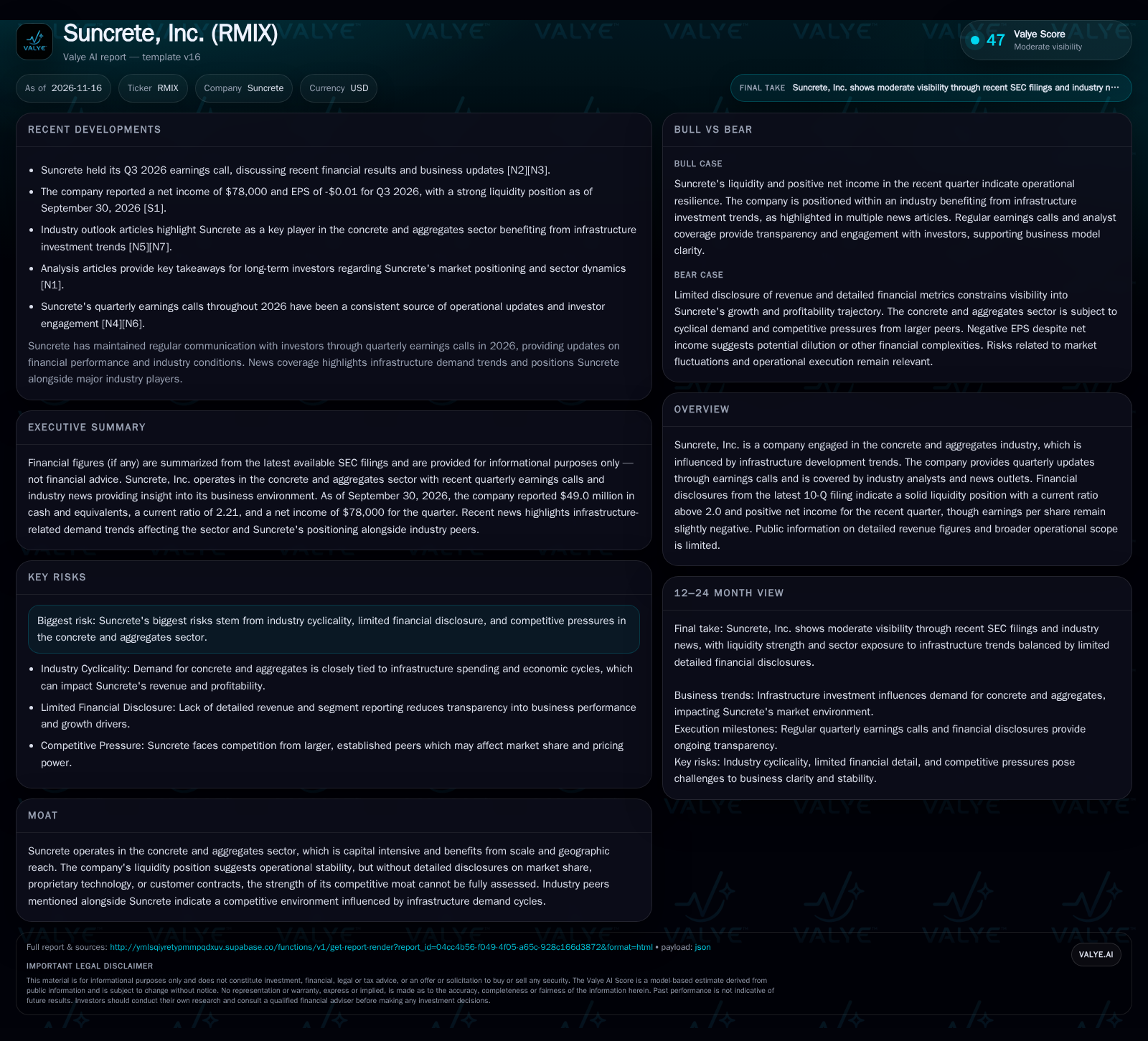
As of September 2026, Suncrete holds $49.0M in cash and a current ratio of 2.21, reporting positive net income but negative EPS for Q3. The company is positioned to benefit from infrastructure-driven demand in concrete and aggregates, yet faces limited financial disclosure and competition from larger peers. The critical question is whether Suncrete can convert sector tailwinds into sustainable, scalable profitability given modest margins and opaque growth drivers. [S1] [N1] [N7]
Suncrete, Inc. stands at a crossroads emblematic of the concrete and aggregates sector: robust infrastructure tailwinds are creating sector-wide demand, but translating those opportunities into sustainable margins and defensible market share is a tougher challenge. As of Q3 2026, Suncrete's reported liquidity position with $49 million in cash and a current ratio above 2.0, yet the company posted only a marginal quarterly profit and slightly negative EPS. The absence of detailed revenue, cost, and segment data clouds the outlook, leaving investors to weigh sector optimism against the realities of scale, competition, and operational leverage in a cyclical, capital-intensive industry. [S1] [N1] [N7]
Recent Financials Signal Stability, but Margins Remain Thin
Suncrete, Inc. reported $78,000 in net income for Q3 2026, with basic and diluted EPS of -$0.01 per share. While this reflects a positive bottom-line result, the negative EPS suggests that share count dynamics or non-operating charges are pressuring per-share profitability. The company’s cash and cash equivalents totaled $49.0 million, and with current assets of $168.0 million against current liabilities of $75.9 million, Suncrete’s current ratio stands at 2.21 and its cash ratio at 0.65. The broader context is one of sector optimism: recent news coverage consistently references infrastructure-driven demand trends, and Suncrete is mentioned alongside major industry players, reinforcing its participation in industry tailwinds. However, the lack of detailed revenue disclosure and persistent negative EPS underscore unresolved challenges in translating sector momentum into meaningful shareholder value. [S1] [N1] [N7]
Capital Intensity, Pricing Power, and the Challenge of Scaling Margins
The concrete and aggregates industry is characterized by high fixed costs, substantial capital investment in plant, equipment, and distribution, and strong local or regional market dynamics. Suncrete’s business economics likely hinge on securing sufficient local volume to cover fixed costs and generate operating leverage—an imperative in a sector where transportation costs constrain the feasible service radius and incentivize local scale. Pricing power is typically modest, with contract structures often tied to large infrastructure projects or municipal spending cycles; price increases are often needed to offset rising input or energy costs but can be difficult to pass through in competitive markets.
Without detailed segment or margin disclosure, it is unclear how Suncrete’s cost structure compares to peers or whether it enjoys any structural cost advantages. The modest net income and negative EPS suggest that incremental revenue may be absorbed by variable costs or that depreciation, interest, or dilution are weighing on results. Ultimately, the path to durable profitability in this sector typically depends on achieving local scale, optimizing asset utilization, and managing input costs more effectively than regional competitors.
Standing Out in a Sector Dominated by Scale and Proximity
Suncrete operates in a highly competitive landscape, with industry leaders such as Vulcan Materials and Martin Marietta setting the benchmark for scale, geographic reach, and operational efficiency. The sector rewards companies that can aggregate local market share, minimize transportation costs, and secure long-term supply contracts with public and private infrastructure customers. Without evidence of proprietary technology, exclusive supply agreements, or differentiated service offerings, Suncrete’s competitive positioning appears most closely tied to its local market strength and customer relationships.
Switching costs for customers are generally low, except where logistical limitations or established relationships provide some friction. The absence of detailed market share or customer concentration data makes it difficult to assess the durability of Suncrete’s moat. In this environment, smaller or mid-tier players often face pricing pressure from larger competitors and must either carve out defensible regional niches or risk being squeezed on both volume and margin. If Suncrete can leverage local scale or unique logistics assets, it could mitigate some competitive pressures, but this remains speculative without further disclosure.
When Infrastructure Spending Lifts All Boats—And Suncrete Captures Its Share
In a favorable scenario, sustained public and private infrastructure investment drives robust demand for concrete and aggregates over multiple years. Suncrete, with sufficient plant capacity and local market reach, could see rising volumes and improved pricing as project backlogs increase and industry utilization rates climb. If the company is able to contain cost inflation and incrementally expand margins, even modest topline growth could translate into meaningful operating leverage.
Evidence confirming this scenario would include clear, sustained improvements in both revenue and margin metrics (if disclosed), upward revisions to guidance during earnings calls, and commentary highlighting contract wins or backlog growth tied to infrastructure projects. A shift from negative to positive EPS—driven by operational, not just accounting, improvements—would be a strong indicator that Suncrete is translating sector tailwinds into scalable, shareholder-friendly economics. Conversely, evidence that would falsify this scenario would be continued negative EPS, lack of margin improvement, or commentary suggesting that competitive pricing is offsetting any volume gains.
Navigating Cyclical Demand with Stable Operations but Limited Margin Expansion
The most plausible outcome is that Suncrete remains a stable, regionally focused operator that benefits from ongoing infrastructure activity but struggles to achieve material margin expansion or outsized growth. Liquidity stays solid, and the company continues to generate modest net income, but persistent cost pressures—from labor, energy, or transportation—limit the ability to convert volume gains into sustainable earnings per share growth.
Confirmation of this scenario would come from quarterly results showing recurring, but marginal, profitability, stable cash balances, and management commentary that emphasizes operational stability over aggressive expansion. Falsification would require either a sharp deterioration in liquidity or profitability—suggesting operational stress—or, conversely, a step-change improvement in margins or EPS that signals successful execution on cost control or pricing power.
Margin Compression and Competitive Squeeze in a Downturn
Should infrastructure spending slow due to macroeconomic headwinds or public funding delays, Suncrete may face declining volumes and intensifying price competition from larger peers seeking to defend utilization rates. In this scenario, the company’s fixed cost base becomes a liability: under-absorption of plant and labor costs erodes margins, and negative operating leverage amplifies the impact of revenue declines.
Confirming evidence would be a drop in quarterly net income (or a swing to operating losses), declining cash balances, and management commentary focused on cost-cutting or asset rationalization. Falsification would require resilience in profitability and cash flow despite sector-wide softness, suggesting that Suncrete has a more defensible position or flexible cost structure than currently apparent.
Milestones That Will Clarify Suncrete’s Path to Scalable Profitability
Quarterly revenue and gross margin trends, if disclosed, would help clarify whether Suncrete is converting sector demand into improved economics.
Any disclosure of contract wins, project backlog, or customer concentration would indicate the degree of revenue visibility and competitive entrenchment.
Movement in EPS from negative to positive territory—particularly if driven by operating results rather than accounting changes—would signal progress toward sustainable profitability.
Management commentary on earnings calls regarding pricing power, input cost inflation, and competitive dynamics will provide qualitative signals of margin trajectory.
Evidence of asset utilization (e.g., plant operating rates), if disclosed, would indicate whether Suncrete is achieving meaningful operating leverage.
Industry-wide trends in infrastructure spending and construction activity remain a crucial external variable shaping demand for Suncrete’s core products.
Disclaimer: This is research-only, informational analysis and not investment advice. It may include AI-generated interpretation and general industry context. Always verify important details using primary sources.

Comments