
RMX Industries Integrates New Intellectual Property to Bolster Defense Technology Portfolio
RMX Industries finalizes a significant IP acquisition amid liquidity pressures, aiming to enhance its advanced video compression and AI platform offerings for defense.
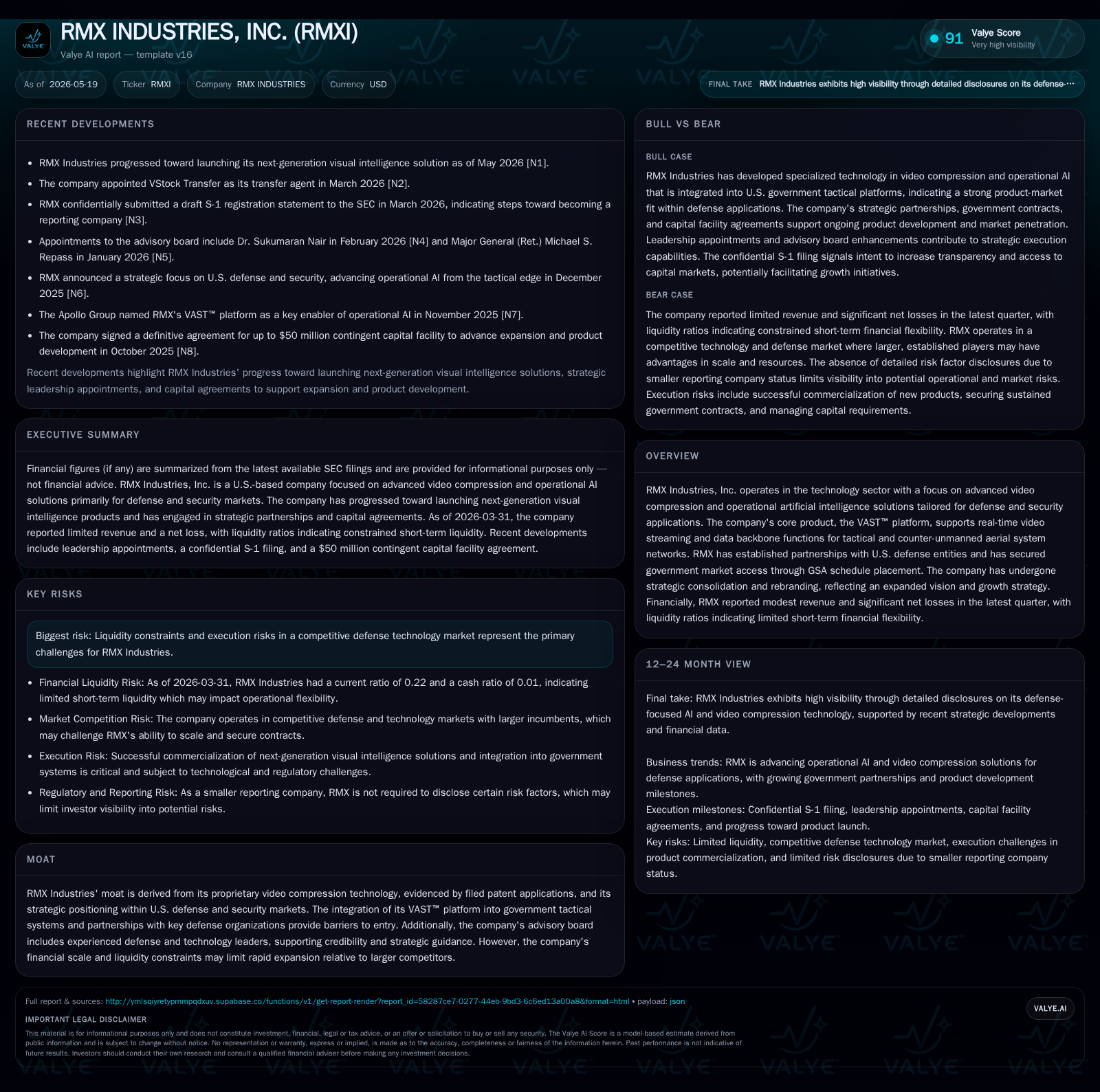
In its Q1 2026 10-Q filing, RMX Industries disclosed the closing of a strategic Intellectual Property Purchase Agreement with Apollo Group Enterprises, issuing 1.5 million shares for software assets that complement its core VAST™ platform. This acquisition reinforces RMX’s foothold in tactical real-time video streaming and AI-driven counter-UAS applications within the U.S. defense sector. However, with cash reserves under $110,000 and a current ratio of approximately 0.22, paired with near-term note maturities tied to liquidity events by June 30, 2026, the company faces notable financial constraints. Growth hinges on leveraging the newly acquired technology and government partnerships while managing execution challenges amidst intense competition and capital limitations.
Latest Operating Developments and Strategic IP Acquisition
RMX Industries’ most consequential recent development centers on the May 2026 closing of an Intellectual Property Purchase Agreement with Apollo Group Enterprises LLC [S3], [S8]. Under this agreement, RMX acquired all rights to specified software platform intellectual property assets that dovetail with its existing VAST™ technology suite—the latter being central to RMX's offerings for real-time video streaming and operational AI targeting tactical defense applications [N1]. The consideration comprised the issuance of 1.5 million Class A Common Stock shares subject to a structured lock-up lasting 180 days followed by a further six-month leak-out restriction limiting daily sales volume post-lock-up [S10].
This transaction is strategically significant as it not only adds complementing software capabilities but also signals RMX’s intent to expand its technological moat against competitors by owning critical proprietary content instead of solely relying on internally developed IP [S3]. Therefore, RMX must operationalize these new assets promptly while navigating imminent refinancing or corporate restructuring deadlines.
Company Business Model: Video Compression and AI Solutions for Defense
RMX Industries generates revenue primarily through specialized contracts targeting U.S. defense and security sectors [N1]. The company’s flagship product is the VAST™ platform which integrates advanced video compression algorithms with operational artificial intelligence designed for highly demanding real-time environments such as tactical networks and counter-unmanned aerial system (UAS) operations
Customers are predominantly governmental agencies reachable via General Services Administration (GSA) schedule channels [N1], allowing streamlined procurement processes tailored for mission-critical defense technology acquisitions. Revenue mechanics depend on hardware-software bundle contracts where pricing reflects licensing fees for the proprietary compression tech embedded within ruggedized systems suited for battlefield deployments.
The specialized nature of these products entails strong switching costs given integration into existing tactical infrastructures. Additionally, long contract cycles typical in government sales require sustained R&D investment focused on incremental advancements rather than commoditized offerings. RMX's business model leverages these structural characteristics to cultivate recurring engagements albeit at smaller absolute scale relative to major defense technology providers.
Competitive Environment: Peers, Barriers, and Market Position
RMX’s moat is anchored in multiple patent filings surrounding its proprietary video compression techniques along with embeddedness within U.S. defense tactical networks that raise switching costs materially [F1], [N1]. Its strategic partnerships with governmental clients provide access barriers difficult for new entrants lacking compliance credentials or proven security track records.
Nonetheless, RMX operates at a significantly smaller scale compared to established defense contractors who benefit from broader distribution channels and more extensive balance sheets supporting production scaling. This size differential limits RMX’s pricing power and constrains rapid capacity expansion necessary to capture larger contract opportunities.
The company mitigates some credibility shortfalls through an advisory board comprising seasoned defense technology experts guiding strategic initiatives [N1]. However, ongoing competition from technologically sophisticated peers means execution agility alongside innovation remains vital.
Growth Drivers: Product Innovation and Government Partnerships
Several growth levers support RMX’s near- to medium-term outlook. Foremost is the planned commercial introduction of next-generation visual intelligence solutions enhancing situational awareness capabilities beyond baseline video streaming [N1]. These products are expected to improve margin profiles by increasing software content proportion within overall bundled contracts post-IP acquisition [S2].
Government contracting pathways continue expanding via deeper penetration into GSA schedules facilitating faster procurement cycles for emerging product lines [S2]. Additionally, evolving battlefield requirements around autonomous threat detection underpin demand for RMX’s AI algorithms integrated within VAST™, promising customer retention through heightened solution efficacy.
Revenue growth will be closely tied to key KPIs including backlog inflows from awarded contracts, adoption rates among defense units upgrading tactical systems, and enhancements in real-time streaming throughput minimizing latency under operational conditions.
Risks and Constraints: Liquidity, Execution, and Market Competition
RMX faces pronounced financial risks stemming from constrained liquidity: cash balances at quarter-end March 31 were approximately $109 thousand juxtaposed against total debt exceeding $3.38 million—yielding a distressed current ratio near 0.22 indicative of immediate solvency pressure [F1]. Such tight coverage amplifies vulnerability to adverse working capital fluctuations.
From an execution perspective, converting acquired intellectual property into tangible revenue streams presents inherent uncertainties given technological integration timelines and contract award cycles. Competitive forces from larger incumbents with broader product portfolios add margin compression risk.
Also notable is dilution risk emanating from restrictive share lock-ups associated with the IP purchase consideration shares issued—these governance measures constrain market liquidity initially but represent potential overhang once restrictions ease [S10]
Upcoming Catalysts and Execution Milestones
Key upcoming events provide visibility into RMX's trajectory:
- Completion of all formalities related to the IP acquisition expected no later than mid-May 2026 ensures full operational control over newly purchased software platforms [S3], [S10].
- Launch timetable advancements concerning next-gen visual intelligence products announced publicly point toward incremental revenue contribution commencing mid-to-late year [N1].
- Contract awards or renewals within federal agencies will serve as tangible markers validating market acceptance of expanded product offerings.
Financial Overview: Current Liquidity and Capital Structure
Reflecting early-phase commercialization efforts as of March 31, 2026, RMX presented modest top-line revenue near $26 thousand contrasting with operating losses exceeding $1 million driven largely by research & development plus general administrative expenses invested ahead of scaled market penetration [F1]. Net loss layers deeper at nearly $6 million consistent with build-out investment phases common in tech-centric small caps.
From a balance sheet perspective, cash reserves totaled just above $109 thousand while total debt stood at roughly $3.38 million yielding net debt close to $3.27 million accentuating leverage risks [F1]
These constraints frame operational challenges forcing prioritization of capital-efficient growth approaches whilst safeguarding contractual obligations linked to looming note maturity dates.
This analysis synthesizes detailed disclosures from RMX Industries’ SEC filings alongside sector knowledge relevant to advanced defense-oriented technology developers specializing in real-time video compression and AI analytics. It positions the company's recent intellectual property acquisition as a pivotal inflection point tempered by stringent liquidity considerations characteristic of small-cap emerging innovators within highly regulated government markets.
Readers should regard this evaluation strictly as an analytical insight without any investment research view or valuation judgment included herein.
Financial position in context
As of 2026-03-31, companyfacts shows $109233 in cash and equivalents and $3.38 million of total debt [F1]. The same snapshot implies net debt of roughly $3.27 million, keeping balance-sheet context relevant but secondary to the operating story [F1]. Current assets of $2.02 million and current liabilities of $9.11 million imply a current ratio near 0.22x for 2026-03-31 [F1].
Disclaimer: This is research-only, informational analysis and not investment advice. It may include AI-generated interpretation and general industry context. Always verify important details using primary sources.

Comments