
Rainier Acquisition Corp: Timeline, Cash Position, and Deal Execution Outlook
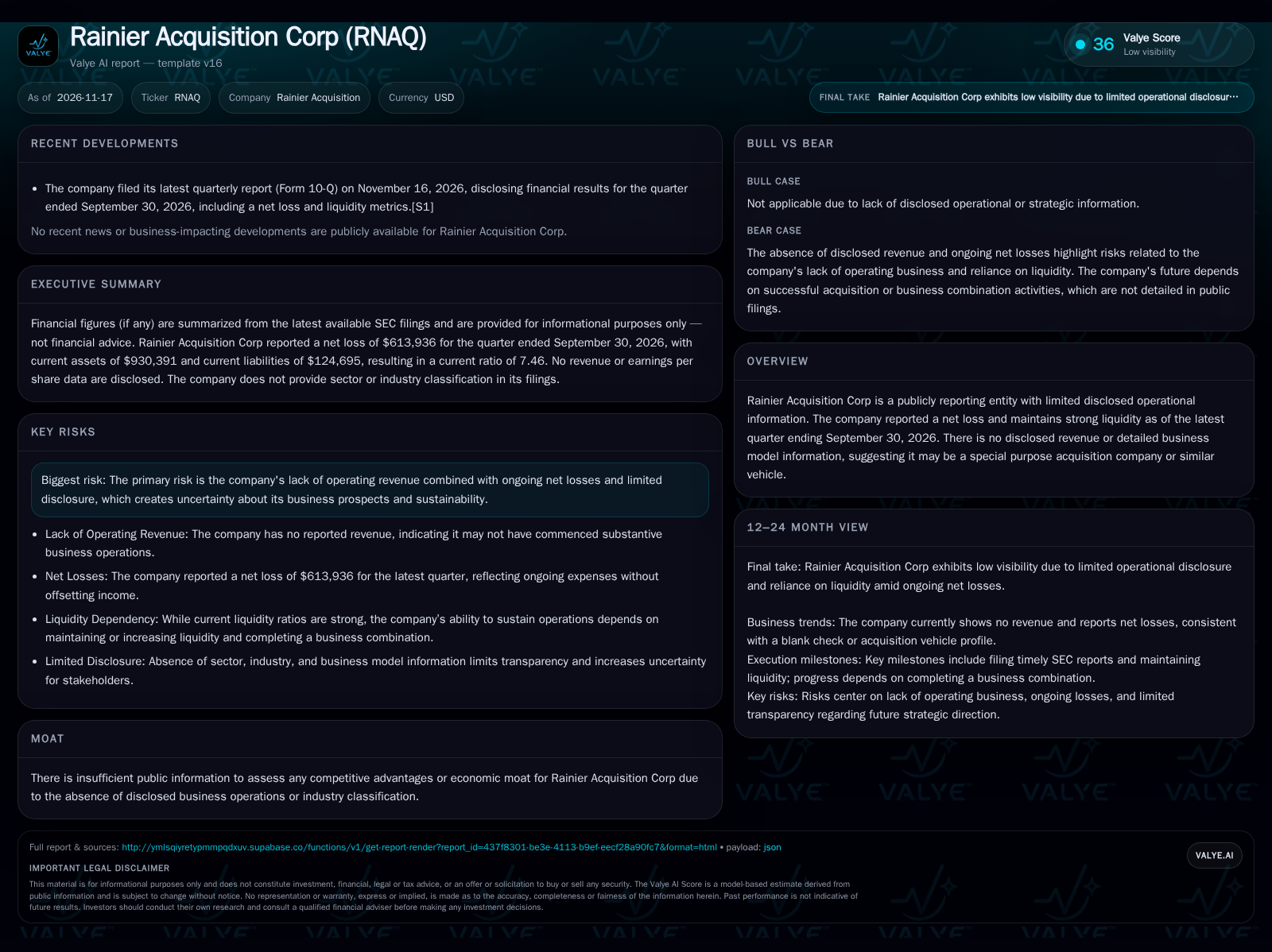
Rainier Acquisition Corp is a newly public blank check company with approximately $930,000 in current assets and no operating business as of Q3 2026. With a 24-month post-IPO window to complete a business combination, the company’s future hinges on sourcing and executing a suitable acquisition before its August 2028 deadline.
Rainier Acquisition Corp completed its IPO in August 2026, raising $75 million in gross proceeds and is now in the early search phase for a business combination. The company faces a 24-month window to identify and close a deal, or risk liquidation and return of capital to shareholders.[S1]
Rainier Acquisition Corp exemplifies the classic special purpose acquisition company (SPAC) model: a blank check vehicle with no operating business, no revenue, and a finite window to deploy IPO proceeds through a merger or acquisition. As of Q3 2026, Rainier is in the initial phase following its August IPO, holding just under $1 million in current assets outside the trust and recording a net loss for the quarter. With a 24-month clock ticking down to an August 2028 deadline, the company’s value proposition and risk profile are dominated by its ability—or inability—to identify and successfully consummate a business combination in time. Until then, Rainier’s economics, competitive positioning, and future prospects remain defined by the unique incentives and structural risks of the SPAC model.[S1]
IPO Proceeds and the 24-Month Deadline for Completing a Deal
Rainier Acquisition Corp completed its IPO on August 28, 2026, raising $75 million through the sale of 7.5 million units, each consisting of a Class A ordinary share and a fractional warrant. An additional $1.94 million was raised via private placement units sold to the sponsor. As of September 30, 2026, Rainier reported current assets of $930,391 and current liabilities of $124,695, yielding a current ratio of 7.46. Importantly, the company has not commenced operations and has no revenue, consistent with its stated blank check purpose. Its net loss of $613,936 for the quarter reflects administrative and search costs typical for SPACs in the pre-acquisition phase. The company has a 24-month window from IPO—ending August 28, 2028—to complete a merger or acquisition, or else it must liquidate and return funds to shareholders.[S1]
Incentive Structures and Risk Factors in Rainier’s SPAC Model
SPACs like Rainier generate no operating revenue prior to a merger. Their economics are defined by the interest earned on funds held in trust (typically in short-term U.S. Treasuries) and the costs of maintaining a public listing, regulatory compliance, and deal sourcing. The current assets on Rainier’s balance sheet outside the trust likely serve as a working capital buffer for these ongoing expenses. The bulk of IPO proceeds remain segregated in a trust account, inaccessible for general operations and intended for the eventual business combination or, if unsuccessful, for return to public shareholders.
The core value proposition for sponsors comes from the promote—typically a 20% stake in the post-combination entity—if a deal is completed. For public shareholders, the risk-reward profile is shaped by the ability to redeem shares for trust value if they disapprove of the deal. This structure creates a strong incentive for the sponsor to close a transaction within the 24-month window, but also aligns the economics to favor deal completion over deal quality, a well-known tension in the SPAC model. The absence of revenue and recurring net losses are structurally normal for this phase. Capital needs are modest unless external due diligence or negotiation costs escalate, but the long-term economics are entirely contingent on the quality and terms of the eventual target acquisition.
Rainier’s Position Amidst Intense Competition for SPAC Targets
Rainier is one of many recently listed SPACs, all vying for a finite pool of attractive acquisition targets. The competitive landscape is characterized by both direct competition—other SPACs seeking similar targets—and indirect competition from private equity, venture capital, and strategic acquirers. Rainier’s lack of sector or geographic focus broadens its theoretical universe of targets, but also puts it head-to-head with a larger set of rivals.
In this context, Rainier’s competitive position depends on its sponsor’s network, reputation, and ability to identify, negotiate, and execute a deal that is both attractive and feasible within the time constraint. The crowded SPAC market of the mid-2020s has led to increased scrutiny of deal quality, higher redemption rates, and more challenging regulatory and market environments for post-merger entities. Unless Rainier’s sponsor team can demonstrate unique access or value-add for potential targets, it faces the same structural challenges as its peers—particularly as the SPAC cycle matures and investor skepticism rises.
Value Potential from a Strong Acquisition and Shareholder Synergies
The most favorable outcome for Rainier would be the identification and successful acquisition of a high-growth, fundamentally sound target in an attractive sector—ideally one that public markets undervalue or that faces barriers to traditional IPO access. If Rainier’s sponsor team can leverage proprietary deal flow or sector expertise to source such a target, and negotiate terms that minimize dilution and maximize post-merger performance, the resulting combined entity could deliver material upside for both SPAC shareholders and sponsors.
Evidence that would confirm this scenario includes a public announcement of a definitive merger agreement with a credible, growth-oriented private company, favorable market reaction to the deal terms, and low redemption rates among public shareholders. Early post-merger financial performance exceeding projections would further validate the upside case.
Expected Outcome: Typical SPAC Performance with Limited Value Upside
The middle-of-the-road scenario for Rainier is that it sources a target within the allotted 24 months, but the target is in line with the broader SPAC market—either a lower-growth, capital-hungry business or one with uncertain public market appeal. In this case, the deal gets done, but public shareholder redemptions are high, sponsor promote is heavily diluted, and post-merger performance is mixed or underwhelming. This outcome is common in the late-stage SPAC cycle, especially as high-quality targets become scarce and market skepticism increases.
Confirmation would come in the form of a deal announcement with a modestly sized private company, redemption rates in the 50%+ range, and tepid market response. Post-merger, the combined entity might struggle to meet projections, trade below trust value, or face ongoing capital needs. Falsification would require either a high-quality deal with strong market reception or a complete failure to close any transaction.
Consequences of Deal Non-Completion and Liquidation Implications
The adverse scenario is that Rainier fails to identify or close a business combination by its August 2028 deadline, triggering liquidation and the return of trust funds to public shareholders. This could result from an inability to find a suitable target, regulatory or market headwinds, or target-side deal breakage. In this case, sponsors lose their upfront investment in the private placement units, and public shareholders receive only the trust value, typically with minimal or no upside.
Confirmation of this scenario would be a lack of deal activity or public target announcements as the deadline approaches, repeated extensions or failed negotiations, and ultimately an SEC filing announcing intent to liquidate. Early warning signs could include sponsor resignations, escalating administrative expenses, or adverse market conditions for de-SPAC transactions.
Key Milestones Shaping Rainier’s Progress and Future Prospects
Announcement of a definitive merger or acquisition agreement, including details on target sector, enterprise value, and deal structure.
Redemption rates among public shareholders at the time of deal approval, if disclosed, as a proxy for market confidence and deal quality.
Sponsor team changes, resignations, or additional capital commitments, which would signal confidence or concern regarding deal prospects.
Escalation in administrative or search-related expenses, which could erode the working capital buffer ahead of the deal deadline.
Extensions to the 24-month deadline, or shareholder votes on extensions, as a sign of difficulty in sourcing or closing a transaction.
Post-merger trading performance and financial results of the combined entity, if a deal is consummated, as the ultimate test of value creation.
Any regulatory changes or shifts in SPAC market sentiment that could impact deal feasibility or shareholder appetite.
Disclaimer: This is research-only, informational analysis and not investment advice. It may include AI-generated interpretation and general industry context. Always verify important details using primary sources.

Comments