
Range Impact, Inc.: The High-Wire Act of Appalachian Land Reclamation and Redevelopment
Range Impact, Inc. is betting that reclamation and creative reuse of former Appalachian mine lands can unlock diversified, long-term value—but faces immediate capital constraints, complex regulatory challenges, and stiff competition from larger players. The thesis now hinges on whether the company can secure sufficient financing and achieve tangible progress on asset conversion before liquidity runs out.
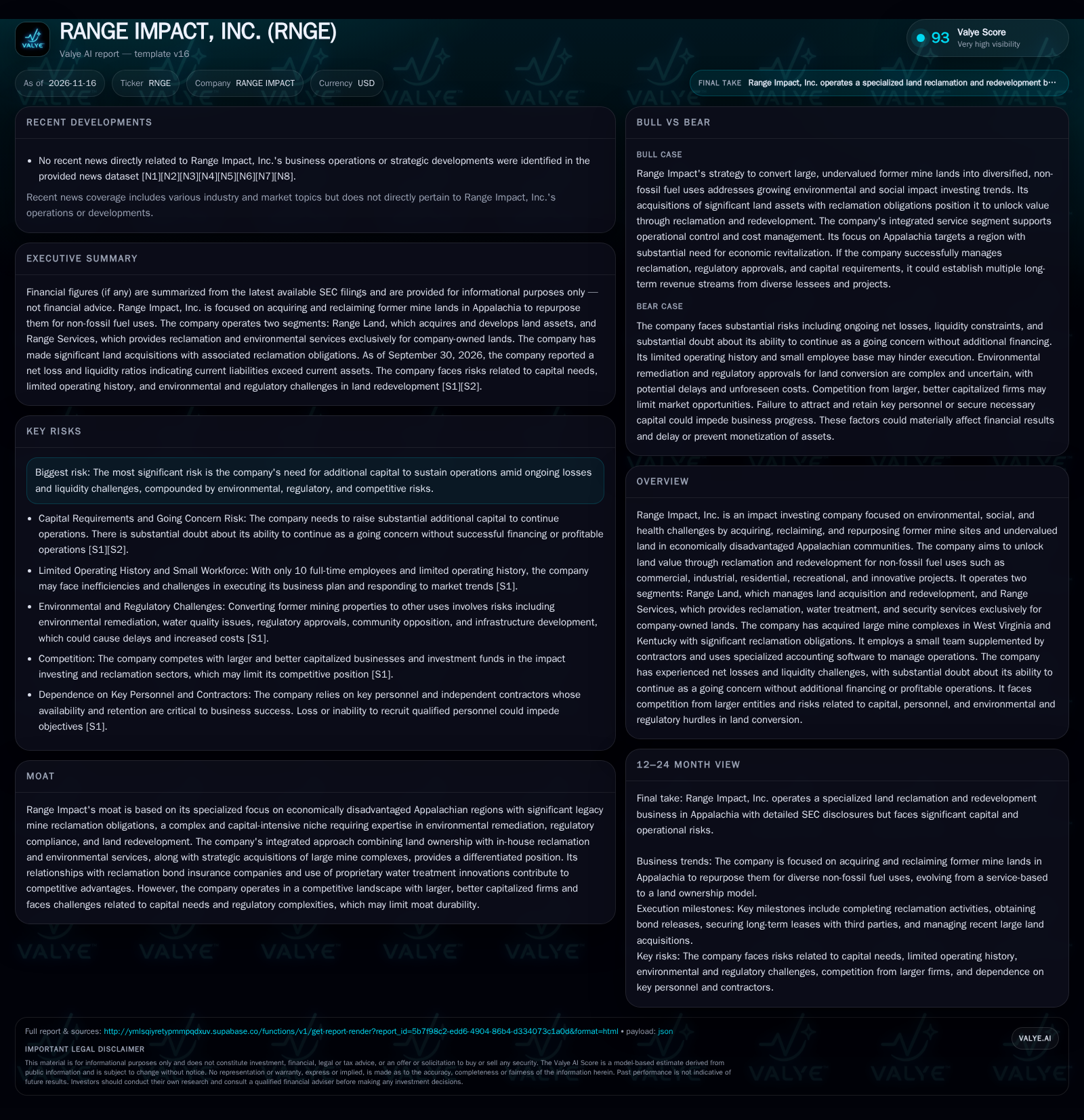
Range Impact, Inc. has pivoted to a land ownership and reclamation-driven model, acquiring large former mine properties in Appalachia with the goal of repurposing them for various non-fossil fuel uses. The company’s current financials highlight a pressing need for new capital, as net losses and a reported cash ratio raise substantial doubt about its ability to continue as a going concern. The key question is whether Range Impact can demonstrate operational milestones—such as successful reclamation, regulatory approvals, and the start of revenue-generating projects—before its liquidity position deteriorates further. Execution risk is high, but the upside could be meaningful if the company can overcome its near-term hurdles.
Range Impact, Inc. seeks to turn the liabilities of Appalachia’s abandoned mine lands into assets through reclamation and redevelopment for sustainable, non-fossil fuel uses. The company’s land ownership strategy, implemented after a pivot in early 2025, has resulted in major acquisitions but also significant environmental and financial obligations. With net losses, a reported cash balance, and a current ratio well below 1.0, Range Impact’s continued existence depends on its ability to secure new financing and rapidly demonstrate tangible asset conversion progress.
Why Range Impact’s Current Financials and Land Acquisitions Set the Stage—and Raise the Stakes
Range Impact, Inc. operates with two segments: Range Land, which acquires and manages former mine lands for redevelopment, and Range Services, which provides environmental and reclamation services exclusively on company-owned properties [S1]. The company has made large-scale acquisitions, including the Fola Mine Complex in West Virginia (120,154 acres), Ramp Run Mine interests, and Premier-Cambrian Mine Complex lands in Kentucky, all with substantial reclamation obligations [S1]. As of September 30, 2026, Range Impact reported a net loss of $3,976,339 for the quarter, cash and equivalents of $651,142, current assets of $2,839,917, current liabilities of $3,815,897, a current ratio of 0.74, and a cash ratio of 0.17 [S2]. These figures underpin the substantial doubt about its ability to continue as a going concern without fresh capital or operational turnaround [S2]. The immediate question is whether the company can deliver on its reclamation and redevelopment goals quickly enough to attract new financing or begin generating recurring revenue before liquidity runs out.
Unlocking Value from Liability: Range Impact’s Path to Monetization
Range Impact’s business model is premised on acquiring undervalued, environmentally challenged land at steep discounts, then investing in reclamation to unlock value for redevelopment. The company targets multiple potential revenue streams: leasing or selling reclaimed land for commercial, industrial, residential, recreational, or agricultural projects, and possibly for power generation or data centers [S1]. The fixed cost base is relatively low—just 10 full-time employees as of March 2026—though reclamation and environmental obligations represent large, project-specific capital outlays [S1]. Operating leverage could be significant if the company can successfully move land from liability to cash-flow-generating asset, as reclamation completion could trigger regulatory bond releases and enable new commercial leases or sales. However, the timing and magnitude of these economic inflection points are highly uncertain. Until then, cash burn continues, with limited recurring revenue from Range Services (which only supports company-owned assets). The economics hinge on the ability to secure upfront or milestone-based payments from third-party lessees or buyers, and to minimize overruns on reclamation costs. Significant additional capital—either from equity issuance, project financing, or strategic partners—will likely be needed to bridge the gap between reclamation investment and asset monetization.
Niche Expertise vs. Scale: Range Impact’s Place in the Impact Investing Landscape
Range Impact operates in a niche but growing segment of the impact investing and land reclamation market, focusing on the Appalachian region—an area with a high concentration of legacy mine lands and economic need [S1]. The company’s differentiated approach combines land ownership with in-house expertise in reclamation and environmental services, supported by proprietary operational software [S1]. This integrated model could offer cost control and process advantages versus pure-play service providers or land investors. However, Range Impact faces formidable competition from larger, better-capitalized firms and investment funds that can outbid for distressed assets, mobilize capital for large-scale projects, and absorb regulatory or operational setbacks more easily [S1]. Additionally, the company’s focus on Appalachia means it is exposed to region-specific regulatory, community, and environmental complexities. Substitute pathways—such as direct government-led remediation, community land trusts, or utility-scale renewables developers—could also compete for the same sites or public incentives. Range Impact’s moat depends on executing difficult reclamation projects efficiently, establishing relationships with regulators and local communities, and demonstrating early successes that validate its model.
What Success Looks Like: Rapid Reclamation, Asset Monetization, and Capital Infusion
In a favorable scenario, Range Impact secures the capital needed to complete critical reclamation milestones on its largest properties, obtains regulatory bond releases, and begins to attract third-party developers or anchor tenants for repurposed land. Early success with one or more high-profile projects—such as converting a former mine into a data center or large-scale agricultural operation—could serve as proof points, attracting further impact-focused capital and enabling the company to scale its model across its land portfolio. The economics would improve rapidly if Range Impact can lock in long-term leases or outright sales with upfront payments or recurring rents, providing the cash flow to fund ongoing reclamation and reduce reliance on dilutive equity or expensive debt. Confirmation of this scenario would come from public announcements of completed reclamation, regulatory approvals, new commercial partnerships or leases, and evidence of improved financial metrics—such as positive operating cash flow or a reversal of the going concern warning.
Incremental Progress Amid Persistent Strain: A Realistic Outlook for Range Impact
The most plausible near-term outcome is that Range Impact ekes out incremental progress on reclamation and land conversion, but remains hamstrung by capital constraints and a lack of recurring revenue. The company may secure small-scale financing—potentially at unfavorable terms—to bridge short-term liquidity gaps, allowing it to advance some reclamation work and pursue regulatory approvals. However, delays in securing anchor tenants or buyers, higher-than-expected remediation costs, or regulatory setbacks are likely to limit visible value creation. The workforce remains lean and execution risk stays high, with continued net losses and periodic going concern warnings. Evidence for this scenario would include minor bond releases, sporadic progress updates, additional small equity raises, and ongoing negative cash flow. A shift to a more favorable trajectory would require tangible progress on both asset conversion and external financing.
Liquidity Exhaustion and Asset Fire Sale: The Adverse Chain of Events
If Range Impact is unable to secure new capital or demonstrate rapid progress on reclamation and asset monetization, the company could exhaust its remaining liquidity within quarters. In this scenario, ongoing net losses and a sub-1.0 current ratio force management to seek distressed asset sales, potentially at steep discounts, or to pursue highly dilutive financings that erode existing shareholder value. Regulatory non-compliance or missed reclamation milestones could trigger penalties, bond forfeiture, or legal challenges, further straining resources. The small workforce and reliance on contractors could become a liability if key personnel depart or project continuity is compromised. Confirmation of this downside would be indicated by emergency financings, asset sales below book value, resignations of key executives, or public disclosures of missed regulatory deadlines and worsening financial metrics.
Milestones That Will Determine Whether Range Impact’s Model Can Survive and Scale
Completion of major reclamation activities and successful regulatory bond releases on flagship properties—public confirmation of these events would be essential signals of execution.
Announcements of new long-term leases, sales, or partnerships with credible third-party developers or end users for repurposed land.
Disclosure of new capital raises, project-specific financing, or strategic investments that materially extend the company’sreported liquidity position.
Evidence of meaningful progress on operating cash flow—such as a narrowing of net losses or transition to positive cash from operations.
Updates on the scale and scope of reclamation obligations still outstanding, including cost estimates and schedule adherence.
Retention and expansion of key personnel and contractor relationships, especially those with specialized environmental or regulatory expertise.
Community and regulatory engagement outcomes—such as public support, permitting progress, or resolution of environmental objections—which would help validate the company’s social license to operate.
If disclosed, detailed breakdowns of land portfolio utilization rates, lease terms, and achieved revenue per acre would provide insight into monetization effectiveness.
Disclaimer: This is research-only, informational analysis and not investment advice. It may include AI-generated interpretation and general industry context. Always verify important details using primary sources.

Comments