
Rein Therapeutics: Pulmonary Fibrosis Ambitions Confront Clinical and Capital Realities
Rein Therapeutics advances LTI-03 for idiopathic pulmonary fibrosis, leveraging FDA Fast Track status and ongoing Phase 2 trials, but faces fundamental questions about clinical success, financial runway, and market viability as a single-asset, pre-revenue biotech.
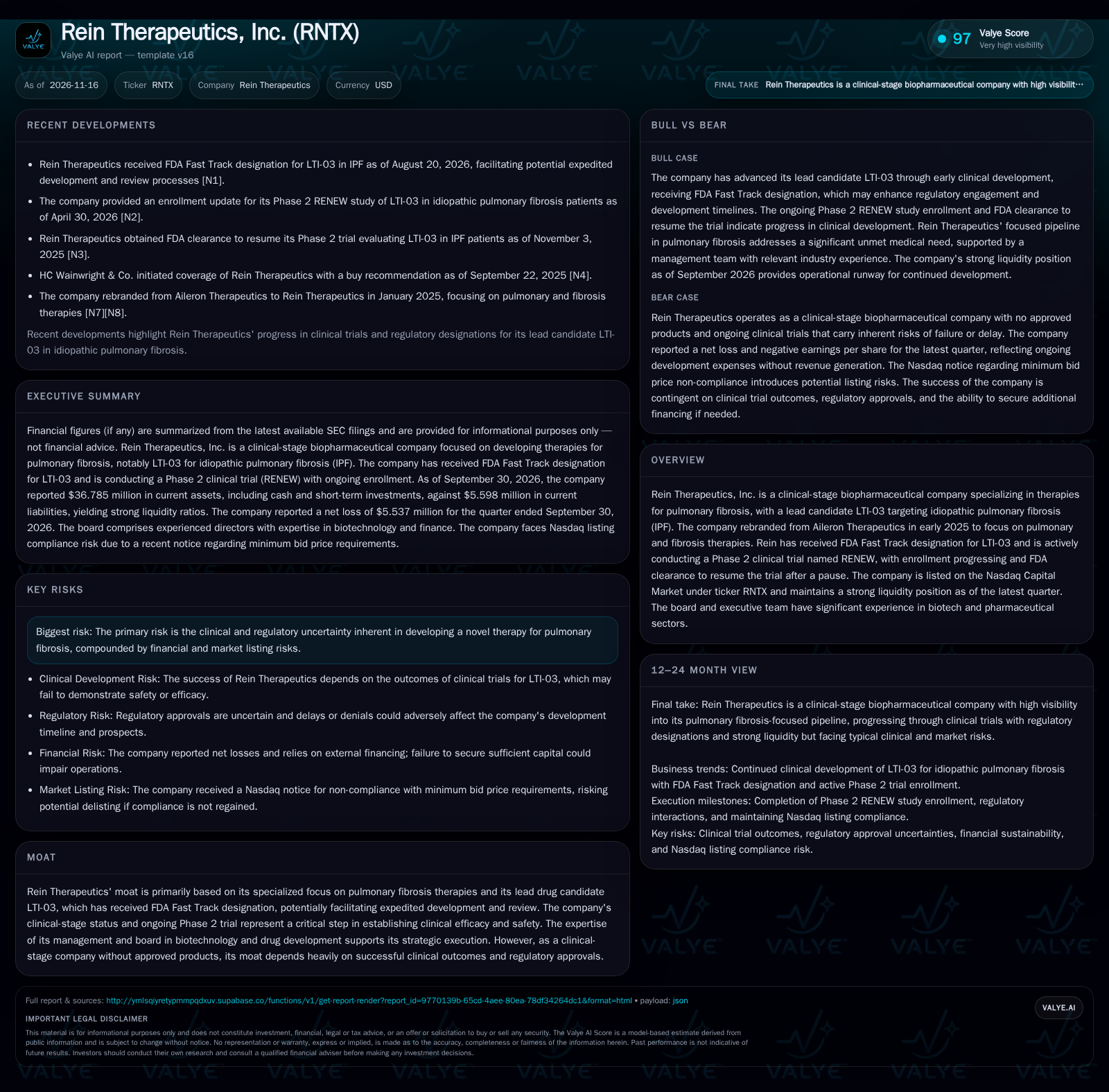
Rein Therapeutics is a clinical-stage biotech developing LTI-03 for idiopathic pulmonary fibrosis (IPF), with FDA Fast Track designation and Phase 2 trial progress. The company maintains reported liquidity position but continues to post net losses and faces a Nasdaq compliance deadline. Its future hinges on clinical outcomes, regulatory milestones, and the ability to secure additional funding if needed. [S2] [N1] [N2]
Rein Therapeutics, Inc. stands at a pivotal juncture as it pursues a high-stakes clinical and regulatory path for LTI-03, its investigational therapy targeting idiopathic pulmonary fibrosis (IPF). With FDA Fast Track status in hand and active Phase 2 trial enrollment, the company demonstrates progress toward addressing a significant unmet medical need. However, as a pre-commercial, single-asset biotech, Rein contends with the dual pressures of clinical risk and capital requirements, while a looming Nasdaq compliance deadline adds further uncertainty. The next phase of development and financing will determine whether Rein can convert scientific promise into commercial viability. [N1] [N2] [S2]
Recent Regulatory and Financial Milestones Shape Rein’s Strategic Outlook
Rein Therapeutics has achieved several notable milestones in recent quarters. Most prominently, its lead candidate LTI-03 received FDA Fast Track designation for IPF as of August 2026, potentially enabling accelerated regulatory communications and review. The company is actively enrolling patients in its resumed Phase 2 RENEW trial following FDA clearance in late 2025, signaling ongoing progress in clinical development. Financially, as of September 30, 2026, Rein reported $36.785 million in current assets—including $943,000 in cash and $34.55 million in short-term investments—against $5.598 million in current liabilities, yielding a current ratio of 6.57. However, the company posted a net loss of $5.537 million for the most recent quarter, a reflection of continued R&D expenditure without product revenue. Rein also received a Nasdaq notice for non-compliance with the minimum bid price requirement, with a compliance deadline of February 2027. These facts frame a company with operational runway, clinical momentum, and clear capital and market-listing risks. [S2] [N1] [N2] [N3]
How a Single-Asset Biotech Converts Science into Value—If It Can
Rein Therapeutics’ business model is emblematic of the clinical-stage biotech archetype: the company is pre-revenue, with its economic future tied almost entirely to the clinical and commercial success of LTI-03. The economics are characterized by high fixed costs in R&D and regulatory compliance, with minimal variable costs until commercialization. If LTI-03 demonstrates efficacy and safety through Phase 2 and subsequent pivotal trials, Rein could pursue one of two economic paths: (1) out-licensing or partnering with a larger pharmaceutical company for late-stage development and commercialization, or (2) building a commercial infrastructure to directly market the drug, which would require substantial new capital and operational capabilities. Pricing for rare-disease therapies such as those for IPF can be substantial, but payer constraints and competitive launches may temper projected margins. The company reported cash and liquidity metrics for the period; these figures do not by themselves establish operating runway, investment capacity, financial flexibility, or financing capacity.
Therapeutic Focus, Fast Track, and the Realities of Pulmonary Fibrosis Drug Development
Rein’s competitive position is defined by its focus on idiopathic pulmonary fibrosis, a disease with significant unmet need but also a challenging clinical and commercial landscape. The FDA Fast Track designation provides regulatory advantage by facilitating more frequent interactions and the possibility of priority review, but it does not guarantee approval or market adoption. Rein’s moat, for now, is predicated on the novelty and potential efficacy of LTI-03, as well as the expertise of its management and board. However, the pulmonary fibrosis space includes established therapies (such as pirfenidone and nintedanib) and a pipeline of competing clinical candidates from both small biotechs and large pharma. Barriers to entry are high due to the complexity of respiratory drug development, but switching frictions for prescribers and patients may be modest if new therapies offer compelling efficacy or safety advantages. Rein’s single-asset focus increases vulnerability to negative trial outcomes or competitive displacement.
If Clinical and Regulatory Milestones Are Met, Value Could Inflect Rapidly
A favorable scenario for Rein would involve LTI-03 demonstrating clear efficacy and safety in Phase 2, generating data that attracts significant partner interest or justifies rapid progression to pivotal trials. The FDA Fast Track status could compress regulatory timelines and enhance the likelihood of engagement with the agency, potentially opening the door to accelerated approval pathways if results are compelling. In this scenario, Rein might secure a lucrative licensing or co-development deal, providing non-dilutive capital and validating its scientific approach. Alternatively, positive data could support a significant capital raise on improved terms, extending runway and enabling broader pipeline development. Confirmation of this scenario would come from: (1) positive top-line Phase 2 results, (2) announced partnerships or licensing agreements, and (3) successful Nasdaq compliance restoration, which would help maintain broader investor access.
Clinical Progress Continues, but Financing and Listing Risks Remain Front and Center
The most plausible near-term path is one of continued clinical execution—advancing patient enrollment, interim data readouts, and regulatory engagement—while managing cash burn and seeking additional capital. Rein is likely to report ongoing net losses as it invests in its Phase 2 program, with the prospect of further dilutive or non-dilutive financings ahead of pivotal data. The risk of delisting from Nasdaq remains unless the share price recovers or a corporate action (such as a reverse split) restores compliance. In this scenario, value is preserved if the company continues to meet clinical milestones and maintains enough financial runway to reach a value-inflecting event, but the absence of clear efficacy signals or partnership interest could keep the stock under pressure. Evidence supporting this scenario would include steady trial enrollment, maintenance of liquidity above minimum thresholds, and transparent communication on listing compliance plans.
Adverse Clinical Outcomes or Funding Gaps Could Trigger a Strategic Reset
The principal downside risk is that LTI-03 fails to demonstrate meaningful efficacy or encounters safety issues in Phase 2, eroding confidence in the program and limiting access to new capital. In this event, Rein’s ability to operate as a going concern would be at risk, as it lacks alternative late-stage assets or revenue streams. Failure to regain Nasdaq compliance could further restrict access to institutional investors and liquidity, potentially forcing a reverse split or delisting to the OTC market. Under this scenario, the company would need to consider strategic alternatives—such as asset sales, mergers, or winding down—if new financing is unavailable. Confirmation would come from negative or inconclusive clinical data, declining cash balances with no announced financing, and ongoing non-compliance with listing standards.
What Will Determine Rein’s Next Chapter in Pulmonary Fibrosis Drug Development?
Completion and outcomes of the Phase 2 RENEW trial for LTI-03, including efficacy and safety data readouts, will be critical.
Updates on patient enrollment rates and trial timelines, as disclosed in company communications, will signal operational momentum.
Any partnership, out-licensing, or co-development announcements would materially alter the company’s funding and commercialization prospects.
Regulatory feedback or milestone updates related to Fast Track benefits (e.g., priority review meetings) would help assess approval timelines.
Actions taken to address Nasdaq minimum bid price compliance—such as reverse stock splits or investor relations initiatives—will affect market access.
New pipeline programs or diversification efforts, if disclosed, would impact the company’s long-term strategic profile.
Disclaimer: This is research-only, informational analysis and not investment advice. It may include AI-generated interpretation and general industry context. Always verify important details using primary sources.

Comments