
Repay Holdings: Pursuing Growth and Efficiency in a Crowded Fintech Payments Landscape
Repay Holdings reported a Q3 2026 net loss and continues to invest in consumer billing platforms and debt reduction initiatives.
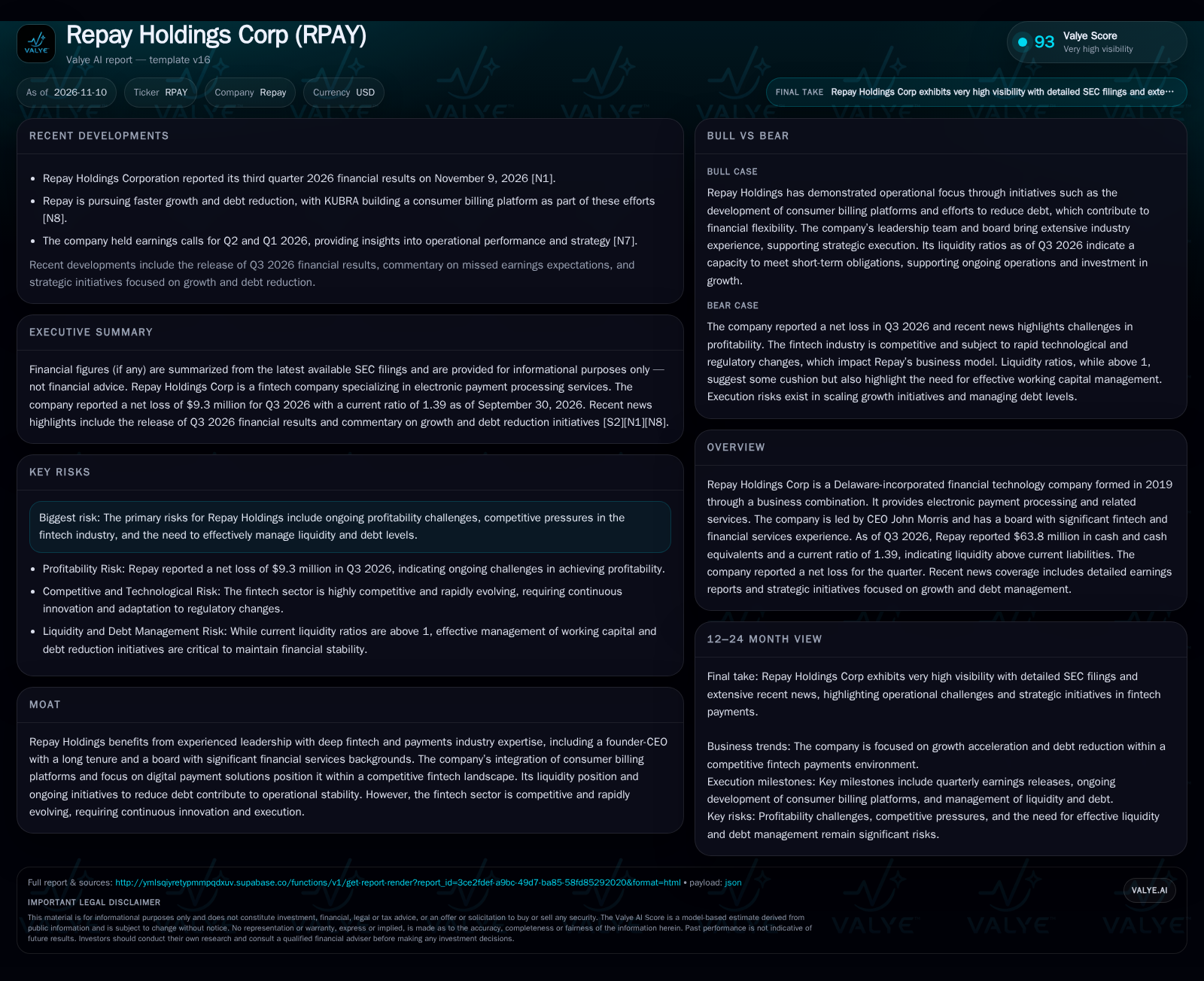
Repay Holdings reported a Q3 2026 net loss and continues to invest in consumer billing platforms and debt reduction initiatives. [S2] [N1] [N8]
Repay Holdings Corp stands at a crossroads familiar to many fintech payment processors: balancing a push for accelerated growth with the persistent challenge of achieving sustainable profitability. The company’s Q3 2026 net loss, alongside its continued investment in consumer billing platforms and debt reduction, places a spotlight on execution risk in a sector defined by rapid technological change, regulatory flux, and margin pressure. [S2] [N1] [N8]
Recent Financial Performance and Strategic Moves
Repay Holdings reported a net loss of $9.3 million for the third quarter of 2026, translating to basic and diluted EPS of -$0.11 per share [S2]. This loss continues a trend of profitability challenges in recent quarters. The company reported cash and liquidity metrics for the period; these figures do not by themselves establish operating runway, investment capacity, financial flexibility, or financing capacity. [S2]
Strategically, Repay is emphasizing both growth acceleration and debt reduction. The KUBRA unit’s development of a consumer billing platform reflects a bet on expanding payment volumes and increasing platform stickiness, aiming to deepen customer relationships and diversify revenue streams [N8]. These moves are occurring under the direction of a leadership team with deep fintech and payments sector experience, which can be a material advantage in execution [S1].
How Repay’s Operating Model Could Scale—And Where Margin Pressure Lurks
In electronic payment processing, revenue is typically generated through transaction fees, payment facilitation, and value-added services layered atop core payment rails. Repay’s investments in consumer billing platforms suggest a strategy to capture recurring revenue streams by embedding itself more deeply in client workflows, potentially increasing transaction volume and retention.
Operating leverage is plausible in this model: while variable costs (such as network fees and customer support) scale with payment volume, software-driven platforms can exhibit high gross margins once scale is achieved. However, the sector’s low switching costs and intense price competition can compress take rates, especially as large incumbents and well-funded startups vie for share. The pursuit of debt reduction indicates a desire to reduce interest expense and free up capital for growth investments, but also signals that past growth was at least partially debt-financed, which can pressure margins if top-line growth stalls.
Repay’s current loss position means that achieving positive operating leverage will require either sustained volume growth, higher-value services, or significant cost discipline. The success of the KUBRA billing platform could be pivotal—if it drives material increases in payment flows or cross-sells, it may move the company closer to breakeven and eventual profitability.
An additional consideration in Repay's operating model is the role of technology scalability and platform modularity. As payment volumes increase, the underlying infrastructure must handle higher throughput without proportional increases in operational costs. If Repay's platform architecture supports modular upgrades and seamless integration with third-party services, it could reduce incremental costs and improve margin expansion potential. Conversely, legacy or rigid systems may require substantial reinvestment to scale, limiting operating leverage. Moreover, the ability to rapidly deploy new features or comply with evolving regulatory requirements can influence customer retention and acquisition, directly impacting revenue growth and cost structures.
Competitive Dynamics: Differentiation, Substitution, and Sector Headwinds
Repay operates in a crowded and rapidly evolving payments landscape, competing with both legacy processors and fintech disruptors offering payment facilitation, embedded finance, and vertical-specific platforms. The main axes of competition include pricing, integration depth, ecosystem breadth, and client retention. Large competitors may enjoy economies of scale and broader distribution, while newer entrants can undercut pricing or offer more agile integrations.
Repay’s potential for differentiation lies in its sector focus and the development of value-added platforms like KUBRA’s consumer billing solution. If these platforms achieve deep integration with client back-office processes, they could generate switching frictions and recurring revenue. However, if such platforms are commoditized or easily replicated, Repay may struggle to defend margins. Regulatory shifts and rapid advances in embedded finance or open banking could also erode barriers to entry, increasing substitution risk.
What Success Looks Like: Platform Adoption Drives Volume and Margin Expansion
The favorable scenario for Repay hinges on strong adoption and scaling of its consumer billing platform, leading to higher payment volumes per client and deeper integration within customer workflows. If KUBRA’s platform becomes sticky—through features, integrations, or value-added analytics—Repay could see improved client retention, higher average revenue per user, and reduced churn.
Operating leverage would materialize as incremental transaction volume flows through a mostly fixed-cost platform, expanding margins. Debt reduction would lower interest expenses, freeing up cash for reinvestment or strategic acquisitions. Confirmation of this scenario would come from sequential improvements in gross margin, declining operating losses, and reported growth in platform transaction volumes and customer counts. A sustained shift to positive net income, supported by consistent top-line growth, would further validate this bull case.
Steady Execution Amid Competitive and Margin Pressures
The most plausible outcome is that Repay continues to grow payment volumes modestly, with the KUBRA platform contributing incremental revenue but facing stiff competition from both established and emerging payment providers. Margins may improve gradually if cost controls are effective and debt reduction efforts succeed in lowering interest expense, but persistent price competition and customer churn may cap profitability.
Evidence for this scenario would be continued quarterly revenue growth, stable or slightly improving gross margins, and a narrowing (but not eliminated) net loss. If Repay is able to reported liquidity-ratio trends above 1 and avoid material increases in debt, it should retain operational flexibility even as sector headwinds persist. Failure to accelerate platform-driven revenue or a relapse into wider losses would challenge this middle path.
If Growth Initiatives Stall and Competitive Pressures Intensify
The adverse scenario would involve underwhelming adoption of Repay’s consumer billing platform, with new customer acquisition or retention failing to offset competitive pricing pressure. In this case, revenue growth stalls or declines, and fixed operating costs prevent margin improvement despite cost-cutting efforts.
Debt reduction may be hampered by continued operating losses, potentially forcing the company to seek additional external financing or curtail growth investments. Confirmation of this scenario would include sequential declines in payment volume, persistent or widening net losses, deteriorating liquidity ratios, and management discussion of restructuring or capital-raising initiatives. Regulatory or technological disruptions could further intensify downside risks.
Milestones and Metrics That Will Define Repay’s Next Chapter
Quarterly trends in gross margin and net income: sustained improvement would support the thesis that operating leverage and platform adoption are taking hold.
Growth in transaction volume and customer count on the KUBRA billing platform—if disclosed—would help test the platform’s impact.
Changes in debt levels and interest expense: meaningful reduction would signal progress on potential financial flexibility.
Customer retention and churn rates—a useful metric if reported—would clarify whether Repay’s solutions are achieving stickiness.
Updates on new client wins or expanded relationships in targeted verticals (e.g., utilities, healthcare) would validate sector-specific strategy.
Regulatory developments affecting payment facilitation or digital billing, which could alter market structure or compliance costs.
Management commentary on competitive pricing dynamics and technology investments during earnings calls.
Disclaimer: This is research-only, informational analysis and not investment advice. It may include AI-generated interpretation and general industry context. Always verify important details using primary sources.

Comments