
Rapid Micro Biosystems Accelerates Growth Despite Persistent Losses
Q1 2026 reveals revenue gains led by Growth Direct system placements, yet net losses and operational headwinds remain key challenges.
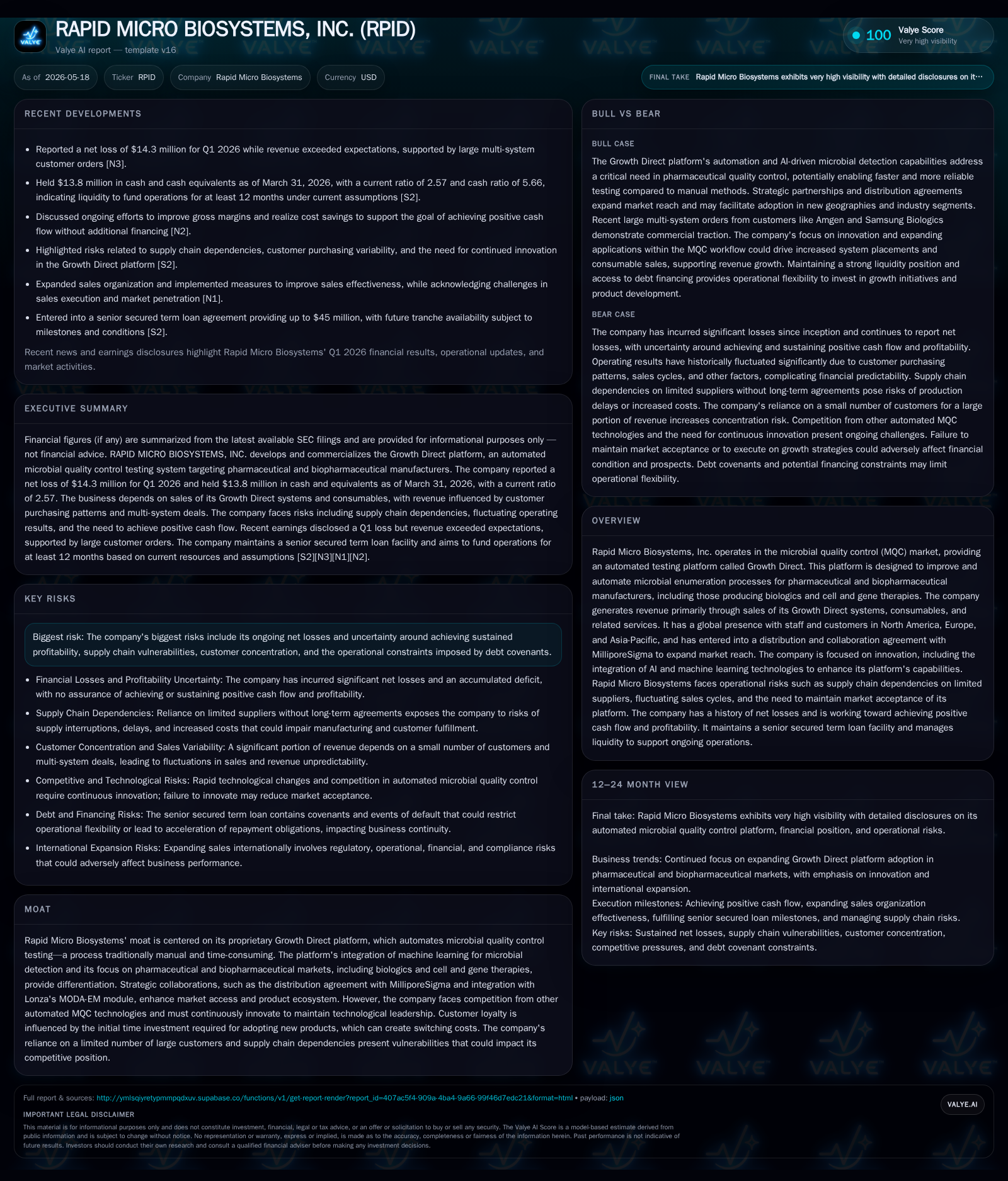
Rapid Micro Biosystems' latest quarterly results show continued revenue growth driven by increased placements of its Growth Direct microbial detection systems, alongside the ongoing advancement of AI integration into its platform. Despite operational progress, the company faces sustained net losses and financial constraints tied to debt covenants and supply chain risks. Strategic partnerships with MilliporeSigma and Lonza reinforce market access, underpinning growth in pharmaceutical and biopharmaceutical microbial quality control automation. Execution on system validation timelines and expansion in recurring consumables will be fundamental to scaling revenue and moving toward profitability.
Latest Quarterly Update: Revenue Growth and Losses Continue
Rapid Micro Biosystems’ Q1 2026 filing (dated May 15) underscores modest but crucial operational progress: product and service revenue grew beyond street estimates driven primarily by increased placements of the proprietary Growth Direct systems [S2], [N3]. This uptick reflects strengthening demand within pharmaceutical and biopharmaceutical manufacturing sectors for automated microbial quality control (MQC) solutions.
Despite these gains, net losses persist at a significant scale—$14.3 million for the quarter—with the cumulative deficit expanding to $536.7 million [S2]. The company continues investing heavily in R&D and SG&A to develop the platform’s capabilities and expand its commercial footprint. These outlays keep earnings negative but are aligned with a strategic focus on long-term growth.
An accompanying May 13 event release reaffirms this trajectory and anticipates unlocking additional capital via conditional borrowing tranches under existing debt agreements contingent upon milestone achievements [S3]. The near-term challenge remains balancing accelerated commercialization against sustained cash burn.
The Growth Direct Platform: Core Business Model and Competitive Advantage
Rapid Micro Biosystems’ revenue model hinges on the sale of its Growth Direct systems—automated instruments that revolutionize traditional microbial testing methods—and the ongoing purchase of proprietary consumables necessary for system operation [S1]. This creates a classic razor-and-blades recurring revenue stream where consumables and service contracts tied to validated installed base usage drive predictable follow-on sales.
The company targets quality control labs within pharma manufacturers developing small molecules, biologics, cell & gene therapies—areas where microbial contamination detection is critical yet traditionally manual and slow [S1], [N7]. Growth Direct employs AI-enhanced image analysis algorithms for microbial enumeration directly from agar plates without destructive sampling steps—reducing time-to-result from days to hours.
Such technological differentiation establishes substantial switching costs given the regulatory burden around method validation in GMP environments. Customers must invest several months validating new systems before fully transitioning workflows [S1]. This delays initial consumable replenishment but locks them into the ecosystem post-validation—supporting margin expansion as gross margins have improved steadily in recent years through cost optimizations [S1].
Industry Dynamics: Automated Microbial Quality Control’s Competitive Landscape
The MQC market is evolving from legacy manual culture-based methods toward automation that reduces labor intensity while accelerating turnaround times amidst increasing biologics production complexity [S1], [S18]. Rapid Micro Biosystems operates in a competitive niche characterized by limited but technologically advanced peers focusing on machine vision applications to microbiology.
Regulatory factors impose rigorous validation standards limiting rapid technology adoption; entrenched manual processes create inertia among quality control labs reluctant to disrupt validated workflows. Competitors strive to deliver similar AI or automated platforms, making continuous innovation critical for Rapid Micro to preserve technological leadership [S18].
Pricing pressures also bear watching given procurement dynamics in large pharma operations; tangible cost savings come primarily from labor reduction balanced against upfront capital expenditure for instruments.
Supply chain risks have heightened due to global tariffs, geopolitical tensions, and inflationary pressures impacting raw materials used in manufacturing both the systems and consumables [S21]. Any disruption could constrain product availability or margin improvement capacity.
Strategic Collaborations and Technology Innovations Driving Expansion
Strategic alliances are pivotal for Rapid Micro’s commercial scaling. Partnerships such as the distribution agreement with MilliporeSigma extend geographical reach across North America, Europe, and Asia-Pacific by leveraging established sales channels [S1], [N7]. Integration with Lonza's MODA-EM module exemplifies embedding Growth Direct technologies within broader pharma manufacturing ecosystems.
Technological innovation centers on enhancing AI models driving microbial detection accuracy while decreasing time-to-result—a key selling point [N7]. Such continuous improvements not only increase platform appeal but also help insulate against competition.
These collaborations foster cross-selling opportunities: as more customers adopt integrated solutions combining hardware with software-driven analytics, switching costs intensify through ecosystem lock-in effects.
Growth Opportunities and Execution Drivers
The primary growth drivers include rising pharmaceutical production volumes globally, particularly within biologics and advanced therapies where microbial contamination risk is high—and rapid MQC testing is paramount [S1]. Regulatory trends encouraging faster batch release also support demand for rapid microbial enumeration.
Measured KPIs like cumulative systems placed (190 units through 2025 year-end) and validated (155 units) underscore progress toward building a sizable recurring revenue base consuming proprietary media and service offerings [S1]. Validation velocity will critically influence recurring revenues since consumable sales only begin after successful system deployment in GMP labs.
Market education remains an execution priority given customers’ cautious culture around adopting novel assays. Management initiatives focus on demonstrating cost efficiencies through case studies emphasizing reduced cycle times and labor savings [N1], [N2].
Operational Risks and Financial Constraints
Substantial operational risks stem from Rapid Micro’s extended history of net losses totaling over half a billion dollars in accumulated deficit as of Q1 2026 [S2], reflecting prolonged investment ahead of profitability.
Debt financing via a Loan and Security Agreement (LSA) caps flexibility through affirmative/negative covenants restricting business actions without lender consent—including limits on incurring additional debt or disposing intellectual property assets [S4], [S5].
Supply chain fragility amid tariff fluctuations or global disturbances poses margin pressure risks affecting product cost structure [S21]. Customer concentration exposes vulnerability if major purchasers pause adoption or delay payments.
Lastly, the intrinsic long sales cycle compounded by multi-month validation processes introduces pacing uncertainty complicating forward-looking forecasts of consumable revenue ramps.
Key Milestones and What to Watch Next
Investors should closely watch upcoming quarterly organic demand indicated by new system order volume alongside increases in system validations completed—triggering transition from capital equipment sales alone toward higher-margin recurring consumables revenues [S2]
Progress toward commercial milestones unlocking additional LSA borrowing tranches provides crucial liquidity cues sustaining operating runway [S3], [N3]. Parallel advances integrating cutting-edge AI enhancements into Growth Direct could widen technological gaps versus competitors cementing customer loyalty.
Management commentary during earnings calls may offer clarity on margin expansion strategies including further product cost reductions or sales productivity improvements potentially signaling inflection points toward operating leverage realization [N1], [N2].
Financial Profile: Cash Position, Debt, and Profitability Outlook
As of March 31, 2026, Rapid Micro held approximately $13.8 million in cash alongside current assets approximating $49.2 million versus current liabilities near $19.1 million—a current ratio of roughly 2.57 indicating reasonable short-term liquidity headroom despite ongoing losses causing negative cash flow generation [F1], [S2].
Historical total debt stands at about $26.2 million based on mid-2021 data; precise current figures are not detailed but likely proximate given no subsequent refinancing announcements reported recently [F1]
This analysis synthesizes Rapid Micro Biosystems’ latest disclosed operating performance anchored by their Q1 2026 SEC filings together with prior annual context providing insights into growth drivers balanced against financial constraints inherent in scaling a technologically innovative platform within regulated pharmaceutical quality control domains. It does not constitute investment advice nor predict future results.
Disclaimer: This is research-only, informational analysis and not investment advice. It may include AI-generated interpretation and general industry context. Always verify important details using primary sources.

Comments