
REGO Payment Architectures Targets Family FinTech Niche with COPPA-Compliant Wallet
REGO Payment Architectures advances its Mazoola digital wallet platform focused on minors and families, emphasizing regulatory compliance and white-label licensing.
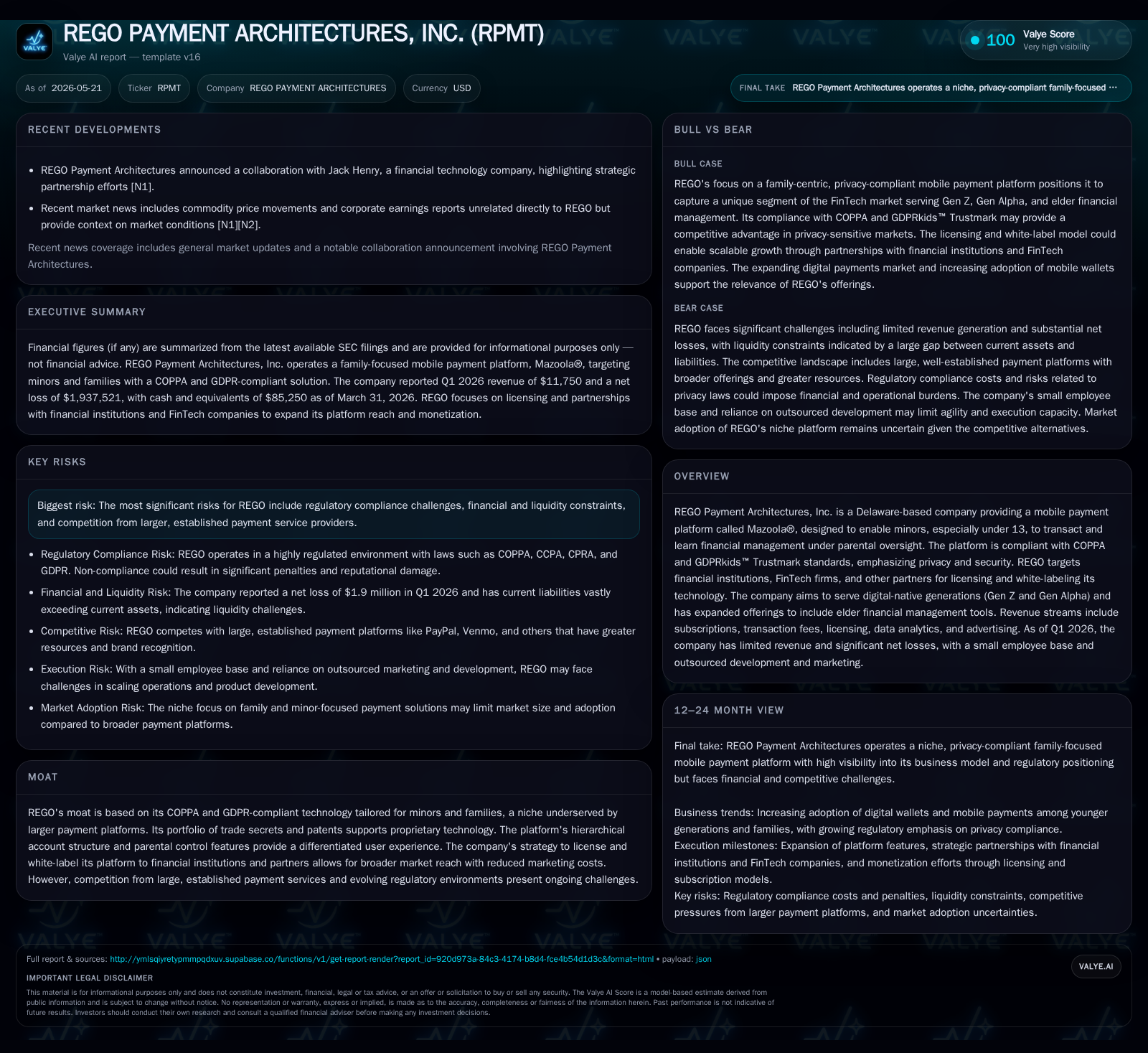
REGO Payment Architectures, Inc. recently filed its Q1 2026 10-Q, reaffirming its early-stage financial profile with limited revenues but ongoing development and commercialization efforts centered on its Mazoola® mobile payment platform. This platform uniquely targets children under 13 and families using COPPA and GDPR-compliant technology, positioning REGO in a niche underserved by mainstream payment providers. The company focuses on monetization through licensing to financial institutions and partners, leveraging patented hierarchical control features to ensure secure, compliant youth financial management. Key challenges include regulatory complexity, competitive pressure from larger payment players, and significant liquidity constraints. Upcoming milestones to watch include expansion of white-label client integrations and platform enhancements.
Latest Quarterly Operating Update and Its Strategic Implications
REGO Payment Architectures' most recent quarterly filing dated May 20, 2026 (10-Q) reported no updates to risk factors but reaffirmed the company’s early commercial stage: insignificant top-line revenue in the three months ended December 31, 2025 ($2,250) alongside operating losses exceeding $8.5 million and net losses near $9.6 million for fiscal year-end December 31, 2025 [F1][S2]. Liquidity remains constrained with approximately $85 thousand in cash against over $50 million in current liabilities as of March 31, 2026, yielding a current ratio effectively at zero—a critical factor underscoring dependency on additional funding or monetization acceleration [F1].
This filing evidences that while REGO has launched its Mazoola® platform commercially with select clients, it remains fundamentally in a developmental-runway phase. The company’s strategic emphasis is now focused increasingly on licensing agreements and white-label deployments to established financial institutions aiming to address family-oriented payment needs that are COPPA-compliant. This shift away from direct consumer revenue generation towards embedded technology partnerships is a key theme dominating the recent update.
Business Model: Monetizing Mazoola’s Family-Centric Payment Platform
REGO’s business model centers on Mazoola®, an all-digital mobile payment wallet designed primarily for minors under the age of thirteen while integrating parents’ oversight functionality. Revenue streams target multiple sources including subscriptions for premium features, transaction fees via both closed- and open-network payments, licensing income from white-label agreements with banks or fintech firms, data analytics sales based on anonymized behavioral data patterns within the platform, contextual advertising tailored towards families and children’s financial literacy content delivery [S8][S11][S24]
The company's approach leverages a multi-tiered hierarchical account system where parental accounts govern subaccounts created for children or elders under family care — each subject to configurable permissions enforcing rules aligned with strict privacy regulations like COPPA and GDPRkids Trustmark certification standards. This architecture creates switching costs by embedding compliance tools that would be costly for competitors to replicate without infringing patents or requiring substantial R&D investments.
Moreover, REGO pursues a licensing-led go-to-market strategy: instead of pursuing costly retail customer acquisition independently, it offers turnkey white-label solutions enabling credit unions, banks (notably one $7 billion AUM bank already onboarded), telecommunication firms, and other institutional partners to diffuse Mazoola technology into their existing customer bases under partner branding—effectively expanding REGO's potential market reach at lower sales/marketing expense [S11][S26]
Product Quality and Compliance: Differentiating in a Heavily Regulated Market
The Mazoola® platform's USP lies heavily in its compliance-first design ethos within a sensitive youth payments space. COPPA mandates stringent restrictions around personal data collection for users under thirteen years old; failure entails steep federal penalties seen historically against tech giants like Google ($170M fine) or TikTok ($5.7M) for violations [S21]. REGO not only claims full compliance but has fortified this through PRIVO-issued GDPRkids Trustmark certification covering European data protection norms as well.
Technically, the product uses patented methods such as Parent Match—a proprietary system linking parent-child accounts with control preferences stored centrally—and advanced age verification technologies ensuring transactional data does not violate statutory thresholds relating to minors' consent [S19][S27]. Data anonymization techniques allow REGO to safely harness behavioral insights for analytics without compromising individual privacy.
Outsourced product development paired with rigorous SOC 2 Type I & II audit certifications reflects quality controls befitting enterprise use cases commonly required by regulated financial institutions. The relatively small internal team—only five employees dedicated across programming, marketing, finance as of end-2025—suggests reliance on scalable vendor partnerships rather than heavy internal infrastructure investment at this early commercial juncture [S5]
Competitive Environment and Industry Structural Considerations
REGO operates amid a dynamic global payments landscape marked by entrenched incumbents such as PayPal, Venmo (PayPal-owned), Zelle (bank-backed), Amex Bluebird among others who dominate digital peer-to-peer transactions broadly but do not specifically address controlled youth payments compliant with COPPA or equivalent regulations [S4]. These incumbents benefit from scale economies and broad merchant acceptance yet lack specialized parental oversight features critical in the company's niche.
Furthermore, the payments sector faces ongoing innovation flux coupled with escalating regulatory scrutiny worldwide—as illustrated by various U.S. state privacy laws (CCPA/CPRA extensions) plus international GDPR enforcement tightening compliance demands continuously new entrants must meet [S21][S25]. Large players benefit from deep pockets absorbing compliance costs more readily than smaller firms like REGO.
Within this context REGO attempts differentiation through strict regulatory alignment paired with targeting digital native Generations Z & Alpha within family ecosystems seldom served by mainstream products. This strategy positions the company into growing segments poised for long-term structural growth driven by demographic tailwinds and increasing digital wallet adoption among youth demographics—a marked contrast to broader cyclical transaction volume trends seen elsewhere in fintech payments.
Key Growth Drivers: Platform Expansion and Licensing Opportunities
Several identifiable growth levers underpin REGO's medium-term commercial prospects:
- White-label Financial Institution Partnerships: Deploying Mazoola® technology across networks such as Computer Services Inc.’s >500 clients and Jack Henry & Associates’
7,500 financial institutions supports rapid scaling potential without direct-to-consumer acquisition overheads. Notably integration progress includes one bank live with $7B AUM base; another credit union ($6B AUM) in beta stages targeting Q1 2026 launch [S26]. - Service Module Expansion: Planned offerings in areas such as investments education modules for youth users; charitable giving facilitation; marketplace access; health-related services complement core transactional capabilities extending ecosystem stickiness [S8].
- Elder Financial Management: Recognizing growing demand triggered by increasing elder financial exploitation risks ($38B estimated losses in US elderly), REGO is advancing “Senior Guard,” a product prototype aimed at family-controlled elder money management—a potentially lucrative adjacent demographic requiring secure oversight tools akin to child-focused controls [S25].
- Data Analytics Monetization: Anonymized purchase behavior databases enable deployment of predictive analytics services either sold directly or bundled with partner platforms creating incremental revenue lines beyond direct transactions [S11].
- Operational Audits & Security Certifications: SOC 2 Type II assurance frameworks reduce institutional buyer friction enhancing credibility essential in highly regulated sectors such as banking [S26].
Collectively these drivers situate REGO’s expansion thesis predominantly around leveraging partner distribution while augmenting value-added feature richness that encourages retention and upsell.
Risks and Constraints: Regulatory, Competitive, and Financial Challenges
Despite promising structural opportunities several material risks warrant attention:
- Regulatory Compliance Costs & Enforcement Risk: Sustained commitment required to maintain COPPA/GDPR compliance amid shifting legislation across multiple states internationally imposes recurring expenses; lapses invite costly penalties plus reputational damage common in recent landmark cases involving large tech companies [S21]. Moreover reliance on third-party infrastructure adds security breach risk despite mitigation efforts.
- Severe Liquidity Constraints: With only approximately $85K cash against over $50M current liabilities reported at quarter end March 31, 2026, REGO faces intense balance sheet stress putting near-term operational continuity contingent on fresh capital capitalization or rapid ramp-up of revenue generation [F1].
- Competitive Entrenchment: Large fintechs possess extensive user bases adaptable towards youth features incrementally diluting exclusivity advantages; barriers lower if incumbent platforms embed parental controls replicating elements of REGO’s suite.
- Intellectual Property Litigation Exposure: While holding patents constitutes protective moat components there remains litigation risk both defensive (others infringing) or offensive (allegations against third parties), potentially costly given limited legal resources typical of small fintech startups [S6].
- Limited Internal Resources: A very small number of employees combined with significant external dependencies may limit rapid innovation pace or controlled rollout capability relative to more established players [S5].
These risks underline prudence over near-term execution feasibility balanced against strategic niche focus.
Forward Outlook: Milestones and Execution Watchpoints
Near-term operational milestones critical for validating REGO’s path include:
- Family Wallet White-label Client Growth: Tracking integration completions beyond the initial two large banking partners including quality of onboarding experience plus end-user adoption metrics remain central validation points specified in recent disclosures targeting further rollout throughout 2026 [S26].
- Mazoola® App Feature Enhancements: Completion of expanded modular offerings like investment education tools or Senior Guard elder management beta tests signal product ecosystem maturation critical for driving subscription conversions.
- Security & Compliance Audits Continuity: Maintaining SOC 2 Type II audit certifications annually ensures institutional confidence necessary to sustain partner trust especially amongst large financial institutions.
- New Partnership Announcements: Additional collaborations extending footprint into telecom providers or merchant chains could widen ecosystem relevance beyond banking spheres leveraging same core tech stack.
- Regulatory Developments Impact Assessment: Close monitoring of evolving privacy law amendments domestically/internationally will guide necessary platform adjustments minimizing violation risks.
Successful navigation against these markers will demonstrate execution discipline needed amid resource constraints.
Brief Financial Profile: Recent Performance and Liquidity Context
As per the latest available data ending December 31, 2025: revenue remains nominal at approximately $2,250 with operating income deeply negative at about -$8.52 million; net loss exceeds -$9.5 million indicating substantial ongoing investment into product development amid minimal monetization achieved so far [F1]. Balance sheet weakness is stark: cash resources amount only to $85K as of March-end 2026 against circa $50.7 million current liabilities resulting in a current ratio near zero pointing toward liquidity precariousness without additional financing support or operational cash flow improvements soon [F1]. Total debt stands at roughly $595K marking moderate leverage but overshadowed by heavy working capital deficits present.
These figures reflect typical startup scale-up stage dynamics emphasizing capital intensity inherent in building out complex regulated fintech platforms targeting an exacting market segment.
Disclaimer: This report is an independent industry analysis based solely on publicly available SEC filings dated up to May 20, 2026 ([S2], [S1]) supplemented by Companyfacts data ([F1]). It excludes any investment advice or research views.
Disclaimer: This is research-only, informational analysis and not investment advice. It may include AI-generated interpretation and general industry context. Always verify important details using primary sources.

Comments