
REST EZ Inc. (RTEZ) Company Analysis: Navigating Early-Stage Challenges Amid Liquidity Constraints
REST EZ Inc. markets a nationally distributed sleep aid product facing typical early-stage risks including brand building, concentrated customer exposure, and severe liquidity challenges. The company’s sole executive control structure and penny stock status compound operational and financial uncertainties.
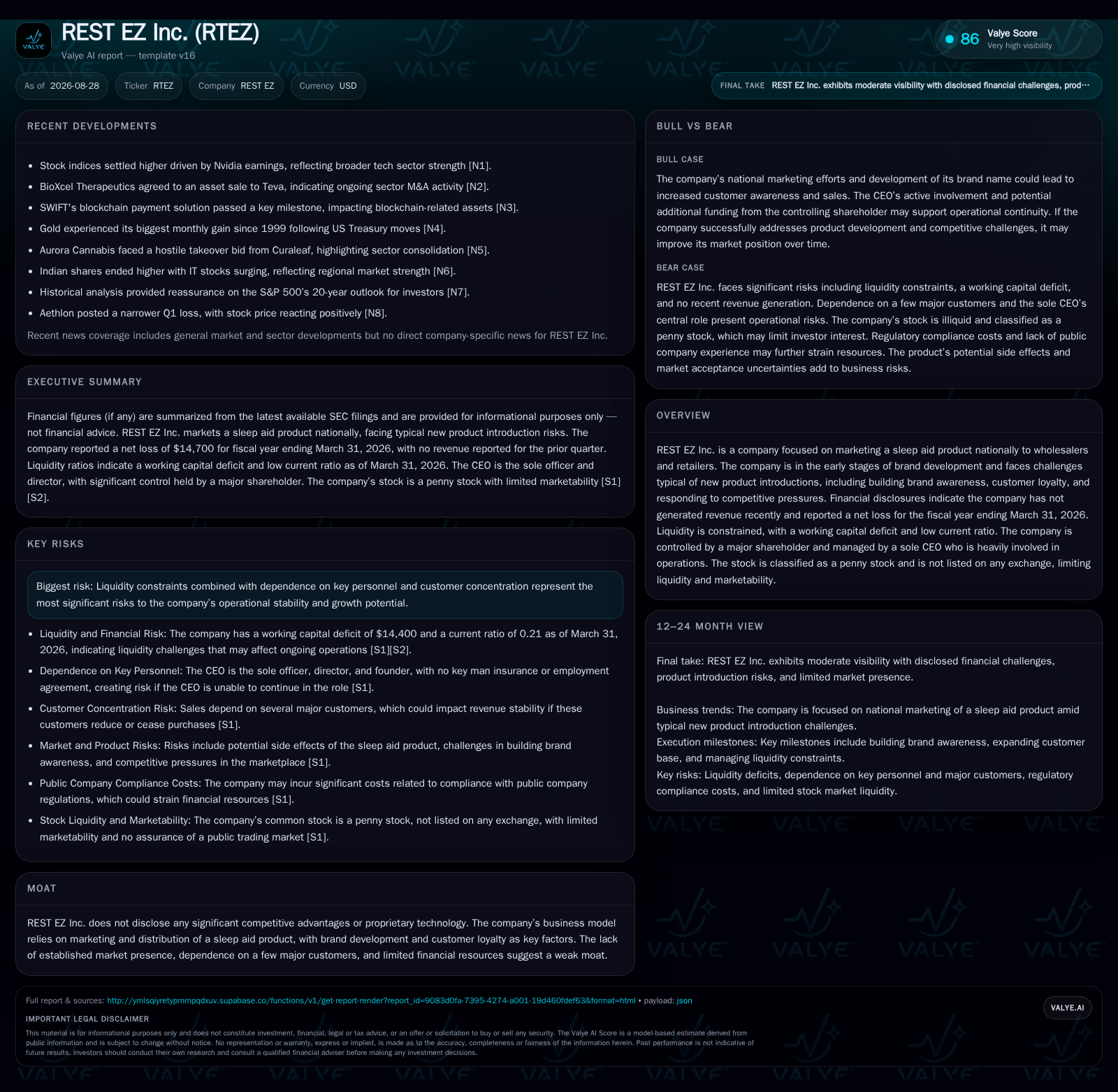
REST EZ Inc. operates in a challenging early-stage environment selling a sleep aid product nationally but struggles with no recent revenue, substantial liquidity deficits, and high customer concentration. The founder-CEO’s central role and controlling shareholder dominance underscore governance risks, while absence of proprietary advantages limits moat potential. Recovery depends on successful brand development, customer expansion, and capital infusion, with downside risks centered on cash scarcity, regulatory cost burdens, and competitive pressures.
REST EZ Inc. operates in the sleep aid market, distributing its product nationally to wholesalers and retailers but grappling with the challenges typical of early-stage consumer product companies. As of March 2026, the company reported no recent revenue and a net loss of $14.7K for the fiscal year, underscoring the difficulty of gaining market traction. Liquidity is severely constrained, with a working capital deficit and a fragile current ratio indicating limited operational runway. Governance is concentrated in the hands of the founder-CEO and a controlling shareholder holding 60% voting power, raising questions about succession and minority shareholder protections. The company’s penny stock status and absence of proprietary technology further complicate value creation prospects. This analysis explores the underlying business model, competitive dynamics, and scenario pathways for REST EZ as it navigates these headwinds.
Latest Operating Snapshot
REST EZ Inc. focuses exclusively on marketing a sleep aid product to wholesalers and retailers across the United States, with no reported revenue in the quarter ended December 31, 2025, and a net loss of $14,700 for the fiscal year ending March 31, 2026 [S1][S2]. This absence of recent sales highlights a critical execution gap in converting product availability into market traction. The company’s working capital deficit of $14,400 and a current ratio of 0.21 reflect severe liquidity stress, constraining operational flexibility [S1][S2].
Governance and control are highly concentrated, with the CEO serving as sole officer, director, and founder, and a controlling shareholder owning approximately 60% of voting stock [S1]. This concentration enables decisive corporate decision-making but presents succession and minority interest risks. Additionally, the company’s common stock is a penny stock not listed on any exchange, restricting liquidity and marketability for investors [S1]. These factors collectively frame REST EZ’s current operational and financial landscape as precarious, highlighting urgent needs in capital, market penetration, and governance robustness.
Business Model and Unit Economics
REST EZ’s business model centers on the wholesale and retail distribution of a sleep aid product, generating revenue primarily through volume sales to these channels. Pricing is likely determined by competitive market benchmarks for OTC sleep aids, with margins influenced by manufacturing costs, distribution expenses, and promotional investments. Given the lack of disclosed unit economics, one can infer that fixed costs include product development, regulatory compliance, and marketing overhead, while variable costs scale with sales volume. The absence of recent revenue and persistent losses suggest the company has not yet achieved a breakeven volume threshold necessary to leverage fixed costs effectively.
Capital intensity appears moderate, primarily associated with inventory, marketing, and compliance rather than heavy manufacturing or R&D. However, operating leverage remains constrained by low sales volume and high administrative expenses, including public company compliance costs. The CEO’s direct operational involvement may reduce some overhead but also concentrates execution risk. Without improvements in sales volume and brand recognition, fixed costs will continue to depress margins, and liquidity constraints may limit investment in growth initiatives, creating a challenging cycle to break.
Moat, Competition and Counterforces
REST EZ does not disclose proprietary technology, patents, or distinctive formulations, implying its competitive advantage relies heavily on brand development, distribution relationships, and customer loyalty within a crowded sleep aid market. This sector typically features well-established consumer brands and numerous generic alternatives, increasing competitive pressure and limiting pricing power. The company’s reliance on a few major wholesale customers amplifies customer concentration risk and potentially weakens negotiating leverage.
Countervailing forces include emerging competitors with greater capital resources, established brand equity, and diversified product portfolios. Additionally, regulatory compliance costs and the need to invest in marketing to build consumer awareness impose barriers. The sole CEO’s central role creates execution risk and limits organizational depth. Without meaningful differentiation or switching costs, REST EZ’s moat is fragile, and it faces substantial threats from incumbent players and new entrants alike.
Bull Case
In a constructive scenario, REST EZ successfully leverages its national distribution channels to build meaningful brand awareness and customer loyalty, translating into steady revenue growth. The CEO’s active operational involvement and controlling shareholder’s willingness to inject capital provide stability and enable strategic investments in marketing and product development. Improved product acceptance and competitive positioning could reduce customer concentration risk by expanding the customer base beyond a few major wholesalers.
Confirming evidence would include sustained revenue growth, expanding customer accounts, improved liquidity ratios, and indications of brand recognition such as repeat orders or consumer feedback. Success in managing public company compliance costs and strengthening governance would also bolster confidence. A falsification test for this scenario would be continued revenue stagnation, worsening liquidity, and loss of key customers or the CEO’s departure without a succession plan.
Base Case
The base case anticipates modest progress in brand development and customer acquisition but persistent financial strain due to limited capital and competitive pressures. Revenue growth might commence but remain insufficient to achieve profitability within the next 12-24 months, with liquidity challenges necessitating ongoing funding from the controlling shareholder. The CEO maintains operational control, but succession planning remains unresolved, posing medium-term governance risk.
Under this scenario, the company manages to avoid major setbacks but struggles to scale meaningfully. Confirming signs include slow but positive revenue trends, incremental improvements in working capital metrics, and stable customer relationships without significant expansion. Failure to secure additional capital or to diversify the customer base would falsify this scenario, as would abrupt increases in regulatory costs or competitive losses causing material revenue declines.
Bear Case
Downside risk centers on failure to generate sustainable revenue, exacerbating liquidity shortfalls and forcing operational retrenchment or insolvency. Dependence on a few major customers exposes the company to abrupt demand reductions or contract losses, while the CEO’s pivotal role creates vulnerability to leadership disruptions. The penny stock classification and absence of exchange listing hinder capital raising, restricting the ability to fund marketing or product innovation.
Regulatory compliance costs and competitive market pressures could further strain resources, leading to deterioration in product acceptance and brand reputation. Confirming evidence of this scenario would be continued net losses, negative cash flow trends, loss of key customers, and CEO departure without replacement. Conversely, stable or improving financials would falsify this scenario.
What Matters Next
Key performance indicators to monitor include: (1) Quarterly revenue growth and customer count to validate market traction; (2) Working capital and current ratio trends to assess liquidity improvements; (3) Customer concentration metrics to track diversification of sales; (4) CEO tenure and any succession planning disclosures addressing management continuity; (5) Capital raising activities or shareholder funding to support operations; (6) Marketing expenditure effectiveness as an indicator of brand development progress; (7) Regulatory compliance costs impacting operating expenses; and (8) Stock trading volume or listing status changes that could affect liquidity and investor access.
Monitoring these KPIs will provide insight into whether REST EZ can overcome early-stage challenges, stabilize its financial condition, and build a defensible market position or if it remains vulnerable to the array of risks inherent in its current operating environment.
Disclaimer: This is research-only, informational analysis and not investment advice. It may include AI-generated interpretation and general industry context. Always verify important details using primary sources.

Comments