RTX CORP: Navigating Aerospace & Defense Complexities Amid Stable Demand and Geopolitical Risks
RTX consolidates aerospace and defense leadership through diversified segments, strong government contracts, and resilient financials.
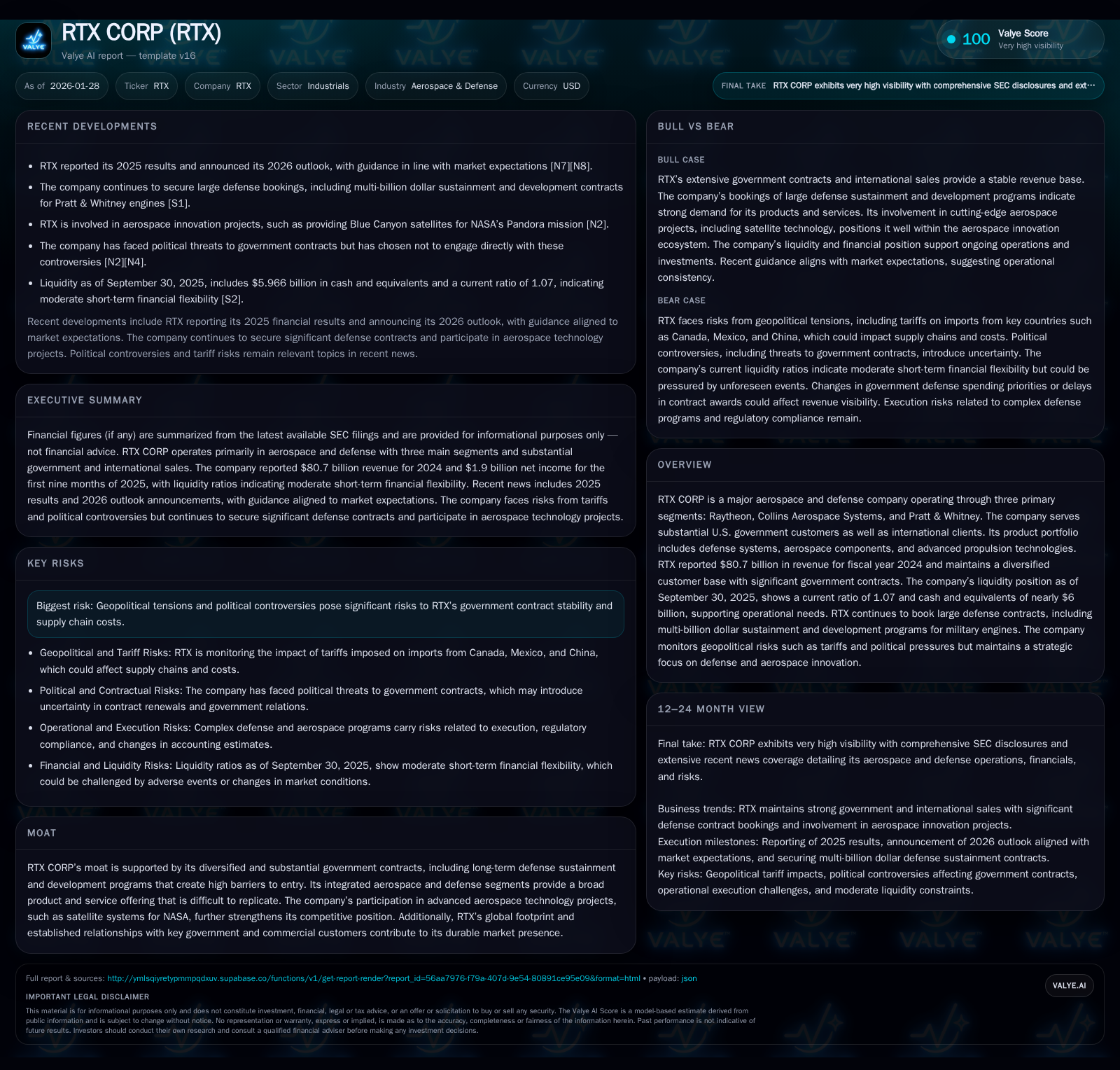
RTX CORP reported $80.7 billion in revenue for fiscal 2024, supported by its three core segments: Raytheon, Collins Aerospace Systems, and Pratt & Whitney. Recent earnings highlighted stable demand and solid order backlogs, with management reaffirming 2026 guidance despite geopolitical tensions and political headwinds. The company’s business model is deeply integrated with U.S. government defense spending and international clients, leveraging advanced aerospace technologies and long-term sustainment programs. However, risks from tariffs, political controversies, and supply chain complexities remain critical to monitor.
What Changed Recently
RTX CORP’s Q4 2025 earnings release detailed a continuation of stable financial performance with revenues and profits meeting expectations. The company reaffirmed its positive outlook for 2026 despite headwinds linked to geopolitical tensions and political controversies, including public criticisms from former political figures which the company has largely chosen to ignore in its operational messaging [N1, N3, N5, N8, N9]. Demand for defense products and services remains solid, underpinned by multibillion-dollar sustainment contracts for military engines such as the F117, F135, and F119, alongside development programs [S21]. The market reacted positively to these results, reflecting confidence in RTX’s positioning amid a defense-heavy earnings week [N10].
Business Model as a System
RTX operates through three primary segments: Raytheon, Collins Aerospace Systems, and Pratt & Whitney, each serving overlapping but distinct aerospace and defense markets. The company’s business model centers on delivering advanced defense systems, aerospace components, and propulsion technologies to a diversified customer base dominated by the U.S. government but also including international governments and commercial aerospace clients [S1, S2].
- Raytheon focuses on defense systems including missile defense, radar, and cybersecurity solutions.
- Collins Aerospace Systems provides avionics, aircraft interiors, and mission systems for commercial and military applications.
- Pratt & Whitney specializes in aircraft engines and related sustainment services.
These segments are interconnected through technology development, supply chain integration, and shared customer relationships, particularly within government agencies. The model relies heavily on securing long-term contracts that provide recurring revenue streams, notably in sustainment and upgrade programs for military aircraft engines. This creates a high barrier to entry due to the technical complexity and regulatory environment governing defense procurement [S1, S21].
RTX also invests significantly in research and development to maintain technological leadership, with operating leverage impacted by continued capital expenditures and R&D spending necessary to support product innovation and compliance with evolving defense standards [S16, S17].
Financially, RTX maintains a strong liquidity profile with nearly $6 billion in cash and equivalents and a current ratio of 1.07 as of Q3 2025, which supports operational flexibility and capital deployment [S10]. The company manages a substantial debt load with various notes due through the 2030s, highlighting the importance of cash flow generation and disciplined capital management [S14, S15].
Industry Map & Competitive Battlefield
The aerospace and defense industry is characterized by a few large, integrated players with deep government ties, substantial R&D capabilities, and complex supply chains. RTX competes with companies such as Northrop Grumman, Lockheed Martin, Boeing Defense, and General Dynamics. Competitive advantages are derived from:
- Long-term government contracts: RTX’s extensive backlog and sustainment programs create stable revenue.
- Technological breadth: Its combined capabilities across propulsion, avionics, and defense systems allow cross-segment innovation and bundled offerings.
- Global footprint: The company serves international allies, which helps diversify geopolitical risk but also exposes it to tariffs and export controls.
The competitive battlefield includes bidding for major defense programs, maintaining technological edge in aerospace propulsion and missile defense, and managing supply chain complexity amid global trade tensions [S1, S21, S22]. The industry also faces increasing scrutiny over geopolitical risks, export regulations, and political influences on defense spending.
Where the Economics Become Real
RTX’s unit economics are shaped by the cost structure of highly engineered products, long development cycles, and complex manufacturing processes. Key economic levers include:
- Contract structures: Fixed-price vs. cost-plus contracts affect margin stability. Sustainment contracts tend to be more predictable, while new development programs carry execution risk.
- Supply chain costs: Tariffs (e.g., 25% on imports from Canada/Mexico, 10% on China as announced recently) impact input costs, although RTX currently expects limited material effect on results [S3].
- R&D and CapEx investment: Maintaining competitive advantage requires ongoing investment, which can pressure margins but also enable premium pricing and contract wins [S16, S17].
- Operating leverage: Scale across segments helps spread fixed costs, but program-specific risks (e.g., delays, quality issues) can impact profitability.
Liquidity and capital structure are also critical. RTX’s nearly $6 billion cash position and manageable current liabilities (current ratio 1.07) support operational needs and allow flexibility for strategic investments or debt repayments [S10, S11]. However, large debt maturities in the 2030s mean sustained cash flow generation is essential.
Diligence Questions / Disconfirming Signals
- How resilient are RTX’s key sustainment contracts to budget cuts or shifts in U.S. defense priorities?
- What is the detailed impact of current and potential future tariffs on RTX’s supply chain costs and pricing flexibility?
- How effectively is RTX managing integration risks related to any recent or planned divestitures, especially regarding Collins Aerospace’s business units [S5]?
- Are there any emerging geopolitical or regulatory risks that could impair RTX’s ability to export to key international clients?
- What contingencies are in place for potential disruptions in production or technology development pipelines?
- How robust is RTX’s innovation pipeline to counter competitive threats from other aerospace and defense firms?
- To what extent could political controversies or executive-level criticisms materially affect contract awards or partner relationships?
Conclusion
RTX CORP remains a cornerstone in aerospace and defense, leveraging its integrated segments and substantial government contracts to deliver stable revenues and maintain technological leadership. The company’s recent earnings and outlook signal confidence in navigating complex geopolitical and market dynamics. Yet, ongoing diligence is warranted around supply chain pressures, tariff impacts, and evolving defense spending priorities that could affect future performance. The firm’s financial footing and diversified portfolio provide resilience, but the aerospace and defense landscape demands continuous adaptation to regulatory, technological, and political challenges.
This analysis is based on publicly available information and does not constitute investment advice. Readers should consider their own research and consult professional advisors before making decisions.
Disclaimer: This is research-only, informational analysis and not investment advice. It may include AI-generated interpretation and general industry context. Always verify important details using primary sources.

Comments