
RxSight’s Breakthrough in Post-Surgical Vision Customization and Its Path to Profitability
RxSight’s proprietary Light Adjustable Lens technology redefines premium cataract surgery while the company navigates ongoing operating losses and capital strategies.
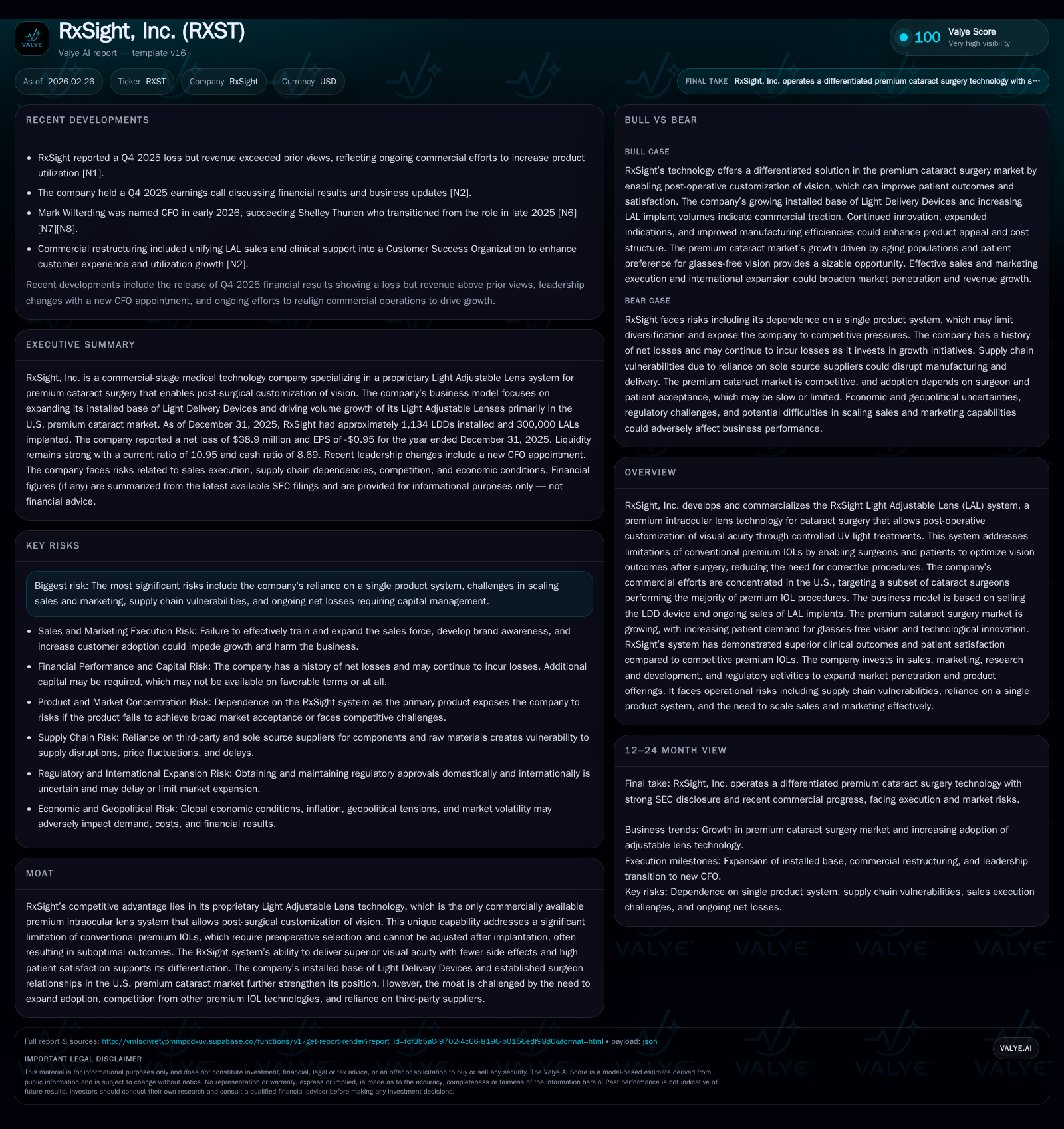
RxSight, Inc. has developed a differentiated intraocular lens system that enables post-operative customization of vision, addressing a key limitation of conventional premium lenses. The unique Light Adjustable Lens (LAL) technology has driven steady revenue growth, though the company continues to manage net losses and cash flow deficits as it scales adoption in the premium cataract market. Financial discipline, capital raises, and expanded surgeon penetration remain essential milestones to move toward profitability amid litigation and supply chain risks.
From Innovation to Market: The Growth Trajectory Behind the Light Adjustable Lens
Imagine a patient emerging from cataract surgery not bound by preoperative guesses on vision outcomes but empowered to refine visual acuity precisely to their lifestyle needs. This transformative scenario describes the core promise of RxSight's Light Adjustable Lens (LAL) system—a disruptive advancement in intraocular lens (IOL) technology that allows post-operative refractive error adjustment via controlled ultraviolet light exposure.
Historically, RxSight has demonstrated progressive revenue growth as surgeon adoption expands within the U.S. premium cataract segment. However, profitability remains elusive. The company reported an operating loss of approximately $48.2 million for fiscal year (FY) 2025, a 30.7% increase in loss compared to FY2024's $36.9 million deficit [F1][N1]. Net losses widened similarly by roughly 41.8%, finishing close to $38.9 million in FY2025 versus $27.5 million prior year.
Operational cash flow deficits have moderated somewhat to negative $15.5 million in FY2025 from negative $17 million the previous year, signaling incremental improvements albeit still reflecting significant investment outlays required for market capture [F1]. Capital expenditure declined by about 30% year-over-year to $3.8 million as capital deployment became more measured alongside commercial scaling efforts.
Historical performance (annual)
| FY | Net ($mm) | CFO ($mm) | OpInc ($mm) | Capex ($mm) | Net YoY |
|---|---|---|---|---|---|
| 2025 | -39 | -16 | -48 | 4 | -41.8% |
| 2024 | -27 | -17 | -37 | 5 | +43.5% |
| 2023 | -49 | -42 | -50 | 5 | +27.2% |
| 2022 | -67 | -59 | -63 | 2 |
Source: SEC companyfacts cache [F1].
Capital returns and efficiency (annual)
| FY | FCF ($mm) | ROE% |
|---|---|---|
| 2025 | -19 | -14.1 |
| 2024 | -22 | -9.8 |
| 2023 | -46 | -30.3 |
| 2022 | -61 | -74.3 |
Source: SEC companyfacts cache [F1].
Table: Historical Financial Summary demonstrates continued investment stage with improving cash flow trends yet persistent losses [F1]
Distinctive Technology Driving Differentiation in Premium IOLs
The RxSight system centers on its proprietary Light Adjustable Lens made from photosensitive silicone-based material distinctively engineered for refractive power modulation via ultraviolet light treatments performed weeks after implantation [S1]. This approach fundamentally redefines premium IOL outcomes:
- Conventional premium IOLs require preoperative selection with inherent optical trade-offs and cannot be adjusted once implanted.
- RxSight’s LAL permits incremental adjustments guided by patient input during postoperative care sessions using the accompanying Light Delivery Device (LDD).
- This iterative customization enhances surgeon confidence while delivering superior uncorrected visual acuity and reducing dependence on secondary corrective procedures.
This unique ability addresses a major limitation faced by ophthalmic surgeons managing refractive error corrections post-cataract surgery — an innovation positioning RxSight as sole provider of adjustable premium intraocular lenses in the U.S., thus creating its moat [S1].
Scaling Challenges: Sales, Marketing, and Litigation Risks Impacting Growth
Despite technological uniqueness driving early traction with surgeons centralizing premium cataract procedures nationally (21% procedure share as of 2025), RxSight faces operational challenges impeding faster growth:
- Expanding a specialized sales force capable of effectively training cataract surgeons requires significant time and investment.
- Awareness among patients and surgeons for this novel solution demands sustained marketing efforts incurring high costs relative to revenues currently generated.
- Reliance on a single product system heightens exposure if adoption falters or supply chain bottlenecks emerge.
- The company is embroiled in consolidated securities class action litigation alongside shareholder derivative suits stemming from allegations over past financial disclosures related to demand projections and guidance [S1][S4]. Although RxSight denies wrongdoing and defends vigorously, unresolved litigation adds stock volatility risk and management distraction [S4].
These factors collectively impose a pronounced execution risk layer critical for future progress.
Future Revenue Drivers and Expansion Opportunities in Cataract Surgery
Market fundamentals underpin favorable long-term growth drivers:
- Cataract prevalence surges substantially with age; roughly half of individuals develop cataracts by age 60.
- There's increasing patient demand for spectacle independence fueled by lifestyle expectations.
- U.S., being largest premium IOL market globally with Medicare coverage structure assigning out-of-pocket for premium upgrades ($2k-$5k per eye), presents sizable addressable opportunity.
- International expansion ambitions exist but remain tempered given regulatory clearance uncertainties abroad along with local reimbursement dynamics posing entry barriers [N2][S2].
Progression toward greater penetration within existing U.S.-based premium surgeon cohorts alongside new indication research could catalyze next phase revenue growth.
Key Financial Metrics: Operating Losses, Cash Flow Trends, and Capital Structure
Financial health indicators reveal mixed signals:
- Operating income losses deepened by about 30.7% from FY2024 to FY2025 reaching near $48 million amid expansion initiatives [F1].
- Net income contractions followed suit at nearly $39 million loss reflecting underlying high costs despite revenue gains.
- The operating cash flow deficit improved modestly but remains negative at over $15 million showcasing continuing investment burn rate offset partially by operational efficiencies.
- Free cash flow (operating cash flow less Capex) stands at negative approximately $19.3 million illustrating cautious capex discipline amidst scaling priorities.[F1]
- Equity base nearly doubled between FY2022 ($90 million) and FY2025 ($276 million), largely attributable to multiple capital raises enhancing liquidity buffers.[F1]
- Year-end current ratio calculated at ~11x signals robust short-term liquidity positioning: current assets surpass current liabilities markedly ($287M vs $26M)[F1], ensuring operational runway even under continued loss-making conditions.
Approximate Return on Equity for FY2025 is negative at around -14.1%, underscoring unprofitable status common for medical device innovators investing upfront in commercial infrastructure [F1].
Capital Allocation Strategies Amid Continued Net Losses
Given recurring net losses without dividend distribution or share buybacks,[F1] RxSight’s capital management strategy prioritizes sustaining operations through equity funding channels alongside disciplined expense control:
- Operating cash flow shortfalls constrain capacity for payouts; thus preserving cash becomes paramount amidst commercial investment needs.
- Risk disclosures highlight dependency on access to additional funding sources under potentially challenging capital market conditions or adverse economic environments[S1].
- Judicious allocation focuses heavily on expanding sales capabilities while managing supply chain vulnerabilities tied to sole-source component reliance[S1].
- Absence of return-of-capital programs aligns with preservation mindset typical among venture-stage medical technology companies transitioning toward scalable growth cohorts.
What To Watch: Milestones, Adoption Rates, and Regulatory Developments
Investors and stakeholders should monitor several pivotal developments shaping RxSight’s trajectory:
- Quarterly sales volume ramp statistics among top-tier U.S. cataract surgeons adopting LAL implants will indicate genuine market penetration extension[N2][S1].
- Surgeon education initiatives effectiveness evidenced through expanded installed Light Delivery Device base usage.
- Progress toward new geographic regulatory approvals unlocks sizeable international markets presently limited[S1][N2].
- Resolution timeline updates regarding securities class actions and derivative suits including outcomes of pending motions affecting legal uncertainty[S4].
- Any announcements regarding complementary product enhancements or indications expanding clinical applicability would provide strategic upside prospects.
Collectively tracking these factors offers visibility into whether RxSight can leverage its differentiated platform toward sustainable profitable growth.
This analysis combines comprehensive financial data with an industry-focused technological overview grounded solely in documented sources without speculative extrapolation or investment recommendations.
Disclaimer: This is research-only, informational analysis and not investment advice. It may include AI-generated interpretation and general industry context. Always verify important details using primary sources.

Comments