
Rayonier Advanced Materials Balances Operational Shifts and Market Cyclicality with Strategic Segmentation
RYAM restructures its High Purity Cellulose segment, navigates cyclical pulp markets, and manages leverage amidst profitability pressures.
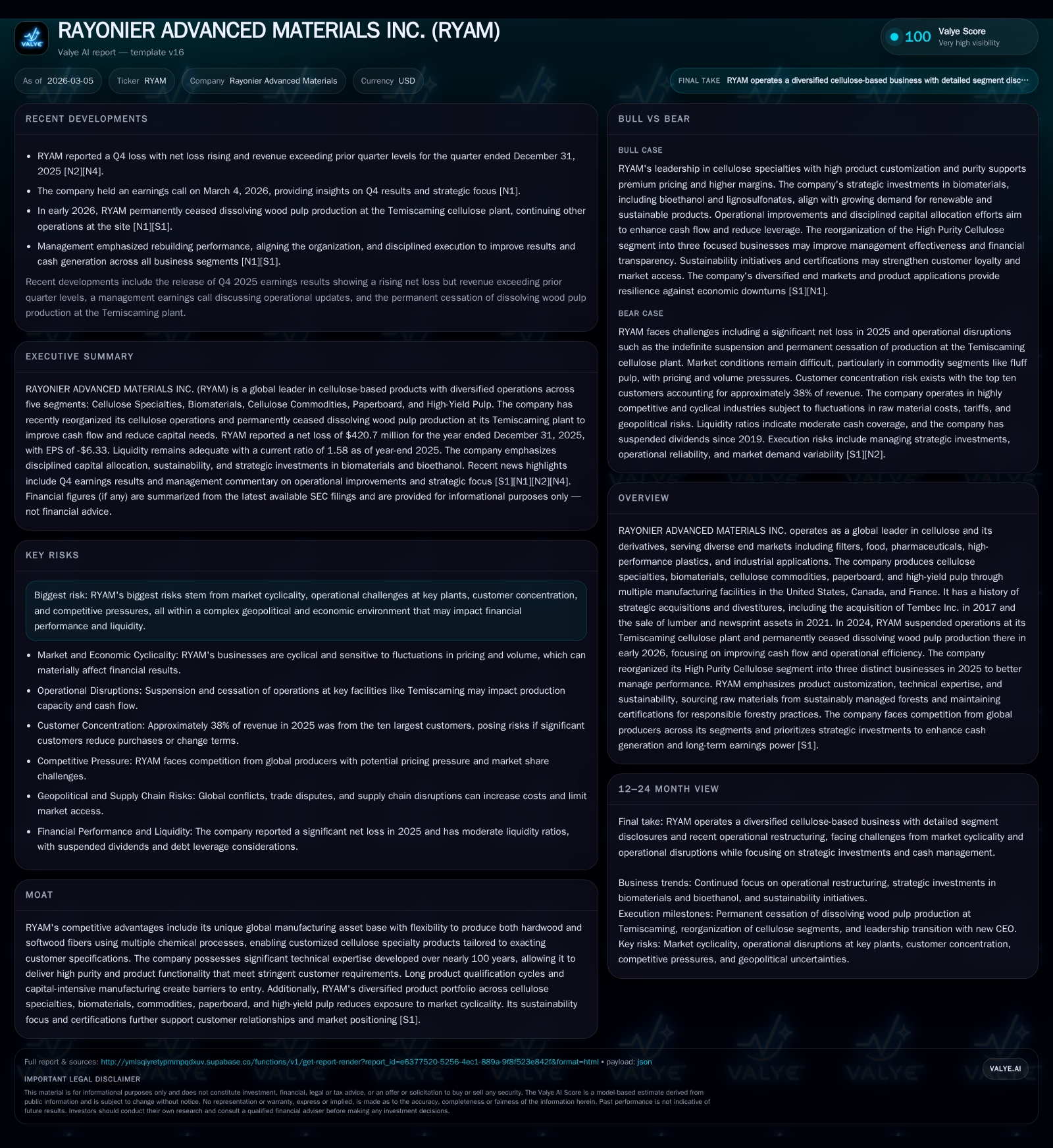
Rayonier Advanced Materials (RYAM) reported a sharp decline in profitability in 2025 despite relatively stable revenue supported by its diversified cellulose product portfolio. The indefinite suspension and subsequent permanent closure of dissolving wood pulp production at Temiscaming mark significant operational shifts aimed at preserving cash flow and operational efficiency. The company restructured its High Purity Cellulose segment into three focused businesses to optimize management and growth prospects while contending with competitive and geopolitical risks. Capital allocation remains prudent, with a suspended dividend policy and limited share repurchases amid elevated debt levels and tight liquidity.
Historical Performance Overview
Rayonier Advanced Materials Inc. (RYAM), established as an independent public entity in 2014 after separating from Rayonier Inc., has developed a diverse global footprint specializing in cellulose-based products serving filters, pharmaceuticals, food additives, high-performance plastics, propellants, among others [S1][S22]. Historically, RYAM’s reported revenue grew from approximately $231 million in 2016 to about $349 million in 2017 per SEC XBRL data [F1]. Strategic acquisitions such as the 2017 purchase of Tembec Inc. expanded capacity notably.
Recent years have showcased volatility tied closely to commodity markets’ cyclicality. Revenue peaked near $1.64 billion in 2023 but declined to $1.63 billion in 2024 and further down to about $1.47 billion in 2025 [F1]. Operating income swung from positive territory ($26 million in 2022) into negative territory in 2023 (-$65 million), rebounding somewhat to $39 million in 2024 before collapsing again to just over $4 million in 2025 — an approximate 90% annual contraction [F1]. Net losses followed this trend with a steep -$421 million loss for 2025 largely attributable to impairments and indefinite suspension charges related to key facilities.
Historical performance (annual)
| FY | Net ($mm) | CFO ($mm) | OpInc ($mm) | Net YoY |
|---|---|---|---|---|
| 2025 | -421 | 24 | 4 | -985.8% |
| 2024 | -39 | 204 | 39 | +62.0% |
| 2023 | -102 | 136 | -65 | -582.6% |
| 2022 | -15 | 69 | 26 |
Source: SEC companyfacts cache [F1].
Capital returns and efficiency (annual)
| FY | ROE% |
|---|---|
| 2025 | -132.9 |
| 2024 | -5.4 |
| 2023 | -13.6 |
| 2022 | -1.8 |
Source: SEC companyfacts cache [F1].
*Note: Segment reporting structure was recast prior periods [S7].
Operational Changes & Segment Reorganization
A significant strategic move was the indefinite suspension of operations at the Temiscaming cellulose plant since July 2024 due to high capital requirements and losses associated particularly with commodity viscose products exposure [S1]. By Q1 2026, RYAM confirmed permanent cessation of dissolving wood pulp (DWP) production there while continuing paperboard and high-yield pulp output at this location subject to market conditions [S1][S22]. This follows the August 2021 divestiture of lumber/newsprint assets acquired from Tembec that were classified as discontinued operations.
Reflecting evolving business dynamics and enhanced financial reporting capabilities through an enterprise system launch, RYAM reorganized its High Purity Cellulose segment into three focused units:
- Cellulose Specialties: Tailored chemical/physical specifications with high-purity performance products.
- Biomaterials: Including biofuels (2G bioethanol), lignin derivatives, tall oil soap conversion projects.
- Cellulose Commodities: Volume pulp products competing primarily on price indices.
This restructuring aims to sharpen operational management focus aligned with distinct market demands and technology roadmaps [S7][S26].
Market Position & Competitive Advantages
RYAM benefits from a unique global manufacturing platform with four key facilities across the U.S., Canada, and France using both hardwood/softwood fibers plus varied kraft/sulfite chemistries allowing customized product formulations unmatched by competitors [S13][S15]. Nearly a century of accumulated technical expertise enables product purity exceeding 98%, viscosity control, uniformity critical to customer qualification cycles extending six months to two years depending on markets such as textiles or filters.
The company's diversified end markets—ranging from cigarette filters (acetate grades), food texturizers (cellulose ethers), pharmaceuticals controlled release agents to industrial plastics—mitigate risk by reducing dependence on any single sector or cyclical trend [S13][S15]. Sustainability credentials via FSC® certification frameworks support fiber traceability central to customer relationships amid rising environmental scrutiny [S21]. Pricing for specialties tends toward annual negotiations while commodity pulps track published indices exhibiting pronounced volatility [S13][S23].
Financial Performance Drivers & Risks
Key financial challenges stem from cyclical demand swings notably in fluff pulp affected by China-related market softness; pricing pressures induced by competitor expansions (some with lower-cost bases); costs volatility for wood inputs (~35-50% of per metric ton costs depending on product type); energy expenditures; transportation; along with geopolitical factors including strained US-China relations contributing to supply chain constraints [S12][S18][S25].
Customer concentration is notable with the top ten clients representing approximately 38% of revenues in 2025—a factor that exacerbates vulnerability should contracts lapse or terms shift unfavorably [S16]. Macroeconomic variables such as inflationary cost pressures are not always fully translatable downstream given contract stipulations often setting prices annually or fixed term intervals [S25]. The indefinite suspension charges for the Temiscaming cellulose plant reflect part of these headwinds compounding margin compression.
Legal proceedings remain manageable but underscore industry complexity given cross-border trade disputes previously affecting lumber tariffs now mostly resolved following asset sales [S12][S16].
Liquidity & Capital Allocation Outlook
Liquidity tightened markedly as operating cash flow decreased over $179 million year-over-year down to approximately $24 million for FY2025 primarily due to earnings contraction combined with one-time benefits realized in previous years not recurring [F1][S9]. Capital expenditures remain elevated focusing on custodial spend totaling approximately $112 million net including strategic project offsets underscoring investment commitment despite cash flow challenges [F1][S11]. Adjusted free cash flow turned negative roughly $(71) million evidencing ongoing funding needs beyond operating inflows.
Total debt balances increased modestly reaching $779 million at year-end versus $730 million prior-year-end elevating net leverage ratios above historical levels (~71%) restricting debt capacity [F1][S5][S8]. Obligations are staggered with majority maturity beyond 2029 providing refinancing runway but covenant adherence imposes operational discipline notably limiting dividends which remain suspended since September 2019 amid no declared payouts [S4][F1].
Share repurchase activity was nominal during the quarter ended December 31, satisfying only withholding tax requirements related to stock-based compensation plans leaving approximately $60 million authorized but unlikely deployed given liquidity constraints and strategic priorities [S4]. A new CEO appointment in January 2026 aims at strengthened execution rigor over capital allocation decisions balancing near-term cash generation against long-term growth investments such as biomaterials expansion projects including prebiotics commercialization efforts under BioNova subsidiary partnering with SWEN Investment capital infusion agreements noted previously [S7][S21][S20].
Future Growth Prospects & Considerations
Opportunities rest heavily on scaling biomaterials initiatives targeting renewable fuel production (second-generation bioethanol), chemical upgrading of existing tall oil soap streams towards crude tall oil outputs serving specialty chemical markets plus advancing high-purity specialty cellulose product lines imbued with sustainability attributes attractive across industries increasingly focused on environmental compliance [N1][N2][S21]. Paperboard volumes are expected to improve supported through new product commercialization paired with operational efficiencies helping offset raw material cost headwinds ongoing [N3][N4][S14].
Conversely risk exposures include persistent demand variability especially linked to China fluffy grades impacting cellulose commodities pricing; geopolitical uncertainties; currency fluctuations impacting international sales comprising approximately two-thirds of revenues; inflationary pressures that may outpace contract terms throttling margin recovery trajectories; concentrated customer purchasing patterns leading potentially to revenue volatility; plus broader economic slowdowns weakening end-use consumption patterns over time [S12][S18][N9]. Regulatory developments such as increased tobacco taxation reducing cigarette filter demand could also dampen specialty acetate grade volumes given their critical downstream application within cigarette filter tow products affecting roughly half that segment's output volume currently [S12].
Further monitoring should center around:
- Execution efficacy around operational turnaround plans including machine reliability,
- Progress on commercial milestones related to biomass conversion technologies,
- Cost containment success relative to fluctuating input prices,
- Movements within pricing structures against benchmark indices,
- Debt refinancings or liability restructuring impacting liquidity profile,
- Potential shifts in segment reporting under new CEO review assessing CODM structure,
- Emerging competitor capacity entrants or policy changes affecting trade flows.
These dynamics will shape how effectively RYAM aligns its century-old technical expertise with evolving marketplace demands amid economic headwinds into mid-decade horizons.
Disclaimer: This report is provided solely for informational purposes based on publicly available information as dated. It does not constitute investment advice nor an offer or solicitation for securities transactions. Readers should conduct their own due diligence before making decisions related to this company or industry sectors discussed herein.
Disclaimer: This is research-only, informational analysis and not investment advice. It may include AI-generated interpretation and general industry context. Always verify important details using primary sources.

Comments