
Sachem Capital Corp. Quarterly Update Highlights Portfolio Shift Amid Credit Loss Pressure
Q1 2026 results reveal tightening underwriting focus and capital structure adjustments as Sachem navigates real estate finance market challenges.
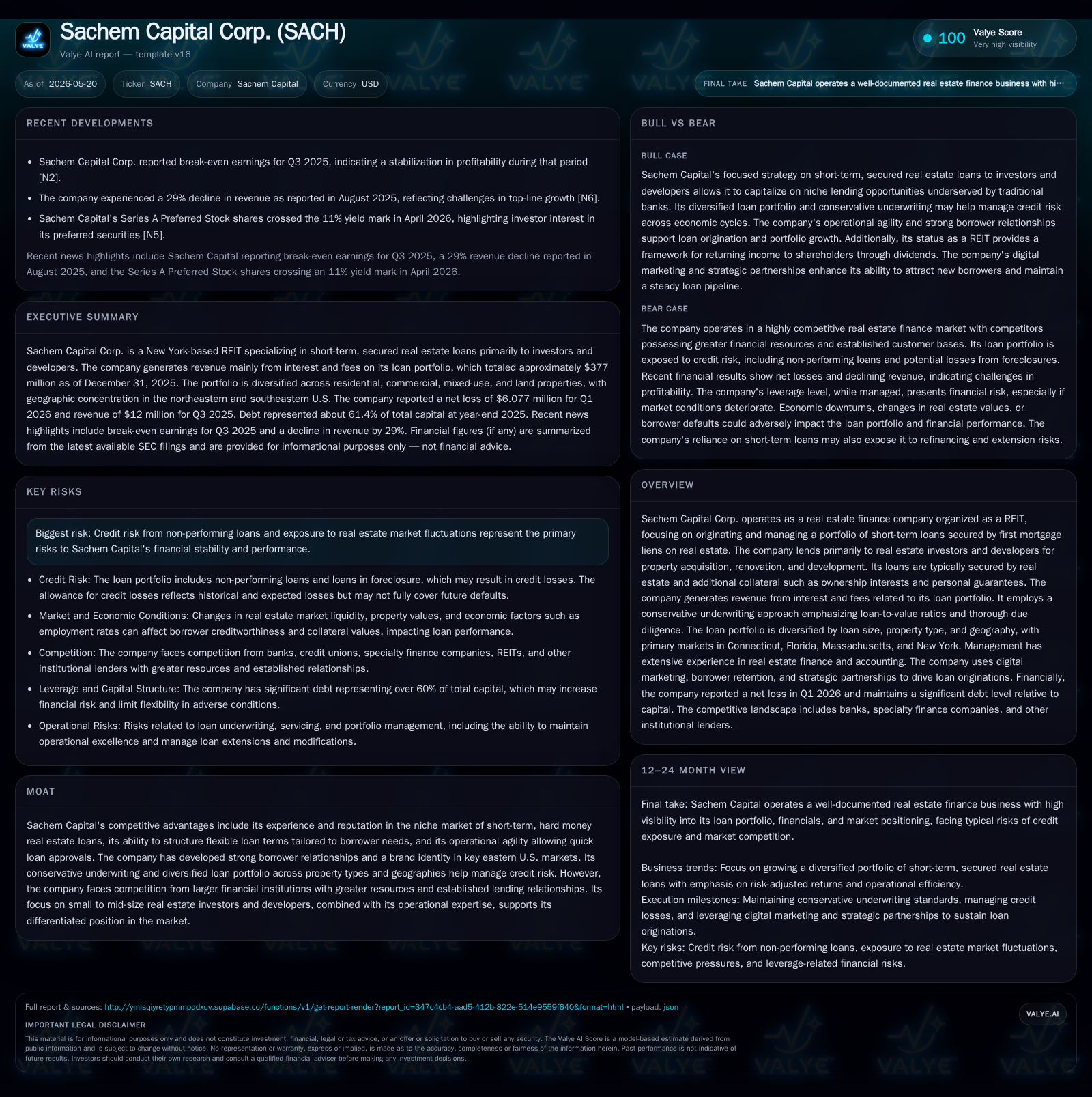
Sachem Capital Corp. reported a net loss in the first quarter of 2026 driven by increased credit loss provisions despite steady loan portfolio size and cash balances. The company continues its core business of short-term, hard money loan origination targeting real estate investors primarily in the Northeast and Southeast. Operationally, Sachem faces pressures from elevated credit risk and maturity of secured notes later this year, requiring attention to refinancing plans. Competitive differentiation stems from experienced underwriting and flexible structuring for smaller borrowers, but growth remains constrained by capital and credit market cycles.
Recent Operating Update
Sachem Capital Corp’s latest quarterly filing for Q1 2026 highlights a challenging operating environment marked by a net loss attributable to common shareholders primarily due to an elevated provision for credit losses. The company reported a provision for credit losses amounting to $5.37 million for the three months ended March 31, 2026, significantly higher than $1.05 million over the comparable period last year [S2]. This marks continued pressure on portfolio quality despite maintaining a robust loan portfolio valued at approximately $341 million as of the quarter end, down marginally from $364 million at end of 2025 but indicating stable ongoing origination volume [S2].
Liquidity remains adequate with cash and equivalents increasing slightly to $11.565 million as of March 31, 2026, providing a critical buffer given near-term debt maturities [F1][S2]. The company carries multiple tranches of unsecured notes totaling approximately $171 million scheduled to mature between December 2026 and September 2027, alongside a senior secured note issuance of $100 million maturing in mid-2030 backed by collateralized mortgage loans held by subsidiary entities [S5][S12]. Refinancing risk related to these upcoming maturities is a key consideration.
Operationally, Sachem has extended its revolving credit facility maturity with Needham Bank until March 2028 with an option for one more year extension under certain conditions, supporting near-term funding flexibility in response to external market strain on real estate financing channels [S19]
Business Model
Sachem operates as a specialized real estate finance company structured as a REIT, focusing on originating, underwriting, funding, servicing, and managing short-term mortgage loans with terms typically ranging from one to three years [S1]. These loans are secured primarily by first mortgage liens on residential or commercial properties owned or controlled by real estate investors or developers requiring capital for acquisition, renovation, or development projects.
Revenue generation stems from interest income accrued on loan portfolios alongside fees related to loan origination, modifications, servicing, extensions, and other administrative activities [S1]. Borrowers finance these fees directly alongside interest payments under terms customized per deal specifics—a feature that provides Sachem operational agility relative to traditional banking competitors that rely on more standardized offerings
A hallmark of their underwriting approach is conservative risk management emphasizing low loan-to-value (LTV) ratios verified through rigorous property appraisals and collateral valuations. Additional protections often come via secondary collateral such as ownership interest pledges or personal guarantees from principals behind borrowing entities.
The firm’s streamlined operational structure runs as a single segment leveraging extensive management expertise in real estate finance and accounting disciplines geared towards optimizing asset quality while selectively growing lending volume in targeted geographic areas concentrated mainly across Connecticut, New York, Florida and Massachusetts [S1]
Industry Structure and Competitive Position
Real estate finance is highly competitive with established players including regional/local banks, savings institutions, credit unions alongside specialty finance firms such as Sachem Capital. Larger financial institutions enjoy scale advantages but may lack the tailored service agility or regional niche penetration that smaller lenders like Sachem leverage.
The market segment Sachem occupies—short-duration hard money loans—caters particularly to smaller-scale developers or investors who need quick funding solutions often outside traditional bank parameters focusing on speed, flexibility of terms tied closely to project timelines or rehabilitation cycles.
Within this niche, Sachem’s competitive moat rests on reputational capital built through consistent underwriting discipline capable of adjusting quickly to borrower-specific risk profiles; its ability to structure loans that fit various types of residential/commercial developing activities; a strong borrower referral network; and an operational cadence optimized for rapid approval turnaround relative to bank cycles [S1]. Such factors generate repeat business dominance among existing borrowers facilitating stable originations without dependency on high-volume transactional churn.
Challenges against this position stem largely from cyclical fluctuations in regional real estate markets which may impact demand elasticity or raise default risk as well as competition from institutional investors increasingly seeking yield opportunities nearer this segment especially when primary markets show signs of growth moderation or stress.
Growth Drivers
Key growth vectors involve expanding loan portfolio size by leveraging existing capital alongside available debt capacity while maintaining disciplined credit quality controls. Effective use of their relatively flexible revolving credit facility supports incremental origination scale without sacrificing underwriting standards.
Geographic focus on high-demand eastern U.S. states where real estate activity remains strong enhances prospects assuming continuity in favorable market fundamentals driving acquisition/development financing needs.
Maintaining strong borrower relationships ensures reliable sourcing through referrals reducing cost of customer acquisition compared to public market financings.
Operational excellence initiatives aimed at cost efficiency via technology adoption (e.g., digital platforms for loan processing) further underpin margins potentially enhancing risk-adjusted returns.
Risks / Watchpoints / Growth Constraints
Credit risk remains paramount given the exposure to non-performing loans arising from sudden economic downturns impacting regional property values or borrower cash flow profiles leading to elevated loss provisions as seen in Q1 trends [S2]. This cyclicality necessitates monitoring impairment trends closely.
Upcoming large-scale debt maturities within the unsecured note portfolio pose refinancing risks especially if capital markets tighten or if earnings volatility constrains borrowing capacity under covenants including the required minimum asset coverage ratio (150%) which is actively monitored per existing agreements [S5][S15]. Failure to comply could hinder future lending operations or dividend distributions.
Dividend payment reductions starting in recent years reflect cautious retention policy aligned with earnings variability but could affect investor sentiment over time if sustained or deepened given REIT status obligations requiring most taxable income payout [S1]
Competitive pressures from larger financial institutions able to offer lower pricing or broader product suites may limit rate-setting leverage particularly when market liquidity improves making alternative funding sources attractive for borrowers.
Regulatory constraints primarily stem from maintaining REIT compliance while managing leverage levels prudently without compromising long-term financial stability.
What To Watch Next
- Monitoring Q2/Q3 loan portfolio performance especially delinquency rates and credit loss measures will provide insight into whether recent provisioning represents temporary spikes or structural shifts.
- Updates on refinancing strategy for substantial unsecured note maturities due end-2026 through late 2027 will elucidate liquidity positioning under volatile capital markets conditions.
- Dividend policy announcements post-Q1 results can signal management’s outlook toward cash flow stability.
- Backlog reports or origination pipeline commentary reflecting borrower appetite amid evolving economic forecasts will be informative regarding near-term growth trajectory.
- Compliance updates concerning debt covenant thresholds particularly asset coverage ratios under multiple credit agreements offer critical early warning indicators.
Financial Profile Summary
As of March 31, 2026, Sachem held cash balances totaling approximately $11.6 million providing essential liquidity headroom amidst operational challenges [F1][S2]. The loan portfolio carried at approximately $341 million represents the firm's core earning asset base although slight contraction since December 2025 indicates some payoff activity outpacing new originations during Q1 [F1][S2].
Credit provisions spiked sharply in Q1 with $5.37 million charged against earnings juxtaposed against only modest improvement in underlying asset quality indicators compared to prior periods suggesting heightened scrutiny necessary going forward [S2]
Debt obligations remain extensive with notable unsecured subordinated notes comprising over $170 million due within roughly eighteen months presenting refinancing tasks critical for sustaining ongoing lending capacity without covenant breaches [S5][S12]. Senior secured notes issued by subsidiaries backed by dedicated collateral provide longer maturity runway albeit restricted assets which cannot support parent operations directly.
Overall earnings reflect these headwinds culminating in reported net loss during the quarter contrasting with profitability restored during full year 2025 period after recovery from prior losses [F1][S2][S1]. Dividend distributions have been moderated while still respecting REIT tax status requirements consistent with preserving operational flexibility amid uncertain economic backdrop.
This analysis is based on publicly filed SEC documents as of May 20, 2026. It is intended solely for informational purposes without offering investment advice or research views regarding securities of Sachem Capital Corp.
Disclaimer: This is research-only, informational analysis and not investment advice. It may include AI-generated interpretation and general industry context. Always verify important details using primary sources.

Comments