
StandardAero’s Exclusive OEM Licenses and Indebtedness Shape Growth and Operational Flexibility
StandardAero leverages strong OEM authorizations and long-term customer contracts to drive growth while managing elevated leverage and regulatory risks.
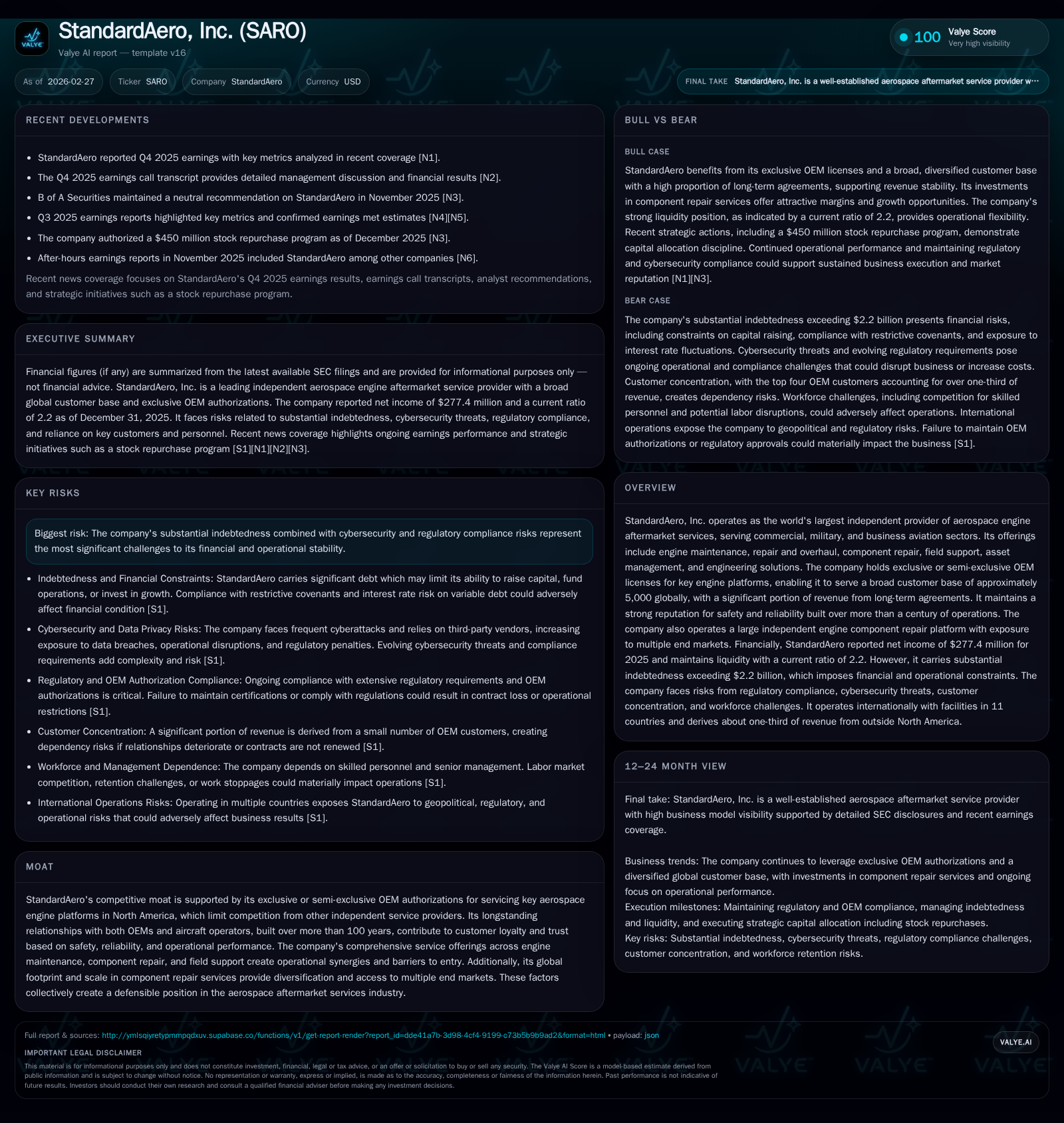
StandardAero, the world’s largest independent aerospace engine aftermarket services provider, has demonstrated significant earnings growth driven by its exclusive and semi-exclusive OEM licenses for key engine platforms and a broad, loyal customer base underpinned by long-term agreements. The company's 2025 performance reflects a sharp rebound in net income and operating cash flows alongside ongoing investments in component repair services. However, its substantial indebtedness imposes constraints on financial flexibility, posing risks especially amid volatile credit markets. Regulatory compliance, cybersecurity, and geopolitical factors remain critical areas of attention.
Historical Performance and Growth Drivers
StandardAero reported robust financial results for the fiscal year ended December 31, 2025, showcasing a pronounced improvement versus 2024. Operating income increased to $551 million from $403 million in the prior year, translating into a 36.7% year-over-year growth [F1]. Net income exhibited an extraordinary increase from approximately $11 million to $277 million in 2025 — a 2427.9% jump reflecting operational leverage and likely margin expansion [F1]. Operating cash flow also surged to $317 million, more than tripling the previous year's $76 million [F1]. These improvements were achieved with reduced capital expenditures of $82 million compared to $103 million in 2024 as the company optimized investment spending [F1].
The company's balance sheet remains sound with a current ratio of 2.2, exhibiting strong liquidity supported by current assets of nearly $2.9 billion against current liabilities of $1.3 billion [F1]. Equity increased correspondingly to $2.67 billion by year-end 2025 [F1], generating an approximate return on equity of 10.4% based on reported net income [F1].
These financial gains reflect StandardAero's strategy focused on its pure-play aerospace engine aftermarket services segment across commercial, military, and business aviation customers worldwide [S1][S23]. Core drivers include its exclusive or semi-exclusive authorizations from OEMs such as Rolls-Royce and Honeywell for servicing high-profile engine platforms like RB211-535 and HTF7000 engines [S23]. Such licenses are critical competitive moats limiting peer access to specialized service contracts within North America.
Furthermore, about 80% of the company’s revenue comes from long-term agreements with a loyal customer base of approximately 5,000 operators globally [S4]. Repeat customers dominate remaining transactional revenues, underscoring client retention through reputational strength built over a century in aerospace aftermarket services [S23]. However, revenue concentration remains notable with four major OEM customers accounting for roughly 36% of total sales in 2025 [S4].
In addition to engine maintenance and overhaul operations, StandardAero has progressively expanded its independent component repair services platform servicing diverse end markets including land, marine, oil & gas as well as aerospace [S23]. This segment offers attractive margins and operational synergies.
Historical performance (annual)
| FY | Net ($mm) | CFO ($mm) | OpInc ($mm) | Capex ($mm) | Net YoY |
|---|---|---|---|---|---|
| 2025 | 277 | 317 | 551 | 82 | +2427.9% |
| 2024 | 11 | 76 | 403 | 103 |
Source: SEC companyfacts cache [F1].
Capital returns and efficiency (annual)
| FY | FCF ($mm) | ROE% |
|---|---|---|
| 2025 | 234 | 10.4 |
| 2024 | -27 | 0.5 |
Source: SEC companyfacts cache [F1].
Note: Revenue figures absent from available data; analysis based on profitability and cash flow metrics.
Future Growth Prospects
StandardAero's prospects hinge on several interlocking factors:
OEM License Renewal: Continuation or expansion of exclusive/semi-exclusive authorizations is pivotal. The company has historically succeeded in renewing such licenses but these are subject to OEM discretion conditional on regulatory compliance and performance standards [S23]. Loss or reduction would erode competitive positioning.
Long-Term Contracts: The predominance of long-term agreements with customers fosters revenue stability but could limit rapid revenue expansion unless new contracts or markets materialize [S4].
Component Repair Platform Expansion: Investments targeting the broader independent component repair market offer margin enhancement potential along with cross-selling synergies with core engine services [S23]. Scaling this segment effectively could diversify revenue bases beyond aerospace end markets.
Geographic Expansion: Approximately one-third of revenue currently originates outside North America; international growth faces regulatory complexity but could provide incremental opportunities [S20][S26]. Managing foreign exchange risk remains important.
Technological Transition Risks: Industry-wide shifts toward sustainable aviation technologies such as hybrid-electric or hydrogen propulsion present both challenges in servicing legacy fleets and opportunities if StandardAero can position itself early in emerging technology maintenance ecosystems [S27].
However, growth caps arise primarily from:
- Market Concentration Risk: Heavy reliance on few OEM relationships limits diversification.
- Regulatory Compliance Burden: Expanding or new market entry requires navigating complex certifications (FAA, EASA), export controls (ITAR), evolving environmental standards, and cybersecurity mandates that may restrict speed or scale of expansion [S15][S16][S19][S21].
- Debt Constraints: High indebtedness could limit capital availability for acquisitions or capex necessary for future growth initiatives (see "Returns/Capital Allocation" section).
Forecasts & Milestones to Watch
While explicit forward guidance is not disclosed in filings or recent transcripts [N2], key indicators include:
- Renewal status of major OEM authorizations by year-end milestones.
- Expansion pace in Component Repair Services measured by capacity utilization or facility additions reported in quarterly updates.
- Progress on regulatory certifications for novel technologies or geographic jurisdictions.
- Management commentary regarding leverage reduction targets or capital allocation changes announced alongside earnings releases [N1][N3].
Returns & Capital Allocation
StandardAero’s significant earnings improvement translated into healthy free cash flow generation estimated at approximately $234 million for FY2025 (operating cash flow minus capex) [F1]. This marks a substantial increase relative to priors years’ levels reflecting operational efficiency gains.
The company's approximate return on equity of 10.4% for FY2025 signals solid value creation given its asset base though detailed breakdowns are unavailable for other return measures like ROIC [F1].
However, leverage remains elevated with total debt around $2.25 billion dominated by the New Credit Agreement facilities bearing variable interest rates subject to rising rate risk — each one-percentage-point shift translates into roughly $30 million annual interest expense fluctuation if fully drawn [S18][S22]. Covenants under credit agreements impose constraints on incurring further debt, asset sales, dividend payments, mergers or acquisitions which restrict financial flexibility notably during downturns or strategic pivots [S7][S8][S10][S22][S25][S28].
Liquidity appears robust on paper given current ratio >2 but servicing high fixed charges amid uncertain demand environment warns caution. Shareholders should monitor:
- Compliance status with credit agreement covenants.
- Discretionary capital allocation decisions balancing debt reduction versus shareholder returns.
- Potential for opportunistic buybacks or dividends within covenant allowances.
- Impact of macroeconomic factors like inflation and interest rate trends on cost structure [S18][S25].
Risk Factors Summary
Aside from leverage risks spelled above, StandardAero faces considerable exposure related to:
- Cybersecurity incidents affecting proprietary data or operational continuity prompting reputational damage or penalties as evolving AI-driven cyber threats grow sophisticated [S1][S26][S28][S29].
- Complex regulatory frameworks ranging from export controls (ITAR/EAR) restricting product/service flows internationally to U.S./foreign aviation safety certification mandates; failure may jeopardize licenses crucial for business continuity especially given stringent FAA/EASA audits and government contracting rules applicable particularly to military clientele [S6][S14][S15][S16][S19][S20][S24]
- Environmental regulations tightening greenhouse gas emission standards pressuring service offerings tied to carbon-heavy legacy aerospace technologies; mandates may require costly adaptations or create stranded assets risk if transitions lag industry innovations around sustainable fuels/electric propulsion [S27]
- Legal proceedings customary for the sector involving product liability claims related to aircraft engine failures possibly impacting financial reserves and attracting adverse publicity with uncertain outcomes over time frames stretching years [S24]
- Geopolitical risks including sanctions regimes affecting international parts supply chains and customer demand patterns compounded by inflationary pressures altering input costs globally particularly energy-intensive repairs/overhaul activities [S20][S26]
- Management control concentrated significantly with Carlyle owning circa one-third voting power potentially influencing strategic direction divergently from minority shareholders' interests alongside ongoing advisory fee arrangements adding complexity to governance perceptions [S11]
Conclusion
StandardAero’s leadership in aerospace engine aftermarket services is underpinned by critical OEM alliance exclusivity across major platforms combined with long-standing customer contracts that anchor steady revenues. Its ability to capitalize on rising aftermarket needs from expanding global aviation fleets positions it well amid growing maintenance demand cycles post-pandemic travel recovery phases.
Nevertheless, the company operates within a highly regulated environment laden with operational complexities including heightened cybersecurity threats and extensive compliance obligations internationally. The capital structure characterized by elevated indebtedness introduces material constraints on financial agility amidst macroeconomic uncertainties such as interest rate volatility.
Monitoring renewal cycles of key OEM contracts, execution progress on component repair expansions, readiness for emerging technology servicing demands alongside careful management of leverage-related covenant triggers will be essential barometers going forward.
Disclaimer: This analysis is for informational purposes only based on publicly available filings and news as of February 27, 2026. It does not constitute investment advice or recommendations.
Disclaimer: This is research-only, informational analysis and not investment advice. It may include AI-generated interpretation and general industry context. Always verify important details using primary sources.

Comments