
Sally Beauty Holdings: Owned Brands, Omni-Channel Execution, and the Next Phase of Beauty Retail Evolution
Sally Beauty’s integrated retail and distribution model, strong owned brand mix, and digital investments underpin ongoing profitability—but execution on store refreshes and digital transformation will determine whether the company can expand its relevance and margin profile in a shifting, highly competitive beauty landscape.
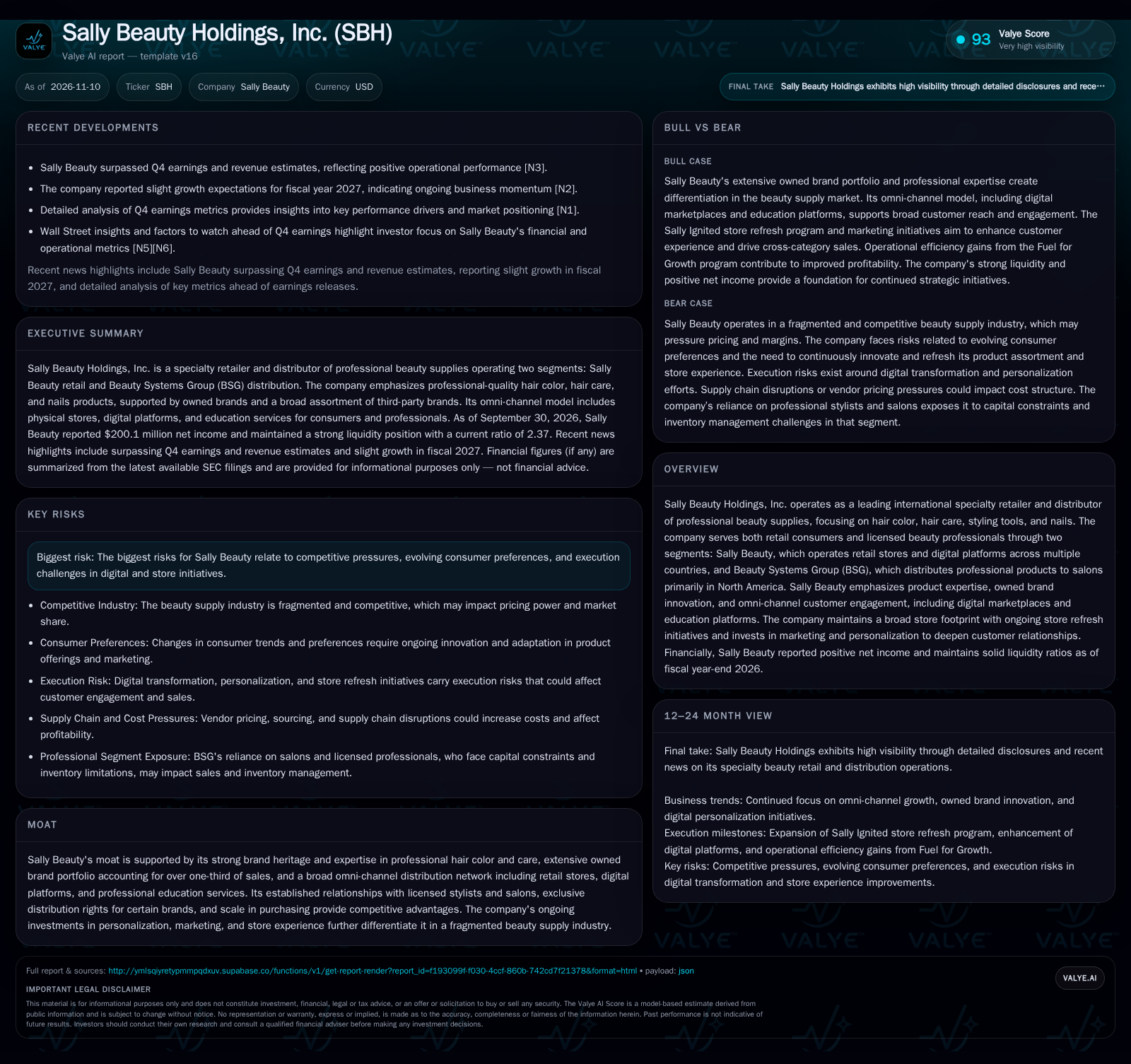
Sally Beauty Holdings remains profitable and operationally stable, with net income of $200.1 million in fiscal 2026 and a current ratio of 2.37. Growth initiatives center on owned brand expansion, omni-channel engagement, and digital platform upgrades, while store refreshes and operational efficiencies continue. The challenge: sustaining differentiation and margin in a fragmented, fast-evolving market where consumer preferences and digital experiences are critical levers. Slight growth is expected for fiscal 2027, but competitive intensity and execution risks remain high. [S1] [N2] [N3]
Sally Beauty Holdings, a major international specialty retailer and distributor of professional beauty supplies, is navigating a dynamic market with a sharpened focus on owned brand growth, digital transformation, and operational efficiency. With over 4,300 stores, strong professional relationships, and a significant digital presence, Sally Beauty leverages its heritage in hair color and care to serve both consumers and licensed professionals. Recent earnings outperformance, ongoing store refreshes, and digital investments signal operational momentum, but the company faces intensifying competition, evolving consumer expectations, and execution risks as it seeks to sustain growth and margin expansion into fiscal 2027. [S1] [N2] [N3]
Recent Results and Strategic Moves Shape the Path Forward
Sally Beauty Holdings reported net income of $200.1 million for fiscal 2026, with basic EPS of $2.09 and diluted EPS of $2.02, reflecting operational efficiency gains and positive momentum. The company ended the year with $158.2 million in cash and equivalents, a current ratio of 2.37, and a broad asset base relative to liabilities. Owned brands made up approximately 36% of Sally Beauty segment sales, highlighting a strategic push to enhance margin and differentiation. Digital initiatives—including AI-driven product search, mobile app enhancements, and expanded marketplace presence—are underway to modernize customer engagement and drive omni-channel growth. Management expects slight growth for fiscal 2027, suggesting cautious optimism amid ongoing investments and market challenges. [S1] [N2] [N3]
Monetizing Expertise and Scale in a Diverse Beauty Market
Sally Beauty’s revenue model is anchored in the sale and distribution of professional-grade beauty products through two segments: Sally Beauty (omni-channel retail) and Beauty Systems Group (distribution to salons and professionals). The company benefits from a mix of owned and third-party brands, with owned brands supporting gross margin through higher direct sourcing and brand control. Hair color and hair care, which together exceed 70% of consolidated sales, remain high-frequency, high-loyalty categories that underpin recurring visits and basket size.
The omni-channel structure—encompassing physical stores, digital platforms, and mobile apps—enables both cross-selling and data-driven personalization, which could improve conversion rates and customer lifetime value if effectively executed. The addition of AI-enabled product discovery and digital marketplaces may expand reach and reduce dependency on in-store traffic, though the economics of third-party platforms (e.g., Amazon, TikTok) may dilute margin relative to direct channels.
Operational leverage is enhanced through the Fuel for Growth program, which has delivered cost savings in sourcing and logistics. Store refreshes (Sally Ignited) and digital investments are capital-intensive but are intended to drive higher productivity per location and improved customer experience. The company’s scale allows for some purchasing advantages, but ongoing inventory management and supply chain complexity add to working capital needs. The professional segment (BSG) is more exposed to business-cycle effects, as salon spending can be volatile in downturns or when professionals face capital constraints.
Leveraging Brand Legacy, Private Labels, and Digital Channels to Counter Retail Pressures
Sally Beauty’s competitive positioning relies on its long-standing reputation in professional hair color, breadth of assortment, and dual-channel access to both consumers and licensed professionals. The company’s extensive store network and digital presence provide physical and virtual touchpoints that many pure-play e-commerce competitors lack. Owned brands, now representing over a third of segment sales, offer margin protection and differentiation from mass and specialty retail competitors.
The beauty supply market remains highly fragmented, with competition from specialty retailers, mass-market chains, e-commerce platforms, and direct-to-consumer brands. Key counterforces include aggressive pricing, rapid new product cycles, and the encroachment of digital-native competitors who may outpace Sally’s innovation velocity online. While Sally’s professional focus and education platforms (e.g., Cosmo Prof Institute) create switching frictions for stylists and salons, these relationships are not contractually locked in and are vulnerable to shifts in brand preference or platform usability.
The rise of influencer-driven brands and the growing importance of digital discovery platforms mean that Sally’s investments in experiential marketing and digital personalization are necessary but not guaranteed to yield defensible advantages. Exclusive distribution rights for certain brands and the company’s purchasing scale are strengths, but they require continuous reinvestment to avoid commoditization.
Potential for Market Share Growth Through Digital Customization and Store Updates
The most favorable scenario for Sally Beauty is one where investments in digital platforms, AI-enabled personalization, and store refreshes translate into sustained customer engagement, higher average transaction values, and improved retention across both consumer and professional segments. As owned brand penetration increases, gross margin could expand, especially if digital channels shift more sales away from lower-margin third-party platforms.
A reinforcing cycle of improved customer data, targeted marketing, and experiential in-store events (such as COLORfest) could drive traffic and loyalty, helping Sally to gain share from less differentiated competitors. If the Sally Ignited program delivers measurable increases in same-store sales and productivity, and digital initiatives yield higher conversion rates, these would be confirming evidence of a successful transformation.
Falsification would occur if digital investments fail to move the needle on engagement or if store refreshes do not generate incremental sales sufficient to justify capital outlays. Stagnant or declining owned brand mix, or a lack of improvement in gross and operating margin, would also undermine the upside case.
Maintaining Profitability Through Incremental Changes Rather Than Radical Shifts
The most plausible near-term outcome is that Sally Beauty maintains moderate growth and stable profitability, supported by incremental gains in digital engagement, ongoing owned brand expansion, and operational efficiency improvements. The company’s scale and omni-channel presence allow it to retain a loyal core of consumers and professionals, while investments in personalization and store experience help offset some competitive pressures.
Management’s expectation of slight growth in fiscal 2027 suggests that the company is not projecting dramatic acceleration, but rather a steady hand on execution. Continued cost discipline from the Fuel for Growth program and measured capital allocation to digital and store upgrades may support margin preservation.
Confirmation of this scenario would include stable or modestly increasing sales, consistent profitability, and gradual improvements in customer retention and basket size. Falsification would be evident in persistent traffic declines, margin compression, or execution missteps in digital rollout or store refreshes.
Risks from Execution Challenges and Intensifying Competition
The bear case for Sally Beauty centers on the risk that digital transformation and store refresh initiatives are insufficiently differentiated or poorly executed, resulting in sluggish customer growth, lost share to digital natives, and erosion of margin. If investments in AI, personalization, and omni-channel marketing fail to drive engagement, or if the company’s product assortment and experiential events do not resonate with evolving consumer tastes, revenue could stagnate or decline.
The professional segment faces particular vulnerability: if salons and stylists pull back on spending due to macroeconomic pressures or switch to alternative distributors, BSG sales could face additional headwinds. Supply chain disruptions or vendor pricing increases could further pressure margins, especially if Sally is unable to pass through costs or accelerate owned brand growth.
Downside confirmation would come from declining sales, shrinking owned brand mix, margin deterioration, and underperformance relative to peers in digital growth or customer engagement. Missed milestones in the Sally Ignited program or negative trends in customer or stylist retention would also signal that adaptation is lagging market change.
Factors Influencing Sally Beauty’s Ability to Maintain Differentiation and Profit Margins
Growth in owned brand sales mix as a percentage of total revenue, tracking whether the company can continue to expand higher-margin proprietary labels.
Trends in same-store sales (if disclosed), especially for locations refreshed under the Sally Ignited program, as a direct measure of in-store productivity uplift.
Engagement and conversion metrics on digital platforms, including website, app, and third-party marketplaces—especially following AI and personalization investments.
Customer retention rates and loyalty program participation levels, which will indicate whether omni-channel and personalization strategies are deepening relationships.
Gross and operating margin trends, to test whether operational efficiencies and mix shift toward owned brands are materializing in improved profitability.
Professional segment (BSG) sales growth and stylist retention, as proxies for Sally’s continued relevance in the salon channel.
Inventory turnover and working capital management, particularly in the context of supply chain complexity and evolving product assortment.
Impact of experiential marketing events and influencer partnerships on traffic and customer acquisition—if disclosed, metrics such as event-driven sales lift or new customer sign-ups would provide insight.
Disclaimer: This is research-only, informational analysis and not investment advice. It may include AI-generated interpretation and general industry context. Always verify important details using primary sources.

Comments