
Shoe Carnival Strengthens Omnichannel Roots While Rebanner Strategy Tests Margins
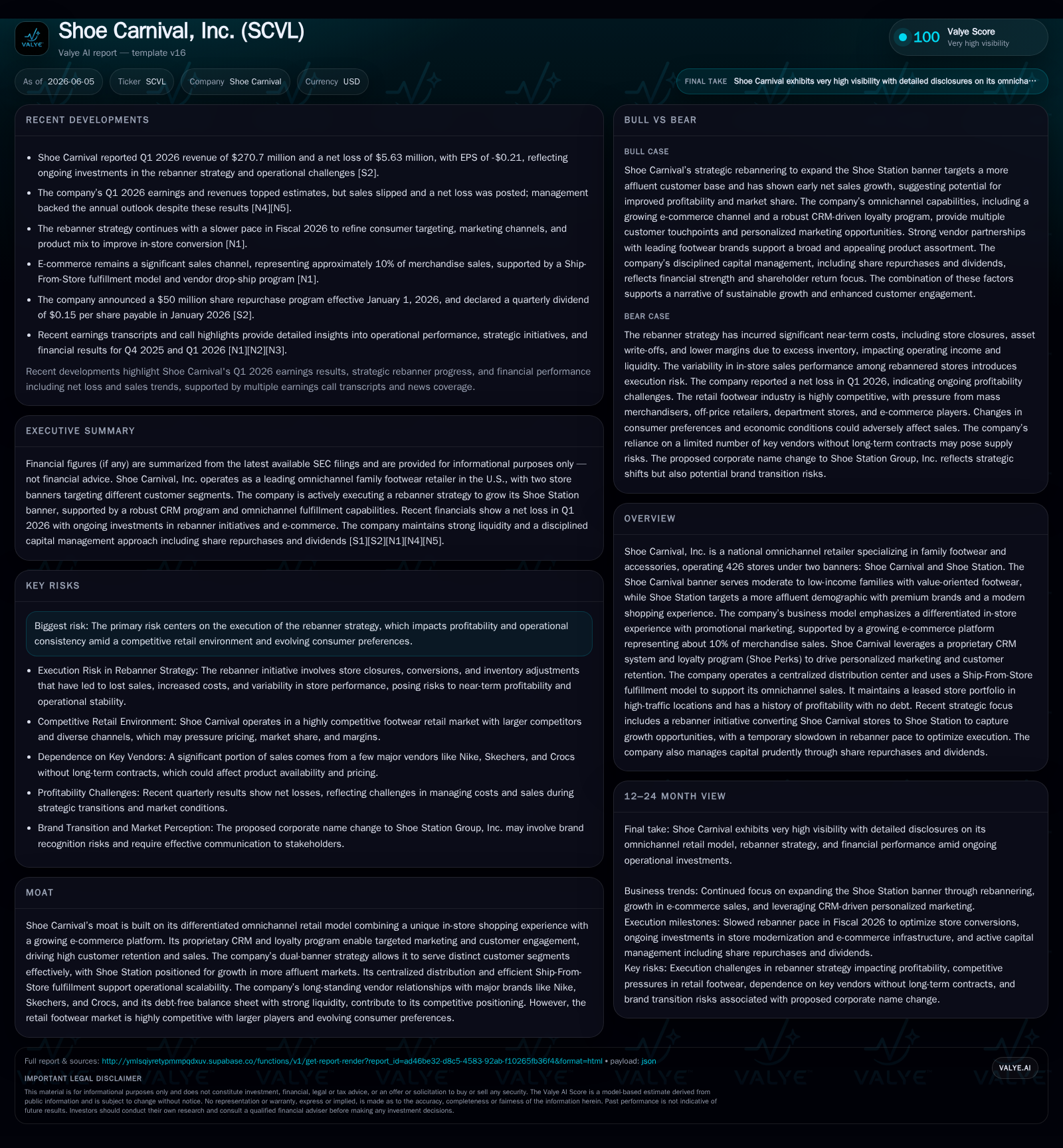
Shoe Carnival's Q1 2026 results reveal omnichannel progress tempered by rebanner-related margin pressures amid competitive footwear retail dynamics.
In its latest quarter ending May 2026, Shoe Carnival reported operating tensions driven primarily by the ongoing rollout of its Shoe Station rebanner strategy, which weighed on near-term profitability through increased costs and store disruptions. Meanwhile, the company’s omnichannel platform, including Ship-From-Store fulfillment and its proprietary CRM loyalty program, showed resilience, supporting approximately 10% e-commerce sales penetration. The dual-banner approach positions Shoe Carnival to address distinct demographic segments: value-focused families under Shoe Carnival and a more premium clientele via Shoe Station. Growth drivers hinge on successful rebanner execution, e-commerce scale-up, and CRM enhancements, while risks revolve around margin compression and consumer shifts in a highly promotional footwear market. Financially, the company maintains a strong liquidity profile with no debt, providing a buffer for strategic investments.
Latest Quarterly Update Highlights Operational Tensions
Shoe Carnival's Q1 2026 filing dated June 5 reveals a clear tension between the company's ongoing investment in its rebanner strategy and the steady progress of its omnichannel operations [S2], [S3]. The rebanner rollout, particularly transitioning stores to the Shoe Station banner aimed at higher-income consumers, exerted downward pressure on operating income due to costs associated with temporary store closures during renovations, asset write-offs, additional depreciation on construction costs, customer acquisition expenses, and necessary markdowns to clear excess inventory incurred from the transition [S15]. These operational impacts contributed to a Q1 net loss with sales slipping relative to expectations as noted in recent earnings commentary [N8].
Conversely, the company's omnichannel infrastructure continued expanding its footprint with e-commerce maintaining roughly a 10% share of merchandise sales while benefiting from enhanced fulfillment capabilities using their Ship-From-Store model that leverages existing store inventories to fulfill online demand efficiently [S1], [S23]. This combination underscores that while near-term profitability is challenged by execution demands of physical store format changes, the underlying business model’s platform elements are strengthening.
Dual-Banner Business Model Captures Distinct Customer Segments
Central to Shoe Carnival’s strategy is operating 426 stores across two distinct banners: the original Shoe Carnival stores targeting primarily moderate-to-low income families seeking value-oriented footwear through fun, promotional in-store experiences; and Shoe Station locations aimed at more affluent consumers desiring premium brands and a modernized shopping environment [S1]. This segmentation enables tailored merchandising strategies—product assortments under Shoe Station include higher-end brands such as Nike and Birkenstock with curated selections aligned to elevated customer expectations—while Shoe Carnival emphasizes competitive pricing complemented by energetic marketing campaigns designed to drive foot traffic [S23].
This dual approach introduces complexity in managing distinct price points, marketing channels, inventory mixes, and customer acquisition tactics but potentially enhances resilience by addressing multiple consumer cohorts – a notable differentiation compared with peers focused solely on mass or off-price segments.
Omnichannel Fulfillment and CRM Loyalty as Strategic Assets
A core strategic strength lies in Shoe Carnival’s omnichannel fulfillment supported by their Evansville centralized distribution center coupled with an advanced third-party hosted order management system tailored to complex omnichannel needs [S1]. Their Ship-From-Store program optimizes inventory utilization by fulfilling online orders directly from physical store stock rather than relying entirely on distribution center shipments. This reduces out-of-stock scenarios online while improving speed-to-customer during non-peak periods.
Additionally, the company's proprietary CRM platform integrates customer shopping behavior insights across channels. The "Shoe Perks" loyalty program leverages this data to deliver targeted segmented marketing messages via both owned and paid media channels [S23], thereby lowering customer acquisition cost while boosting retention. Such granular customer profiling also informs merchandise mix adjustments at individual stores enhancing conversion rates—a critical lever given the varying demographics served across banners.
Competitive Landscape and Positioning Amid Promotional Pressure
The US footwear retail sector is highly fragmented and intensely competitive. Shoe Carnival faces competition from mass merchandisers (offering aggressive prices), off-price retailers (focusing on branded discounts), department stores, traditional specialty shoe stores, sporting goods outlets, as well as pure e-commerce companies [S5].
Promotional intensity is a key battleground. While promotional marketing drives traffic into Shoe Carnival’s stores—reflecting their differentiated fun shopping environment—it simultaneously compresses gross margins compared to peers who may enforce stricter full-price selling discipline or operate heavier direct-to-consumer models. Maintaining balance between promotional volume gains and margin protection requires nimble inventory management supported by their POS-driven analytics systems.
Growth Catalysts: Rebanners, E-commerce Expansion and Loyalty Programs
Looking forward, growth heavily depends on successfully scaling up the Shoe Station rebanner program as the primary avenue for expanding reach into higher-income geographies where premium footwear demand is stronger [S15]. However, prudent pacing has been adopted after mixed initial results—with approximately 21 stores slated for rebanner in H1 Fiscal 2026—as management seeks better clarity on customer response patterns before accelerating rollout
Parallel expansion of e-commerce remains vital; although it currently constitutes about 10% of total merchandise sales—a modest share relative to some specialty apparel peers—the company’s investment in scalable order management systems should enable further penetration without proportionate increases in fulfillment cost [S1], [F1]. Enhancements in CRM sophistication through tighter data integration aim to extend customer lifetime value while reinforcing Shoe Perks engagement.
Risks and Execution Challenges Around Rebanner Strategy
The rebanner execution carries notable operational risk. The upfront capital investment (estimated $5–7 million in Fiscal 2026 following $37 million in Fiscal 2025), coupled with decreased near-term margins due to markdowns on legacy inventory plus disruption-related sales losses during store construction phases impairs short-term profitability [S15]. There is also risk of brand dilution or alienation if product offerings under Shoe Station do not resonate sufficiently or cannibalize existing store economics under the original banner.
Moreover, evolving consumer preferences increasingly favor digital-first shopping experiences—which warrants continual adaptation of both physical store design and digital channel capabilities. Failure to anticipate or respond quickly enough could erode market share amid more agile competitors.
Next Steps and Key Milestones to Monitor
Upcoming quarterly earnings reports will be critical indicators of progress post-rebanner rollouts through comparable same-store sales analysis specifically monitoring recovery or improvement momentum following earlier disruption periods [N3], [S2]. Key milestones will include pace and success of further conversions within other markets identified as favorable for premium banner expansion as well as measured increases in e-commerce penetration beyond current levels.
Additional focus will fall on margin stabilization efforts through improved inventory management leveraging real-time POS insights coupled with refined promotional strategies aimed at balancing traffic generation without excessive discounting.
Brief Financial Context Supporting Operational Trends
As of May 2026 quarter-end, Shoe Carnival carried no long-term debt retaining a cash balance north of $116 million combined with current assets over $570 million against current liabilities near $142 million — yielding a robust current ratio near 4.0 that supports ongoing strategic investments without leverage risk [F1], [S2]. Revenue for fiscal year ended January 31, 2026 stood at approximately $1.135 billion with operating income at about $66.8 million prior periods affected by earlier rebanner costs though near-term Q1 results reflect margin contraction tied specifically to rebannering activity [F1]. This strong financial footing provides flexibility amid operational challenges stemming from transformation initiatives.
This analysis is based exclusively on disclosed SEC filings and reported operating data; it does not constitute investment advice or research views regarding SHOE CARNIVAL INC securities.
Disclaimer: This is research-only, informational analysis and not investment advice. It may include AI-generated interpretation and general industry context. Always verify important details using primary sources.

Comments