
Sharing Economy International: Early-Stage Platform Ambition Confronts Severe Liquidity and Execution Risks
Despite a proprietary rental marketplace and sustainability positioning, Sharing Economy International Inc. faces acute financial strain, no current revenue, and major execution hurdles as it seeks to establish ECrent.com in the competitive global sharing economy.
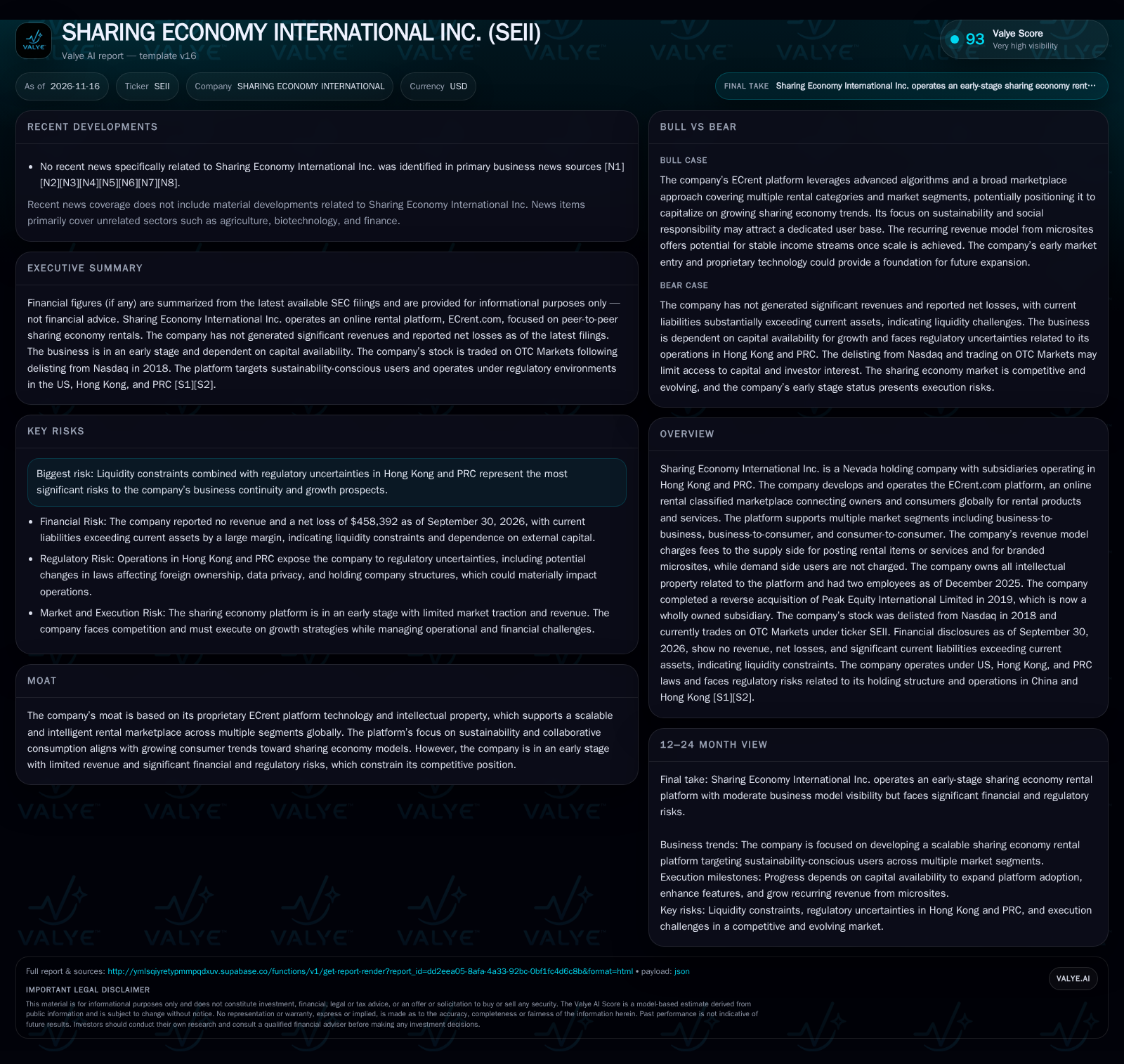
Sharing Economy International Inc. operates ECrent.com, a proprietary online rental marketplace targeting global peer-to-peer, B2B, and B2C rentals. The business remains in an early stage, reliant on outside capital, and exposed to regulatory risk in Hong Kong and the PRC [S1] [S2].
Sharing Economy International Inc. is attempting to carve out a niche in the global sharing economy through its proprietary ECrent.com rental platform, targeting both consumer and business segments with a supply-side fee model. However, as of Q3 2026, the company faces acute financial distress, with no revenue, substantial net losses, and a severe liquidity shortfall. The business remains in a pre-scale phase, highly dependent on new capital, and exposed to both execution and regulatory risks in its key Asian markets [S1] [S2]. Whether its platform can achieve critical mass before financial constraints force a pivot or wind-down is an open question.
Liquidity Crisis and No Revenue Define Current Reality
As of September 30, 2026, Sharing Economy International Inc. reported no revenue from its ECrent.com rental platform, while incurring a net loss of $458,392. The company’s cash position stood at $198,829, with current assets totaling $1,037,302 against current liabilities of $11,320,185, yielding a current ratio of just 0.09. [S2] The company’s business remains in an early stage, with platform adoption and revenue generation yet to materialize meaningfully [S1] [S2].
Supply-Side Fee Model Faces Scale and Funding Hurdles
Sharing Economy International’s ECrent.com platform is designed to monetize by charging fees to the supply side—owners or businesses posting rental items or services, and for premium microsite storefronts—while offering free access to demand-side users [S1]. This model prioritizes frictionless adoption for renters, but places the burden of monetization on supply growth and willingness to pay for listings or branding. The platform’s economics are initially asset-light and scalable in theory, as digital marketplaces typically exhibit high fixed costs (platform development, marketing, compliance) with low variable costs per transaction.
However, without critical mass, the supply-side fee model risks low utilization and poor revenue visibility. In the early stage, significant investment in user acquisition, platform enhancement, and trust-building is typically necessary before positive operating leverage can be achieved. [S2] The platform’s focus on sustainability and collaborative consumption could appeal to certain user segments, but monetizing these values requires both scale and effective market positioning.
A critical challenge for the supply-side fee model lies in balancing the pricing structure to incentivize listings without deterring potential suppliers. If fees are set too high, early-stage suppliers may be reluctant to commit inventory, especially when alternative platforms may offer lower or no fees to attract supply. Conversely, fees that are too low may fail to generate sufficient revenue to cover platform costs and investment needs. This delicate pricing equilibrium is further complicated by the need to invest heavily in platform features that enhance supplier confidence, such as verification processes, insurance options, and dispute resolution mechanisms, all of which increase operational complexity and costs before scale is achieved.
Moreover, the platform’s reliance on supply-side monetization means that demand-side growth, while essential for network effects, does not directly translate into immediate revenue. This bifurcation requires the company to prioritize supplier acquisition and retention strategies, which may include offering promotional incentives or subsidized listings in the short term. Such tactics, while potentially effective in jump-starting supply growth, exacerbate cash burn and delay profitability. The sustainability of these subsidies depends heavily on continued external funding and the platform’s ability to convert early adopters into paying users once critical mass is reached.
Platform Differentiation Versus Entrenched Market Forces
The ECrent.com platform operates in a highly competitive sharing economy landscape, facing competition from both global digital rental marketplaces and localized sharing platforms. Major consumer-to-consumer and business-to-consumer players in the rental and sharing space often benefit from network effects, established user bases, and significant capital reserves.
Sharing Economy International’s proprietary technology and intellectual property offer some defensibility, particularly in supporting multi-segment (B2B, B2C, C2C) rentals and advanced matching algorithms [S1]. However, early-stage status and limited resources constrain the company’s ability to achieve critical platform liquidity—the point where enough supply and demand interact to create self-reinforcing network effects. Furthermore, regulatory risk in China and Hong Kong may limit operational flexibility or platform adoption in those key markets [S1]. Without significant capital infusion, the company is vulnerable to substitution by better-funded competitors and may struggle to retain or attract supply-side customers.
If Platform Achieves Network Effects, Monetization Could Accelerate
The most favorable outcome would see ECrent.com achieve sufficient scale in supply and demand, creating a positive feedback loop where more listings attract more renters, which in turn draws in more supply. If the company can secure external funding, invest in user acquisition, and demonstrate meaningful adoption in target markets, the asset-light platform model could yield strong incremental margins as fixed costs are leveraged over a growing transaction base.
Evidence for this scenario would include a sustained increase in active listings, user engagement metrics, and the first signs of recurring supply-side fee revenue. Third-party partnerships, integrations, or ecosystem alliances could further catalyze adoption, especially if the platform’s sustainability and collaborative consumption positioning resonates with a growing demographic of environmentally conscious users.
Continued Struggle for Traction Amid Financial Pressure
The most plausible path is that Sharing Economy International continues to operate with limited traction, struggling to generate meaningful revenue while burning cash at a rate that outpaces available resources. Platform adoption may grow incrementally, but without a step-change in capital availability or a viral user growth event, the business is likely to remain sub-scale.
Confirmation of this scenario would be ongoing net losses, continued absence of revenue, and further deterioration in liquidity metrics. Any small gains in listings or engagement would be insufficient to offset the company’s fixed cost base or to attract the level of supply-side participation needed for sustainable monetization.
Liquidity Exhaustion Forces Restructuring or Wind-Down
The adverse case is that the company’s acute liquidity shortfall leads to an inability to meet obligations, forcing a restructuring, asset sale, or wind-down of operations. Without new capital, the company may be unable to maintain the platform, pay vendors, or retain critical staff and consultants, further eroding any chance of achieving platform scale.
Confirmation of this scenario would include default or non-payment events, negative working capital trends, or disclosures about going concern uncertainties. Regulatory or compliance setbacks in Hong Kong or the PRC could accelerate this outcome, as could loss of any remaining key employees or partnerships.
Benchmarks That Will Reveal Whether Platform Scale or Liquidity Dominates the Outcome
Any disclosure of active listings, monthly active users, or transaction volume on ECrent.com would help test whether the platform is gaining traction.
First evidence of recurring revenues from supply-side fees or microsite subscriptions, if disclosed, would signal initial business model validation.
Updates on capital raises, financing agreements, or new investor participation, which are critical for sustaining operations given current liquidity.
Changes in regulatory status or compliance requirements in Hong Kong and the PRC, especially if they impact the ability to operate or repatriate cash.
Retention or expansion of partnerships with businesses or institutional supply-side customers, which could accelerate platform adoption.
Management turnover, consultant departures, or reductions in disclosed employee/consultant headcount, which could indicate operational stress.
Any indication of strategic alternatives being pursued, such as asset sales, mergers, or attempts to monetize the ECrent platform or intellectual property.
Disclaimer: This is research-only, informational analysis and not investment advice. It may include AI-generated interpretation and general industry context. Always verify important details using primary sources.

Comments