
Senseonics Holdings: The Stakes of Direct Commercialization and Extended-Life CGM Adoption
Senseonics’ shift to direct U.S. and European commercialization of its 12-month implantable glucose monitor presents both a differentiated value proposition and execution risks. The company’s financial profile and capital access highlight the importance of market uptake, reimbursement, and operational discipline as it seeks to scale in a competitive diabetes technology landscape.
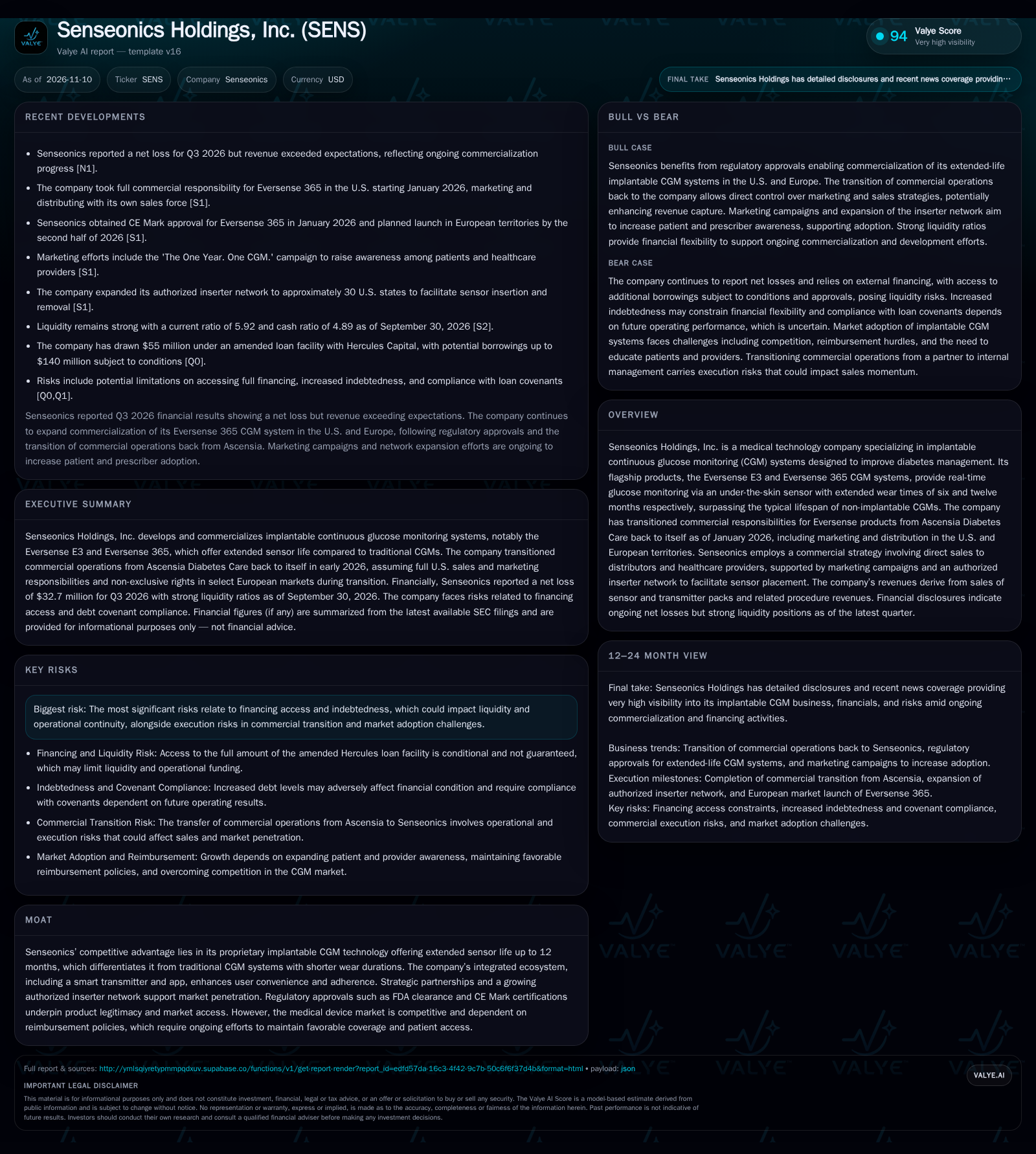
Senseonics Holdings, developer of the Eversense implantable CGM, now controls U.S. and impending European commercialization after the end of its Ascensia partnership. With FDA and CE Mark approvals for its 12-month sensor and a growing inserter network, Senseonics faces the dual challenge of accelerating adoption and managing financial losses. Execution on direct sales, access to debt capital, and successful market expansion will determine if its differentiated technology can capture durable share in the CGM market. [S1] [S2]
Senseonics Holdings is at a strategic turning point: having reclaimed full commercial control over its long-duration implantable CGM system in the U.S. and preparing for a European rollout, the company is betting that direct sales execution and a unique 12-month sensor life can drive adoption in the crowded diabetes technology market. Yet, with persistent net losses, conditional access to further debt, and the need to build prescriber and patient awareness, Senseonics’ outcomes will be shaped by its ability to execute on commercial transition, secure reimbursement, and demonstrate that its differentiated technology translates to durable revenue growth and margin improvement.
Recent Developments: Commercial Autonomy, European Approval, and Financial Realities
Senseonics now controls U.S. marketing and distribution of its Eversense 365 implantable CGM system, following the conclusion of its exclusive partnership with Ascensia Diabetes Care at the end of 2025. This transition gives Senseonics direct influence over its commercial strategy, sales force deployment, and patient/provider engagement in its core market. [S1]
The company secured CE Mark approval for Eversense 365 in January 2026 and targets a European launch in the second half of the year, broadening its potential addressable market. [S1]
Financially, Senseonics posted a net loss of $32.7 million for Q3 2026 and reported $47.8 million in cash as of September 30, with a current ratio of 5.92. The company reported cash and liquidity metrics for the period; these figures do not by themselves establish operating runway, investment capacity, financial flexibility, or financing capacity. [S2]
Revenue Model and the Economics of Extended-Life Implantable CGMs
Senseonics generates revenue from three primary sources: sales of sensor packs, transmitter packs, and procedure fees for sensor insertion and removal. The Eversense 365’s 12-month sensor life is a core differentiator, potentially reducing the frequency of sensor replacements compared to traditional CGMs—which typically require weekly to quarterly changes—and shifting the revenue mix toward higher-value, less frequent transactions.
The company’s economics are influenced by the upfront procedural component (insertion/removal, often performed by certified providers in the Eon Care Network), the recurring sale of transmitters (which are removable and rechargeable), and the potential for higher-margin direct distribution following the end of the Ascensia partnership. However, longer sensor life may reduce replacement volume per patient, increasing the importance of expanding the installed base and capturing new users, rather than relying on high-frequency repurchase cycles.
Operating leverage may improve as sales scale, with fixed costs in R&D, regulatory, and commercial infrastructure spread across a larger revenue base. Yet gross margins will depend on manufacturing efficiency, pricing discipline, and the ability to maintain healthy procedure economics amid payer negotiations and potential competitive pricing pressure. Capital needs remain significant given ongoing net losses and the upfront investment in sales force, inserter network, and market education.
Defining the Competitive Edge: Differentiation Versus Market Entrenchment
Senseonics’ implantable CGM technology, with up to 12-month sensor duration, is a clear technical differentiator versus established transcutaneous CGM systems, which typically offer 7- to 180-day sensor lifespans. This may appeal to patients seeking fewer insertions, improved convenience, and reduced device fatigue.
However, the CGM market is dominated by large, entrenched players offering non-implantable systems with robust reimbursement, broad provider familiarity, and strong distribution. Competing on convenience and wear time alone may not be sufficient if Senseonics cannot match the scale, payer integration, or ecosystem effects of market leaders.
Switching costs are moderate for patients but higher for providers due to the need for procedural certification, workflow adaptation, and insurance navigation. The authorized inserter network is a strategic asset, but its geographic coverage and utilization rates will be critical to driving adoption. Reimbursement and prescriber comfort are major external counterforces, as is the ability of competitors to accelerate their own sensor-life improvements or discount pricing to defend share.
How Direct Sales and Unique Sensor Life Could Unlock Market Share
If Senseonics executes effectively on its direct commercial strategy—deploying its sales force, expanding the inserter network, and converting prescriber awareness into patient adoption—the company could accelerate installed base growth, especially among patients dissatisfied with frequent sensor changes. The Eversense 365’s year-long sensor may resonate with a sizable segment of the diabetes population seeking convenience and reduced procedural burden.
Favorable reimbursement expansion, successful European launch, and proof of durable real-world performance would provide validation and could catalyze higher utilization rates among endocrinologists and diabetes clinics. If gross margins rise on higher volumes and direct distribution, losses could narrow and operating leverage could materialize.
Evidence supporting this scenario would include rapid sequential growth in new patient starts, increased procedure revenues, expansion of the authorized inserter network, and positive payer coverage updates—especially from major U.S. insurers. Announcements of key institutional contracts or real-world data demonstrating adherence and outcomes would further confirm upside potential.
Commercial Transition Drives Modest Uptake Amid Competitive and Payer Hurdles
The most plausible outcome is a gradual ramp in adoption as Senseonics builds its direct sales capability, but faces inertia from established CGM incumbents and persistent challenges in payer coverage. The expanded inserter network may facilitate access in select regions, but national penetration will likely be uneven, and provider education will be an ongoing cost center.
Revenue growth could be steady but not explosive, as some patients and providers remain on traditional CGMs due to habit, familiarity, or reimbursement preference. Margin improvement may be slow if manufacturing scale and pricing power are constrained by limited share gains. Cash burn would continue unless operating losses narrow significantly or access to additional debt is achieved on favorable terms.
Confirming evidence would be stable or modestly rising new patient starts, incremental expansion in European markets, and steady—but not stepwise—improvement in payer coverage. Signs of plateauing adoption or rising customer acquisition costs would challenge the bull thesis.
What If Execution Lags or Financing Gaps Emerge?
If Senseonics struggles to scale its direct sales infrastructure, fails to expand its inserter network, or cannot overcome provider and patient hesitation, adoption could stagnate. Execution risk is elevated as the company transitions away from its former distribution partner and assumes full responsibility for commercial outcomes.
A slow European launch or reimbursement setbacks could limit revenue growth, while ongoing net losses would erode cash reserves. If Senseonics is unable to satisfy conditions for further borrowings under its Hercules Capital facility, it could face liquidity strain, potentially requiring dilutive equity issuance or operational cutbacks.
Downside evidence would include flat or declining new patient starts, delays in inserter network expansion, missed commercialization milestones, unfavorable payer decisions, or disclosures of difficulty accessing additional debt capital. Materially increased net losses or warnings about going concern would further signal downside realization.
Milestones That Will Determine Senseonics’ Commercial Trajectory
Quarterly new patient starts for Eversense 365, especially in the U.S. and, if disclosed, in Europe post-launch.
Growth and geographic coverage of the authorized inserter (Eon Care) network; utilization rates would help test adoption potential.
Updates on payer coverage expansion and reimbursement rates for Eversense 365, particularly among major U.S. commercial insurers.
Gross margin trends as direct sales scale—improvement would suggest leverage and pricing discipline.
Progress and timing of the European launch, including distributor partnerships and initial adoption metrics, if disclosed.
Access to additional debt capital under the Hercules facility or alternative financing arrangements; disclosures of any covenant or liquidity constraints.
Real-world evidence of patient adherence, satisfaction, and clinical outcomes relative to traditional CGMs, if published.
Quarterly cash burn and operating loss trends—narrowing losses would signal progress toward financial sustainability.
Disclaimer: This is research-only, informational analysis and not investment advice. It may include AI-generated interpretation and general industry context. Always verify important details using primary sources.

Comments