
Stitch Fix’s Turnaround: Improving Margins and Evolving Personalization Strategy
Stitch Fix's integration of AI-driven algorithms with human stylists underpins improving financial metrics and shapes future growth prospects amid competitive apparel retail challenges.
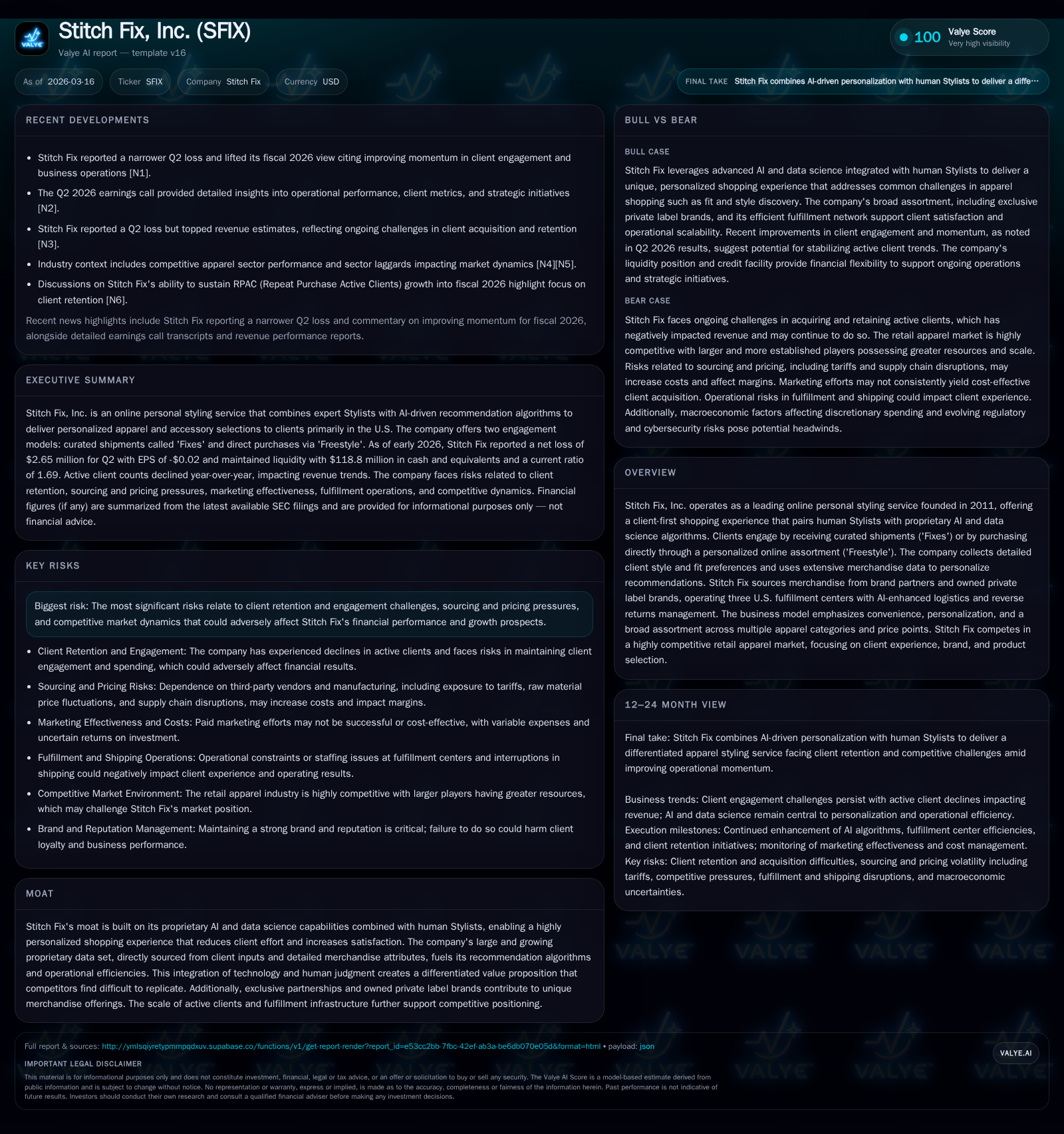
Since its inception in 2011, Stitch Fix has pioneered the hybrid model of personalized styling combining expert human insight and proprietary AI to deliver curated apparel shipments and direct online sales. After years of operating losses driven by scaling and market pressures, the company has narrowed operating losses by over 70% from FY23 to FY25, reflecting improved margin discipline supported by advances in personalization technology and fulfillment efficiencies. Looking forward, Stitch Fix's growth will hinge on client acquisition and retention, optimization of AI-stylist workflows, and managing supply chain cost pressures. Capital allocation remains conservative with positive free cash flow emerging, though profitability inflection points remain contingent on sustaining engagement amid fierce competition.
Foundations of Growth: Historical Performance and Business Model Evolution
Stitch Fix transformed apparel retail after its founding in 2011 by marrying expert human stylists with proprietary artificial intelligence (AI) to deliver a highly personalized shopping experience. Clients primarily engage via curated shipments called “Fixes” or directly through a personalized online assortment known as “Freestyle.” The business model focuses on reducing the friction traditionally associated with shopping—eliminating hours spent browsing—and relies heavily on detailed client inputs about style, fit preferences, and feedback to refine offerings.
Financially, the journey from early growth toward improving profitability is instructive. Stitch Fix posted operating losses of -$208 million in FY22 which narrowed modestly over the next years: -$177.8 million in FY23, -$133.4 million in FY24, culminating in -$38.9 million in FY25—a remarkable 70.8% improvement in operating income year-on-year at the latest measure [F1]. Net losses followed a similar trajectory refining from -$207 million (FY22) to -$28.7 million (FY25), illustrating enhanced cost control alongside revenue expansion.
This progression correlates with the company evolving beyond its original women's apparel focus into complementary segments including menswear, kids, petite lines, maternity wear, plus sizes, shoes, and accessories — broadening its addressable market while deepening client lifetime value potential [S1,S28]. Strategic investments upgraded inventory management and assortment breadth but were balanced against efficiencies developed through AI-assisted operations.
Recent Financial Results Signal Momentum Shift
In Q2 FY26 ended January 31, 2026, Stitch Fix reported continuing narrowing of quarterly losses alongside revenue outperforming analyst estimates. Management highlighted operational leverage effects materializing partly due to more efficient marketing spend—refining customer acquisition costs—and improvements in fulfillment center productivity leveraging AI for inventory routing and returns handling [N1,N2,N4,S2].
Guidance lifted for the full fiscal year emphasized positive momentum trends although significant profitability remains aspirational. Commentary pointed toward carefully calibrated investments to scale client engagement programs without diluting margins excessively. This marks an important inflection point where prior scaling pains give way to more stable unit economics.
Data Science and Stylist Integration: Proprietary AI as a Competitive Moat
Central to Stitch Fix’s differentiation is its proprietary AI ecosystem that fuses rich datasets sourced directly from clients with stylists’ qualitative judgment. The company collects granular data on garment attributes—such as inseam length, pocket shape, silhouette—and extensive style preferences encoded through client feedback loops [S1,F1].
AI algorithms optimize stylist-client pairings based on compatibility scores while augmenting stylists' decisions about selection recommendations (Fixes), effectively reducing client decision fatigue prevalent in conventional shopping formats. This dual approach—human insight supported by scalable machine learning systems—forms a moat difficult for competitors lacking comparable data depth or integration capabilities.
Beyond personalization accuracy improvements, analytics feed demand forecasting and pricing strategies that optimize markdowns dynamically across owned private label brands and exclusive partner merchandise [S5]. This end-to-end technology integration fuels both the consumer experience value and backend operational efficiencies.
Market Positioning Amidst Fierce Retail Competition
Stitch Fix competes broadly against traditional retailers with physical footprints as well as pure e-commerce platforms selling similar apparel ranges. Its moat expands beyond product exclusivity thanks to owned private labels coupled with exclusive merchandise designed expressly for Stitch Fix clients—a factor supporting differentiated assortments not easily replicated by competitors [S5,S6].
Additionally, proprietary AI-enabled logistics underpin fast fulfillment cycles meeting consumer expectations for timely delivery whilst reverse logistics modules facilitate streamlined returns—a critical component given fashion’s high return rates. These operational aspects help mitigate price sensitivity risks pervasive across apparel retail.
Nevertheless, competitors boasting larger scale infrastructures enjoy inherent advantages in purchasing power, shipping costs, and brand recognition — placing ongoing pressure on Stitch Fix’s marketing efficiency and customer loyalty initiatives.
Client Acquisition and Retention: Key Growth Drivers
Retention challenges persist as a material risk per SEC disclosures reflecting historical churn volatility that undermined prior margin stabilization efforts [S1,S2]. Growth hinges critically on attracting new clients without sacrificing existing engagement levels; repeat purchase rates function as a key health metric for lifetime value expansion.
Marketing spend effectiveness is pivotal here amid variable channel performances; the company’s recent commentary underscores more disciplined budget deployment targeting identifiable segments poised for higher conversion ratios [N1,S2]. Promotion programs fostering convenience—such as scheduling regular shipments—and personalized incentives seek to deepen brand affinity.
Monitoring quarterly shifts in active clients alongside variations in average order size will offer predictive insights into longer-term revenue durability.
Operational Efficiencies and Fulfillment Center Dynamics
Stitch Fix operates three U.S.-based fulfillment centers whose staffing models have evolved alongside implementation of AI-driven inventory placement algorithms designed to reduce transit times and optimize stock utilization regionally [S1,S4]. These centers also incorporate advanced reverse logistics frameworks reprocessing returns efficiently—a significant cost lever given apparel’s inherently higher return frequency compared with other retail categories.
Staffing flexibility within these centers aligns with demand seasonality while cross-trained teams enable responsive adaptation during peak cycles or unexpected fluctuations. Integration of shipment routing software supports dynamic carrier selection optimizing last-mile delivery economics crucial under rising shipping cost pressures widespread in retail logistics.
Overall, these fulfillment enhancements materially contribute to margin improvements observed over recent fiscal years.
Capital Allocation and Returns: Balancing Investment With Discipline
Capital expenditure patterns over FY22-FY25 reflect strategic selectivity: Capex declined sharply from $46.3 million (FY22) down to $13.9 million in FY24 before ticking back up moderately to $16.3 million (FY25), signaling controlled reinvestment primarily targeted at enhancing fulfillment automation rather than expansive new infrastructure buildouts [F1].
Operating cash flow demonstrated volatility—peaking at $57.8 million (FY23) before retreating to $28.2 million (FY24)—while continued investments constrained absolute free cash flow generation until the approximate $11.9 million FCF realized in FY25 marks progressive financial maturity when offsetting capex costs are considered [F1].
Repurchase activity ceased post-FY22 after $30 million buybacks that year reflecting capital preservation preference amidst transformation efforts [F1]. Return on equity remains negative at about -14% driven largely by residual net losses despite equity base contraction from $323 million (FY22) down to $203 million (FY25) echoing cumulative results retention dynamics.
Historical performance (annual)
| FY | Net ($mm) | CFO ($mm) | OpInc ($mm) | Capex ($mm) | Net YoY |
|---|---|---|---|---|---|
| 2025 | -29 | -39 | 16 | +77.7% | |
| 2024 | -129 | 28 | -133 | 14 | +25.1% |
| 2023 | -172 | 58 | -178 | 19 | +17.0% |
| 2022 | -207 | 55 | -208 | 46 |
Source: SEC companyfacts cache [F1].
Capital returns and efficiency (annual)
| FY | Buybacks ($mm) | FCF ($mm) | ROE% |
|---|---|---|---|
| 2025 | -14.2 | ||
| 2024 | 0 | 14 | -68.9 |
| 2023 | 0 | 39 | -69.5 |
| 2022 | 30 | 9 | -64.2 |
Source: SEC companyfacts cache [F1]. Revenue not provided explicitly post-2018; table focused on profitability/cash flow trends
Outlook and Key Milestones to Watch
While no concrete forward earnings guidance milestones were delineated beyond general statements of improving momentum during recent earnings calls [N4,N1], critical performance indicators investors should monitor include active client counts, repeat purchase rates indicating retention improvements, marketing ROI measures spotlighting acquisition efficiency gains, alongside supply chain cost evolution under tariffs affecting goods sourced predominantly from China [S1,S8].
Margin trajectory will likely hinge on how successfully Stitch Fix further scales its AI-stylist hybrid approach while controlling overhead costs related to fulfillment center staffing amid economic uncertainties affecting discretionary apparel spending.
Risks Constraining Future Expansion
Stitch Fix confronts several substantive risks outlined in recent SEC filings:
- Client attrition risk persists given historical retention difficulties impacting revenue stability [S1,S2].
- Exposure to international tariffs especially on Chinese-origin merchandise introduces margin volatility and price pass-through complexity risking demand elasticity impacts [S13,S26].
- Intense competition from entrenched multi-channel retailers possessing greater purchasing power could erode market share if exclusivity advantages or technological differentiation weaken [S5,S6,S25].
- Compliance complexity around evolving privacy laws including cookie tracking restrictions may degrade user data quality feeding AI recommendation accuracy adversely affecting personalized service effectiveness [S14,S19,S20].
- Legal risks remain tied notably to ongoing securities litigation settlements related to prior Freestyle offering disclosures costing $32 million planned settlement payments subject to court approval — resource diversion remains a possibility if future claims arise unexpectedly [S12,S16].
- Operational risks include dependency on fulfillment center staffing adequacy; any disruption could degrade customer delivery experience harming brand reputation [S2,S4].
Mitigation demands continuous innovation protecting IP assets that underpin proprietary algorithms while balancing operational agility against macroeconomic headwinds affecting consumer discretionary spending patterns.
Disclaimer: This analysis is intended solely for informational purposes based on available evidentiary sources without providing investment advice or recommendations.
Disclaimer: This is research-only, informational analysis and not investment advice. It may include AI-generated interpretation and general industry context. Always verify important details using primary sources.

Comments