
SpyGlass Pharma Updates Clinical and Capital Trajectory Following Q1 2026
SpyGlass Pharma reports solid liquidity post-IPO and steady progress on Phase 3 enrollment for its lead BIM-IOL System.
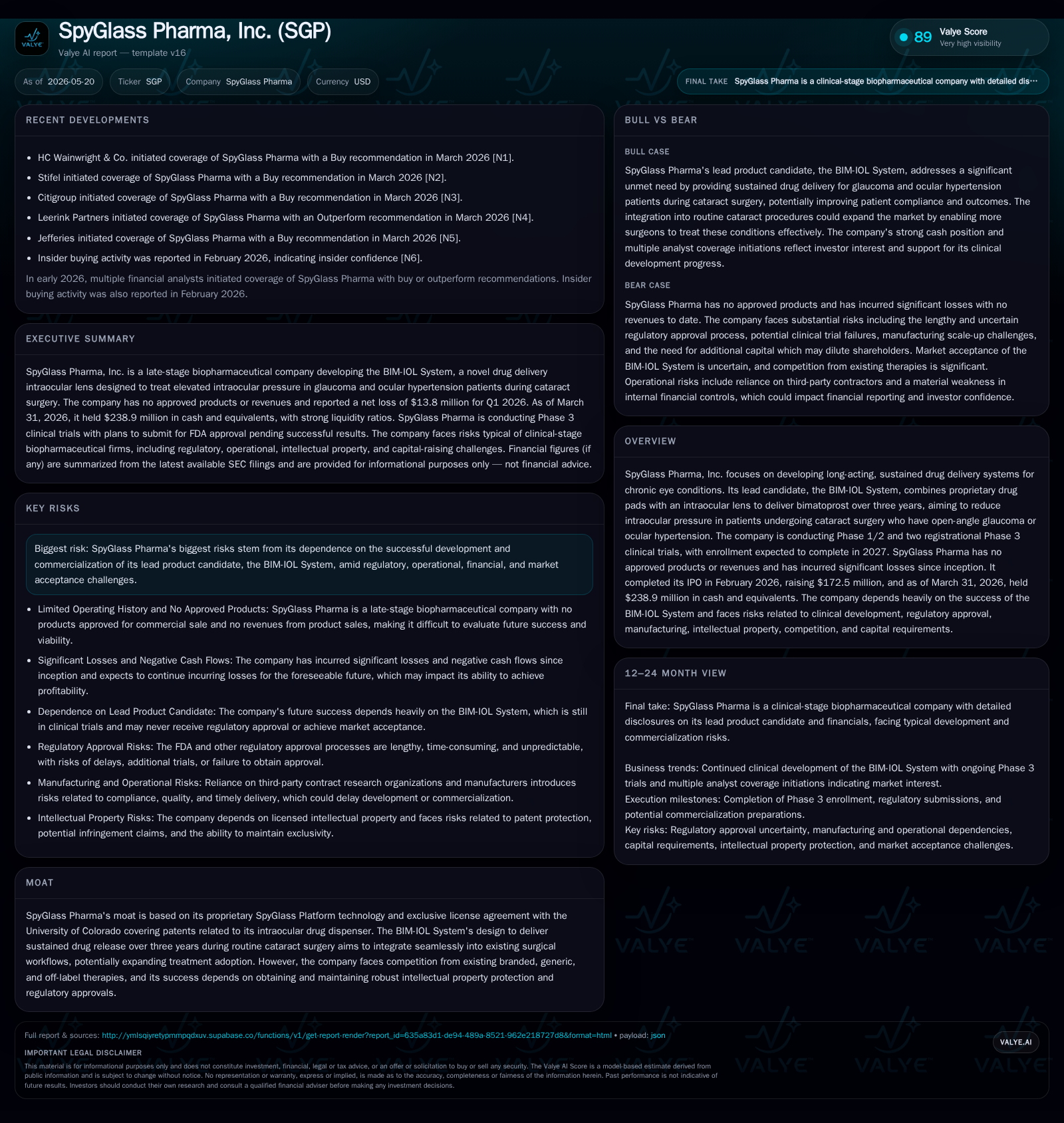
SpyGlass Pharma continues advancing its BIM-IOL System, an innovative drug delivery intraocular lens designed for sustained glaucoma treatment over three years. As of Q1 2026, the company holds approximately $239 million in cash, supporting ongoing Phase 3 trials with enrollment expected to complete by 2027. The business model integrates glaucoma treatment into routine cataract surgery, addressing adherence challenges linked to topical medications. While SpyGlass benefits from exclusive intellectual property rights and promising clinical data, risks remain from clinical and regulatory dependencies, IP litigation, and surgeon adoption uncertainties.
Quarterly Update Anchored by May 2026 Filing
SpyGlass Pharma’s latest quarterly report filed May 14, 2026 [S2] and related event filing [S3] provide important updates shaping near-term prospects. The company ended Q1 with approximately $239 million in cash and equivalents alongside modest current liabilities of $6.7 million—resulting in a current ratio near 38 [F1]. This strong liquidity position is bolstered by February’s IPO proceeds ($172.5 million gross) combined with earlier financings. Such capital availability is critical for a clinical-stage company incurring substantial research and development costs without product revenues.
Operationally, SpyGlass confirms ongoing enrollment in two registrational Phase 3 trials for its BIM-IOL System involving roughly 400 patients per trial across about 45 sites. Enrollment completion is targeted for 2027 [S1], focusing execution on this pivotal milestone. No material unexpected events were reported concurrently.
SpyGlass Pharma’s Drug Delivery Platform and Product Pipeline
SpyGlass’s proprietary SpyGlass Platform integrates a novel drug delivery system with an intraocular lens (IOL), designed for implantation during routine cataract surgery. The lead BIM-IOL System couples drug pads impregnated with bimatoprost—a prostaglandin analog approved by the FDA for ocular hypertension—with the IOL implant to enable sustained drug release over three years [S1]. This approach addresses key limitations of traditional glaucoma care reliant on daily topical drops: poor adherence, inconsistent dosing, and chronic management burdens.
Clinical data have been encouraging; initial human feasibility studies showed sustained mean intraocular pressure (IOP) reductions of approximately 37% at three years without product-related adverse events. Around 95% of treated patients were free from supplemental topical IOP-lowering medications at that timepoint [S1]. Early Phase 1/2 trial results align with these findings at three and twelve months.
Beyond the BIM-IOL System for patients undergoing cataract surgery with open-angle glaucoma or ocular hypertension, SpyGlass is developing a ring-shaped sustained-release implant intended for pseudophakic patients—those who have previously received artificial lenses from cataract surgeries. This second-generation candidate aims to enable retreatment independent of concurrent cataract procedures [S1], potentially expanding market reach within chronic eye disease management.
Competitive Context and Market Positioning in Glaucoma Management
The glaucoma treatment landscape is complex and competitive. Current standards rely heavily on patient adherence to topical medications; noncompliance contributes significantly to disease progression. Surgical options like minimally invasive glaucoma surgeries (MIGS) require specialized training among ophthalmic surgeons. SpyGlass’s BIM-IOL System differentiates itself by embedding therapy into widely performed cataract surgeries—an outpatient procedure common across ambulatory surgery centers—thereby broadening treatment accessibility.
This strategy could potentially triple the number of cataract surgeons offering effective IOP control at surgery compared to MIGS-trained specialists alone [S1]. However, competition remains intense from branded prostaglandin analogs administered topically, generics offering cost-effective alternatives, off-label agents, as well as established MIGS devices marketed by incumbents such as Glaukos [S4]. Ongoing litigation initiated by Glaukos alleging trade secret misappropriation introduces additional regulatory and intellectual property risk that could impact competitive positioning [S4].
Pricing dynamics will depend on payor reimbursement policies influenced by demonstrated clinical benefits versus standard care, surgeon adoption driven by ease of use and outcomes data, and long-term cost-effectiveness related to reduced medication burden.
Growth Catalysts Rooted in Clinical Milestones and Regulatory Pathway
The primary growth catalyst is successful completion of ongoing Phase 3 trials evaluating safety and efficacy endpoints compared to existing therapies. Positive top-line results demonstrating durable IOP reduction coupled with significant decreases in topical medication dependence would validate SpyGlass’s value proposition.
Enrollment completion expected in calendar year 2027 sets a timeline toward FDA New Drug Application (NDA) submission using the streamlined 505(b)(2) pathway planned for 2028 [S1]. Regulatory approval would unlock commercialization opportunities integrated into high-volume cataract surgery workflows—potentially improving patient access without necessitating additional specialist visits.
Success here could address major adherence challenges long limiting effective glaucoma control, improving patient outcomes while potentially reducing healthcare costs associated with disease progression or complications from poor compliance.
Risks Centered on Clinical, Regulatory, IP, and Commercial Adoption Challenges
SpyGlass faces concentrated risks largely tied to dependence on its single late-stage product candidate—the BIM-IOL System—to drive future growth. Failure or delays in clinical trial success or regulatory approval would materially impair prospects [S18]. Ongoing litigation filed by Glaukos alleging trade secret misappropriation relating to overlapping technologies poses risks including management distraction, increased legal expenses, injunctions limiting operations or intellectual property use rights, or royalty obligations affecting profitability [S4].
Commercial adoption uncertainties persist: acceptance by cataract surgeons depends on seamless procedural integration and compelling patient benefits sufficient to shift practices away from established therapies or require significant new surgical competencies beyond standard cataract procedures. Pricing negotiations sensitive to healthcare payor coverage policies add complexity [S18]
Additionally, SpyGlass must raise substantial capital beyond IPO proceeds to fund continued development phases including scaling trial execution and building commercialization infrastructure given absence of current product revenues [S2][S11]. Failure to secure financing could necessitate program delays or restructuring.
Upcoming Milestones to Track: Enrollment Progress, Regulatory Filings, and Capital Needs
Key upcoming milestones include:
- Completion of patient enrollment across two registrational Phase 3 studies expected by end-2027 [S1];
- Release of interim or full efficacy/safety data post-enrollment serving as critical inflection points;
- NDA submission targeted within calendar year 2028 assuming positive trial outcomes;
- Monitoring deployment effectiveness of IPO capital against burn rates influencing timing/frequency of future fundraising efforts.
These milestones will influence investor perception regarding valuation aligned with clinical de-risking stages.
Financial Position and Capital Structure Supporting Development Phases
As of March 31, 2026 quarter-end, SpyGlass held approximately $239 million in cash and equivalents against minimal current liabilities (~$6.7 million), yielding a robust liquidity profile supportive of expensive late-stage clinical activities [F1][S2]
While accumulated deficits exceed $100 million reflecting sustained investment without product revenue generation [F1], recent IPO proceeds have substantially fortified the balance sheet compared to prior periods [S9].
This financial strength provides runway through key development milestones including anticipated NDA submission around late 2028 based on company estimates [S15]. Nonetheless, operating losses remain significant due to ongoing R&D expansion creating dependency on future capital raises if delays occur.
This analysis is based solely on publicly filed SEC documents including latest quarterly disclosures dated May 14, 2026 and does not constitute investment advice.
Disclaimer: This is research-only, informational analysis and not investment advice. It may include AI-generated interpretation and general industry context. Always verify important details using primary sources.

Comments