
Shentel’s Strategic Fiber Expansion Tests Resilience Amid Competitive Pressures
Intensive fiber network growth coincides with rising losses and capital demands, highlighting operational and financial balancing acts.
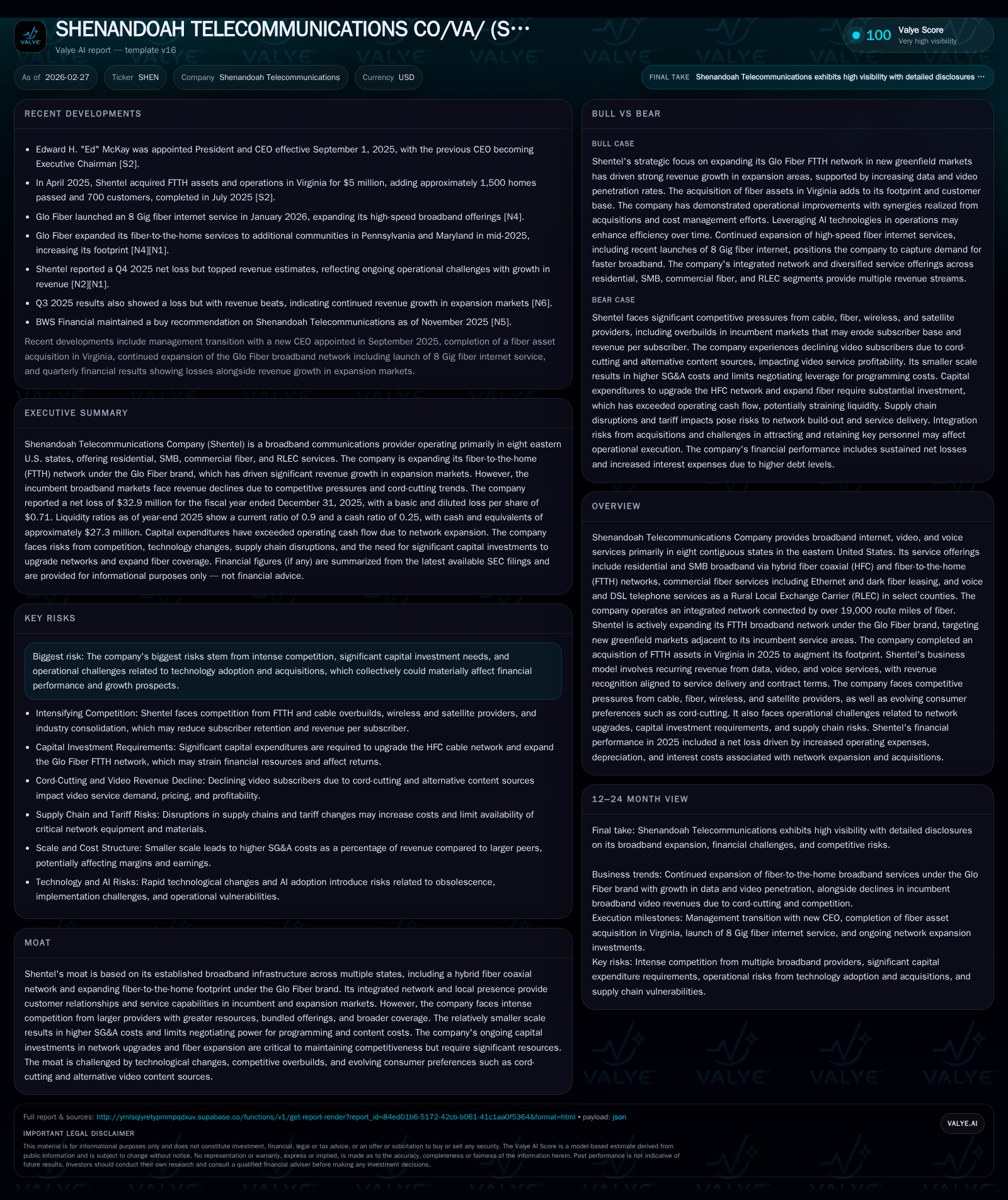
Shenandoah Telecommunications (Shentel) is actively expanding its fiber-to-the-home (FTTH) footprint under the Glo Fiber brand while managing a downsizing legacy hybrid fiber coaxial (HFC) business. Revenue declined modestly in 2025 alongside operating losses driven largely by elevated investment in broadband infrastructure. Significant capital expenditures exceed operating cash flows, necessitating advanced financing structures including securitized ABS notes and revolving credit facilities. Competitive pressures from cable overbuilds, emerging wireless-fiber bundles, and cord-cutting trends challenge Shentel’s market positioning even as fiber expansion offers a strategic growth path. Management transitions underscore a focus on operational efficiency amid intensified competition.
From Cable Legacy to Fiber Future: Historical Growth and Transition Dynamics
Shenandoah Telecommunications Company has been navigating the shift from traditional hybrid fiber coaxial (HFC) broadband networks toward an aggressive fiber-to-the-home (FTTH) expansion under its Glo Fiber brand across eight eastern U.S. states. Historically reliant on incumbent broadband markets delivering residential and small/mid-sized business services, the company witnessed revenue peak before declining modestly by approximately 2.5% from fiscal year 2024 to 2025 [F1]. This decline parallels the gradual erosion of legacy HFC service demand during increasing competitive incursions.
Operating income swung into negative territory after profitable years, registering a loss of about $23 million for FY2025 compared to a positive $9.6 million in FY2023 [F1]. This downturn aligns with heightened capital spending commitments necessary for deploying fiber infrastructure and integrating acquired FTTH assets, reshaping Shentel’s margin profile. The incumbent broadband segment experienced subscriber pressures related to overbuilds by cable competitors possessing more expansive bundled offerings [S1]. However, growth in Glo Fiber’s greenfield expansion partially offsets these headwinds with higher bandwidth offerings catering to evolving consumer demands [N2].
Historical performance (annual)
| FY | Net ($mm) | CFO ($mm) | OpInc ($mm) | Capex ($mm) | Net YoY |
|---|---|---|---|---|---|
| 2025 | -33 | 101 | -23 | 359 | -117.0% |
| 2024 | 194 | 63 | -29 | 319 | +2311.3% |
| 2023 | 8 | 114 | 10 | 257 | +195.9% |
| 2022 | -8 | 75 | -8 | 190 |
Source: SEC companyfacts cache [F1].
Capital returns and efficiency (annual)
| FY | Div ($mm) | FCF ($mm) | ROE% |
|---|---|---|---|
| 2025 | 6 | -258 | -3.7 |
| 2024 | 6 | -257 | 21.1 |
| 2023 | 5 | -143 | 1.2 |
| 2022 | 4 | -115 | -1.3 |
Source: SEC companyfacts cache [F1].
- Estimated revenue derived from SEC filings; actual full-year revenue undisclosed [F1][S2]
Glo Fiber Expansion and Market Footprint: Catalysts and Headwinds
The company's strategic focus centers on expanding Glo Fiber's FTTH penetration into new markets adjacent to its existing footprint with ultra-high-speed internet offerings such as the "8 Gig" symmetrical service launched recently providing speeds up to eight gigabits per second—significantly outpacing traditional cable or DSL competitors [N4][S1]. By building out newer areas where competitive entrenchment is limited or absent, Shentel leverages the high-capacity scalability of all-fiber networks.
In July 2025, Shentel augmented its FTTH portfolio through acquisition of a Virginia-based FTTH provider for $5 million covering approximately 1,500 home passings and nearly 700 customers [S2]. This asset purchase enhances market density critical for spreading fixed infrastructure costs which are central economic challenges inherent to new fiber deployments.
Capital intensity remains substantial—deployments involve "passings" or potential location counts that dictate future revenue base growth but entail upfront construction outlays often supported by federal/state government grants committed under Broadband Equity initiatives [S15]. As these greenfield expansions mature into paying subscriber relationships, they will be essential growth drivers counterbalancing flat or declining legacy HFC subscriber bases.
Competitive Landscape and Technological Challenges in Regional Broadband
Approximately 30% of incumbent broadband passings face competition from FTTH or enhanced cable overbuilds that erode incumbent market share and pressure average revenue per user (ARPU). Additionally, all Glo Fiber passings encounter incumbent cable competitors, raising challenges in subscriber acquisition where multiple providers offer competing service tiers [S1].
Emerging convergence trends between wireless carriers bundling mobile with fixed broadband complicate customer retention efforts; partnerships between wireless providers and broadband operators introduce bundled propositions emphasizing flexibility unavailable solely via traditional wireline options [S1].
Cord-cutting accelerates reduced demand for legacy video services as consumers increasingly favor OTT providers like Netflix or Disney+, forcing Shentel to absorb content programming cost increases against shrinking subscriber counts—a common telecom trend across regional operators [S1]. Aging HFC infrastructure requires costly upgrades to maintain parity with newer fiber rivals and meet evolving consumer expectations for latency-sensitive applications such as gaming or telehealth.
Financial Results in Focus: Revenue Trends, Operating Losses, and Cash Flow Strength
In FY2025 Shentel recorded revenues estimated around $427 million marking a slight contraction (-2.5%) relative to prior year while operating income showed improvement compared to FY2024’s loss but remained negative at approximately $(23) million [F1][N2]. Net losses deepened significantly mainly due to elevated depreciation expense associated with capital expansions and certain non-cash impairment factors aligned with transition costs.
Concurrently operating cash flow demonstrated strong resilience growing more than 60% year-over-year reaching roughly $101 million indicating healthy underlying business cash generation albeit eclipsed by aggressive capex spending which totaled nearly $359 million (+12%)—fully covering network buildouts including subsidies received offsetting portions thereof [F1][N1]. This reflects an investment-driven cash burn rather than operational weakness.
Segment revenue shifts underscore declining incumbent residential/SMB broadband revenues against burgeoning contributions from faster-growing Glo Fiber expansion markets which increased revenues by more than $6 million sequentially during Q3 alone hinting at progressive unit growth despite margin dilution linked to elevated deployment expenses [N1][S2].
Capital Structure Overhaul and Liquidity Management Insights
To support sustained heavy capital investment exceeding operating cash flow capacity, Shentel executed refinancing culminating in a securitization transaction involving bankruptcy-remote ABS Entities securitizing approximately $567 million principal aggregate of fiber network revenue term notes repayable circa December 2030 secured by assets across six states including Virginia where recent acquisitions occurred [S1][S10][S21].
Complementing this structure are:
- A $175 million revolving credit facility bearing interest at SOFR plus variable margins supporting liquidity through December 2030;
- A variable funding note facility ($175m capacity) subject to leverage covenants;
- A delay draw liquidity note ($25m) designed as contingency fallback.
As of year-end Shentel had drawn about $75 million against its revolving credit line illustrating financial discipline while leveraging this sophisticated structure allowing flexibility for incremental drawdowns constrained within strict leverage ratios embedded within credit agreements monitored closely throughout performance cycles [S4][S11][S14][S22].
The effective cost of debt including ABS notes and revolver averaged mid-single digits but remains moderately exposed to floating rate benchmarks such as SOFR plus adjustable margins given prevailing market rate volatility post-pandemic inflationary pressures [S9][S19].
Capital Allocation: Aggressive Capex vs Modest Dividends
Shentel prioritizes network investments: capex outlays reached ~$359 million consolidating an upward trend since FY2023 with sizeable portions supported through government grants easing net spend burdens but not eliminating funding requirements entirely [F1][S15][S29]. These outlays are crucial both for expanding Glo Fiber’s footprint and maintaining/upgrading incumbent HFC lines facing technological obsolescence risks.
Dividends remain modest totaling around $6.4 million paid during FY2025 consistent with past years’ payouts well below typical telecom sector averages illustrating restrained shareholder distributions reflective of reinvestment mandates; notably no share repurchases have occurred since FY2019 underscoring conservative cash return policies amid capex priorities [F1][S23].
This cautious allocation approach signals management commitment towards long-term value creation anchored on infrastructure buildouts coupled with measured financial stewardship avoiding exacerbated leverage strains.
Future Watchpoints: Network Upgrade Milestones and Competition Intensity
A key milestone includes scaling the "8 Gig" FTTH offering launched early-2026 aiming to attract bandwidth-intensive users including telecommuters seeking premium speeds extending beyond standard gigabit tiers typical among incumbents [N4][N1]. The pace of passing activations converting into paying subscribers at expected ARPUs will be critical near-to-medium term metrics.
Upgrades required for HFC plant parity represent latent capex drivers requiring planning particularly regarding DOCSIS technology advancements or potential accelerated migration toward full fiber architecture contingent on commercial viability assessments [S1]. Competition may intensify horizontally from incumbent cable giants launching overbuilds and vertically via emerging bundled wireless partnerships threatening fixed access exclusivity resulting in pricing pressures necessitating innovative marketing or customer experience enhancements.
Management Changes and Strategic Leadership Impact
The CEO transition effective September 2025 appointed Edward H. “Ed” McKay who brought extensive operations leadership experience internally fostering continuity amidst transformation challenges; former CEO Christopher E. French transitioned into Executive Chairman allowing strategic oversight while delegating day-to-day execution responsibilities—an alignment judged instrumental amid ongoing competitive and capital deployment phases [S2]. McKay’s operational focus emphasizes optimizing deployment efficiency alongside integrating acquired assets amplifying FTTH rollout velocity balancing profitability concerns.
This analysis synthesizes publicly available financial disclosures up through February 27th, 2026 combined with recent regulatory filings and company announcements distinguishing between historical facts supported directly by data sources ([F1], [S#], [N#]) versus analytical interpretation highlighted accordingly herein. No investment recommendations or price guidance is intended or provided within this report.
Disclaimer: This is research-only, informational analysis and not investment advice. It may include AI-generated interpretation and general industry context. Always verify important details using primary sources.

Comments