
Shimmick Corp’s Strategic Backlog Growth and Risk Management Shaping Future Infrastructure Wins
Shimmick's backlog expansion and selective bidding underscore its focused growth amid operational and liquidity challenges in critical infrastructure markets.
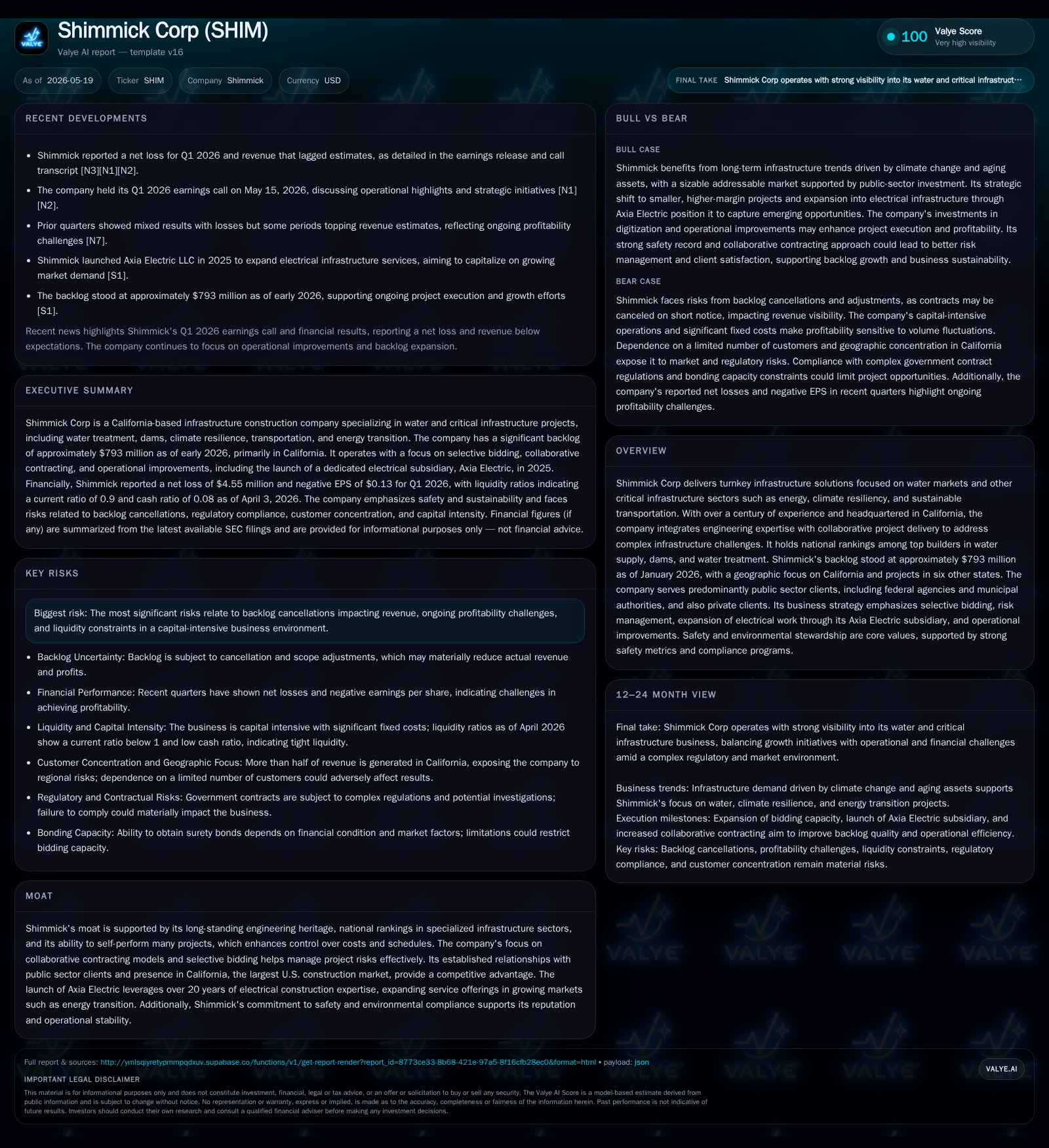
In Q1 2026, Shimmick Corp reported an expanded backlog nearing $793 million, highlighting strong demand in water and critical infrastructure sectors. Despite growth, the company faced operating losses due to project execution costs and profitability pressures inherent in fixed-price contracts. Shimmick leverages its deep engineering heritage and self-performance advantage, while expanding electrical services via Axia Electric to capture energy transition opportunities. Strategic selective bidding and collaborative contracting mitigate risk but backlog cancellations and liquidity constraints remain key challenges. Near-term performance will hinge on backlog conversion efficiency, margin improvements, and maintaining financing flexibility.
Q1 2026 Operating Update: Backlog Expansion Meets Profitability Headwinds
Shimmick Corp's latest quarterly filing (10-Q dated May 15, 2026) reveals a meaningful increase in its backlog to approximately $793 million as of early January 2026 [S2][S1]. This heightened backlog signals sustained demand strength particularly in California—the company’s geographic stronghold—and extends across six additional states. This accumulation aligns with management’s emphasis throughout 2025 on selectively expanding bid capacity while managing risk profiles prudently [S1][N2]. However, despite this growth in work on hand, Shimmick posted an operating loss for the early part of fiscal 2026 totaling around $19.4 million through the fiscal year ended January 2, 2026 [F1][N3]. These losses reflect execution difficulties tied to highly competitive fixed-price contracts common within the infrastructure sector as well as lingering impacts from legacy projects secured prior to current risk-focused bidding strategies [S22].
The company's approach to self-performing significant portions of its work provides better cost control but does not fully shield it from margin pressure amid ongoing inflationary cost risks. Revenue recognition remains complex under the input method (based on costs incurred relative to total expected costs), which can update prior period estimates leading to earnings volatility [S22]. This dynamic necessitates diligent project oversight to prevent costly overruns or revenue reversals.
Business Model and Service Offerings: From Water Treatment to Electrical Construction
Shimmick offers comprehensive turnkey infrastructure solutions predominantly addressing water markets—encompassing water treatment plants, dams, reservoirs—and has broadened into other critical sectors such as energy transition and climate resilience projects [S1]. The breadth encompasses advanced wastewater recycling technologies (e.g., ozonation, membrane filtration) and construction of water conveyance systems critical for flood control and hydroelectric power generation.
A core competitive advantage lies in Shimmick’s engineering heritage dating back over a century combined with integrated project delivery models that build customer stickiness through collaboration with public agencies. This is reinforced by self-performing capabilities that allow tighter schedule control and reduce dependence on subcontractors for core works [S1][N1]. The launch of Axia Electric LLC in mid-2025 formalized the company’s electrical construction expertise accumulated over two decades into a distinct subsidiary targeting medium- and low-voltage electrical scopes tied closely to renewable energy buildouts, transit electrification, and technology-driven infrastructure upgrades [S23]. This strategic service line expansion opens new growth avenues aligned with long-term energy transition trends.
Industry Positioning: Niche Leadership in Water Infrastructure and Critical Projects
Geographically rooted mainly in California—which accounts for over half of its revenue—the company holds national rankings within top-15 builders for specialized segments including water supply (#12), dams/reservoirs (#8), and desalination plants (#11) according to Engineering News Record data cited in filings [S1]. This niche positioning leverages deep technical skills required by complex environmental regulations governing water projects while navigating the challenging multi-agency permitting processes prevalent across states.
Public sector clientele comprise about 96% of Shimmick’s backlog with federal agencies, municipal water authorities, irrigation districts, flood control districts, transit authorities, and state/local public works departments constituting primary customers [S18]. Their predominance stabilizes demand relative to commercial construction cycles but imposes stringent compliance requirements that demand operational excellence.
Competitive Landscape: Shared Risks and Advantages in Selective Bidding and Collaboration
The heavy civil construction industry broadly is marked by intense competition with price-sensitive fixed-price contracts dominating many governmental projects. To contend effectively while protecting margins, Shimmick emphasizes selective bidding—assessing scope size, location feasibility, resource availability, competitive environment, contract type risks—to maintain a balanced portfolio that mitigates potential losses from overly aggressive bids or high-risk designs [S10][S21]. Collaborative contracting models are increasingly preferred for complex projects; these arrangements involve preconstruction phases where contractor qualifications are assessed alongside open-book pricing structures enabling shared risk management between owner and builder [S10].
Such disciplined market engagement helps maintain bond capacity utilization efficiently by avoiding undercapitalized bids that could lead to overruns. While peers also adopt similar approaches given sector-wide inflationary cost pressures (not uncommon among established heavy civil contractors), Shimmick’s combination of selectivity plus self-performance enhances execution control relative to pure subcontract-focused competitors.
Growth Drivers: Backlog Management, Axia Electric Expansion, and Market Trends
Key growth levers for Shimmick include continual backlog expansion via an increased pipeline driven by rising public-sector spending on water infrastructure modernization amid climate change imperatives [N7][S22]. Additionally, Axia Electric represents a strategic initiative capitalizing on accelerating investments in energy transition infrastructures such as EV charging facilities for transit agencies, renewal of aging power distribution assets within critical facilities, and technology campuses requiring specialized electrical installation expertise [S23][N2].
The aging U.S. infrastructure stock combined with regulatory impetus for sustainability upgrades sustains a stable long-cycle demand base supporting mid-single-digit annual growth projections for relevant infrastructure sectors nationally [S18]. While legacy project execution pressures depress short-term profits—as evidenced by Q1 operating losses—improvements are expected from recent bidding discipline yielding higher-margin work.
Risks and Constraints: Contractual Risks, Liquidity Pressures, and Sector-Specific Challenges
Despite strategic advances, Shimmick faces notable risks typical of its industry niche. Fixed-price contracts expose it to the risk of cost overruns driven by material price increases or unforeseen technical hurdles; design-build contracts add exposure to design errors causing rework costs [S21]. The substantial cancellability of contracts on short notice creates backlog uncertainty since recognized backlog may not fully convert into revenue if clients defer or cancel scope unexpectedly—potentially impacting forecasted cash flows materially [S24].
Subcontractor performance variability also threatens project timelines and cost baselines given significant reliance on external services despite self-performance efforts. Compliance failures related to environmental regulations or safety statutes could trigger penalties or project restrictions undermining reputation and financial results [S21]. Liquidity constraints stem from a working-capital-intensive business model with a current ratio below one (0.9), signaling limited cover for current liabilities against assets; meanwhile net debt stands near $16.8 million combining cash reserves of approximately $15 million against total debt around $31.7 million (latest balance-sheet points) [F1].
Near-Term Watchpoints: Backlog Realization, Margin Improvement, and Contract Wins
Close monitoring is warranted on conversion efficiency of the sizable backlog into profitable revenue streams over upcoming quarters—particularly execution performance on newer projects secured post-implementation of stricter bidding criteria. Margins represent a key operational barometer since past results reveal vulnerability to inflationary inputs despite project control advantages. Success in expanding Axia Electric’s footprint through new contract wins will also materially influence revenue mix diversification.
Additionally, sustaining sufficient liquidity amidst working capital demands requires careful management given lagging collections or retention holds typical in public-sector construction contracts. Incremental progress toward increasing collaborative contracting participation could promote smoother risk-sharing frameworks reducing downside volatility.
Financial Overview: Capital Structure, Liquidity Status, and Profitability Snapshot
As of April 3, 2026 balance-sheet data indicate cash & equivalents near $15 million against total debt approximating $31.7 million as last reported at March 2024 quarter-end; net debt therefore stands around $16.8 million with a current ratio at roughly 0.9 reflecting moderate working capital tightness [F1]. The recent operating income loss approximating $19.4 million underscores near-term profitability strains linked primarily to elevated costs incurred on ongoing contracts along with provisioning adjustments due to changes in estimated completion costs [F1][N3].
Disclaimer: This analysis is based exclusively on authorized public filings referenced herein dated through May 19, 2026. It reflects no investment advice or research views but aims solely to provide an informed perspective on Shimmick Corporation's business operations as disclosed.
Disclaimer: This is research-only, informational analysis and not investment advice. It may include AI-generated interpretation and general industry context. Always verify important details using primary sources.

Comments