
Saker Aviation’s Shift from Heliports to Financial Advisory: Strategic and Market Implications
The company’s future now hinges on its ability to scale its advisory business from a single-client base, leveraging liquidity to buy time for business development in a highly competitive market.
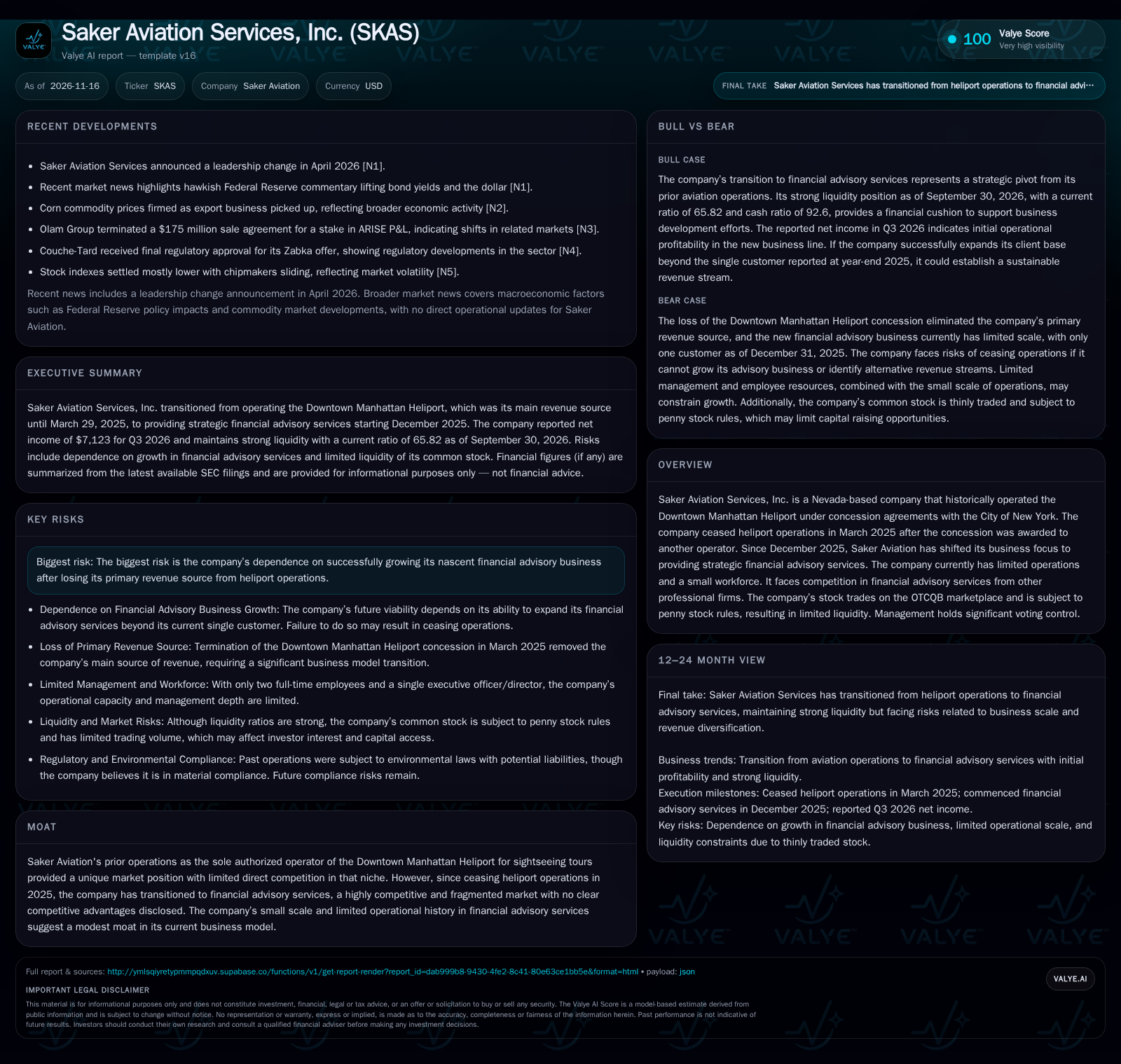
Saker Aviation has exited aviation operations and now provides financial advisory services to a single client as of late 2025. Success now depends on client acquisition and market differentiation in a crowded sector. [S1] [S2]
Saker Aviation Services’ identity has undergone a dramatic transformation. Once the exclusive operator of the Downtown Manhattan Heliport—a unique and defensible niche—the company lost its concession in early 2025 and subsequently pivoted to the crowded field of financial advisory. While this transition preserved the corporate shell and leveraged its remaining liquidity, Saker now faces the daunting task of building a viable business from a single-client foundation, with minimal staff and no clear competitive edge. Its large reported cash balance buys time, but the window to prove commercial traction in a highly competitive environment may be narrow.
Saker’s Transition from Heliport Monopoly to Sole-Client Advisory Services
Three facts define Saker Aviation’s present reality. First, the company’s primary revenue source—the Downtown Manhattan Heliport concession—was terminated effective March 29, 2025, forcing a wholesale business model reset. Second, Saker commenced strategic financial advisory services in December 2025, but as of year-end had only a single customer, highlighting the embryonic stage of its new business line. The company reported cash and liquidity metrics for the period; these figures do not by themselves establish operating runway, investment capacity, financial flexibility, or financing capacity. [S1] [S2]
Understanding the Economics Behind Saker’s Advisory Model: Cost Structures and Margin Challenges
The transition from capital- and labor-intensive heliport operations to financial advisory fundamentally alters Saker’s cost structure. Whereas the former required significant fixed assets, regulatory compliance, and staff, the new model is potentially asset-light, with only two full-time employees and no executive officers as of year-end 2025. This should lower fixed overhead and allow for rapid scalability in theory—if demand materializes. However, advisory services tend to be relationship-driven, with revenue often tied to hours billed, project fees, or retainer arrangements. With only one customer, Saker’s revenue base may be lumpy and unpredictable, and pricing power is likely limited unless the company can demonstrate unique expertise or access. Operating leverage could become favorable if Saker acquires multiple clients, as incremental advisory work often carries high gross margins after covering the cost of talent, but the current scale offers no such leverage. The company’s substantial liquidity reduces near-term capital needs, but the economics hinge on successful client acquisition and retention. [S1] [S2]
The shift to an advisory business also introduces variability in revenue recognition timing and cash flow patterns. Unlike the more predictable, contractually defined revenue from operating a heliport, advisory fees may be contingent on milestone achievements, client approvals, or project completions, which can delay cash inflows. This variability complicates short-term financial planning and heightens the importance of maintaining reported liquidity position buffers. Furthermore, the company’s ability to price services effectively depends on its perceived expertise and reputation, which are still nascent in the advisory domain. Without a track record or distinctive value proposition, Saker may face downward pressure on fees, limiting gross margins and constraining reinvestment capacity.
Navigating Competition in Professional Services: Saker’s Position in a Relationship-Centric Market
Saker’s former moat—a city-conferred monopoly on a high-traffic heliport—has vanished. The financial advisory industry is intensely competitive, with well-entrenched incumbents, boutique specialists, and a low barrier to entry. With only one customer as of late 2025, Saker faces the classic cold-start problem: breaking into established client relationships and differentiating in a market where trust and execution history matter most. Unless the company can carve out a niche, form strategic partnerships, or leverage legacy aviation relationships into advisory mandates, its competitive position appears fragile. [S1]
In addition to client acquisition challenges, Saker must contend with the reputational dynamics inherent in professional services. Trust and credibility are often built over extended periods and through demonstrated success with multiple clients. The lack of visible advisory achievements or a diversified client portfolio may hinder the company’s ability to generate referrals or leverage word-of-mouth marketing, which are critical in this sector. Moreover, established competitors may respond aggressively to new entrants by offering bundled services or discounted rates, raising the barriers for Saker to gain meaningful market share. Strategic partnerships or alliances could mitigate these challenges, but forming such relationships requires time and mutual confidence that may be difficult to secure at the current scale.
Potential for Growth Through Liquidity: Building a Sustainable Advisory Business
A favorable outcome for Saker would involve leveraging its liquidity to attract talent, invest in targeted business development, and convert legacy aviation contacts into advisory clients. The company could focus on sectors where it has historical expertise—such as aviation, transportation, or infrastructure finance—or identify underserved niches with less competition. Success would require rapidly expanding the client roster beyond the single disclosed customer, generating multi-client, recurring advisory fees that cover fixed costs and allow for positive operating leverage. Evidence confirming this scenario would include sequential growth in client count, diversification of revenue sources, and a move from quarterly profitability blips to sustained net income. Milestones such as new contract announcements, disclosed sector specialization, or the hiring of seasoned advisory professionals would further bolster the bull case. Failure to see pipeline expansion or evidence of sector focus would falsify this scenario. [S1] [S2]
If Saker successfully leverages its liquidity to recruit experienced advisory professionals, it could accelerate market penetration by enhancing service quality and expanding capacity. Seasoned advisors bring established networks and credibility, which can shorten sales cycles and improve client retention. Moreover, focusing on sectors aligned with Saker’s historical expertise could create a competitive advantage by combining industry knowledge with financial advisory skills. This specialization might enable the company to develop tailored service offerings that differentiate it from generalist firms, potentially commanding premium fees. However, this strategy depends on identifying niche markets with sufficient demand and limited competition, and on executing targeted marketing and business development efforts effectively.
Likely Outcomes Without Major Breakthroughs: Saker’s Growth Prospects
The most plausible path for Saker over the next 12-24 months is one of slow progress and persistent uncertainty. The company may win a handful of new advisory mandates, but client concentration will likely remain high, and revenue volatility could persist. With only two employees and limited brand presence, Saker may struggle to compete for larger or more lucrative projects. Cash burn may be modest, given the asset-light model, but without evidence of revenue ramp or client diversification, the company’s valuation and long-term viability would remain speculative. Confirmation of this scenario would come from continued single-digit client counts, marginal profitability or small losses, and no major publicized wins. Falsification would require a step-change in business scale, such as multi-client disclosures, major sector partnerships, or evidence of recurring, diversified revenue streams. [S1] [S2]
Absent a significant breakthrough, Saker may face a protracted period of client concentration risk, where revenue is heavily dependent on a small number of engagements. This scenario exposes the company to volatility from client attrition or project delays, which could disrupt cash flow and profitability. Additionally, limited brand recognition and a small team may restrict the company’s ability to bid competitively for larger mandates or participate in multi-disciplinary advisory projects. The asset-light model reduces fixed costs but also limits the company’s capacity to invest in business development or technology platforms that could enhance service delivery and scalability. Consequently, growth may remain incremental and insufficient to achieve sustainable profitability without strategic shifts or external capital infusion.
Risks of Saker’s Advisory Shift: Consequences of Limited Market Penetration
A negative outcome would see Saker unable to expand its client base or establish a differentiated advisory offering, leading to persistent operating losses and eventual exhaustion of its liquidity cushion. In this scenario, the company’s cash and investments would be gradually depleted by overhead costs, and the thinly traded stock would constrain capital-raising options. Key warning signs would include continued reliance on a single client, shrinking cash balances, staff attrition, or statements about exploring strategic alternatives or ceasing operations. The company’s own risk disclosures acknowledge the possibility of winding down if new revenue streams are not secured. Confirmation of this scenario would be repeated disclosures of stalled business development, persistent net losses, or moves to liquidate assets or pursue mergers solely for survival. [S1] [S2]
Key Developments That Will Influence the Success of Saker’s Advisory Strategy
Number of active financial advisory clients disclosed in future filings or communications—client count is a direct measure of business traction.
Total advisory revenue and its concentration by client—if disclosed, this would reveal both scale and dependence on single relationships.
Hiring or retention of experienced advisory professionals—expansion of the team would suggest growth ambitions and increased capacity.
Public announcements of sector focus, strategic partnerships, or major contract wins—these would help validate the company’s differentiation strategy.
Evidence of recurring or multi-year advisory contracts—if disclosed, such contracts would improve revenue visibility.
Disclosures regarding strategic alternatives, asset sales, or going concern warnings—these would signal stress or a failure to execute the new business model.
Any regulatory or compliance developments related to past aviation operations or new advisory activities—unexpected liabilities could impact the company’s cash position.
Disclaimer: This is research-only, informational analysis and not investment advice. It may include AI-generated interpretation and general industry context. Always verify important details using primary sources.

Comments