
Snap-on Inc Strengthens Operational Efficiency and Market Reach in Q1 2026
Snap-on's Q1 2026 results highlight progress in segment growth, operational initiatives, and robust financial health supporting its strategic agenda.
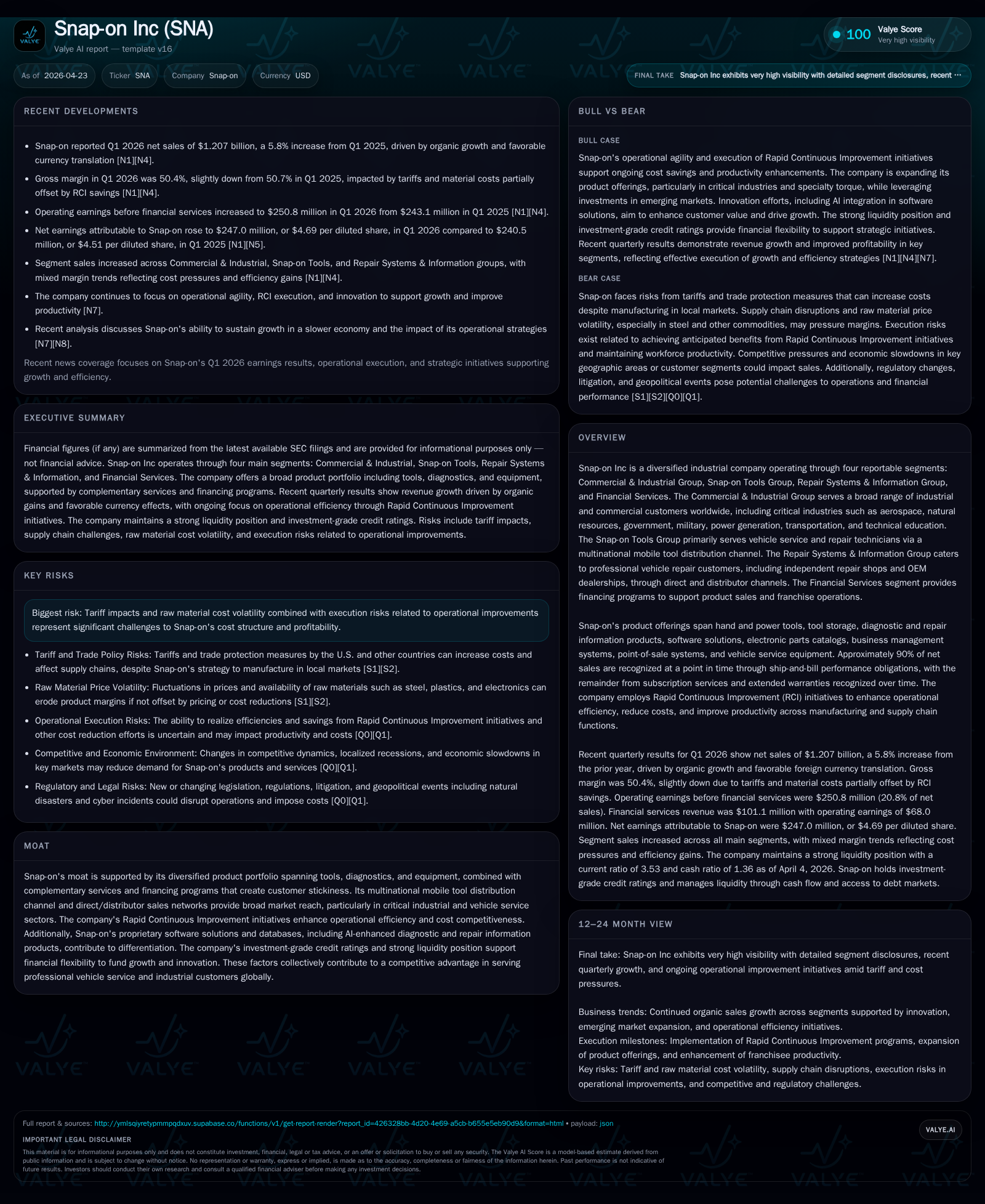
In the first quarter of 2026, Snap-on Inc reported organic revenue gains driven by critical industrial sectors and specialty torque tools despite material cost pressures. The company's diversified business model across four segments—tools, diagnostics, repair information, and financial services—underpins its market resilience and customer loyalty. Operational efficiencies via Rapid Continuous Improvement programs and a strong liquidity position support Snap-on’s capacity to innovate and expand globally, even as tariff effects and execution risks persist. Monitoring quarterly segment performance and margin trends along with new product adoption will be key to assessing Snap-on's trajectory.
Q1 2026 Operating Update: Performance Highlights and Strategic Implications
Snap-on Inc’s first quarter ended April 4, 2026 showcased incremental organic growth amid an environment of persistent tariff headwinds and raw material cost inflation [S2]. Total segment net sales grew approximately 0.9% organically year-over-year, supported by a mid-single-digit gain in the Commercial & Industrial Group's critical industry businesses—especially specialty torque products—and a double-digit increase in segment sales compared to Q1 2025 [S19]. The Snap-on Tools Group also advanced its revenues with higher activity across the multinational mobile tool distribution channel [S24].
However, gross margins contracted by roughly 230 basis points in some segments due primarily to higher tariffs and materials pricing [S19], reflecting industry-wide input cost pressures that Snap-on has faced since the escalation of U.S. trade measures starting in 2025 [S1]. The company partly mitigated these impacts through operational savings under its Rapid Continuous Improvement (RCI) program aimed at cost reduction and manufacturing efficiencies—a central theme underscored in management commentary during the earnings call [N1,N4]. Segment operating earnings showed moderate improvement or stability across key segments despite margin headwinds.
This latest quarter underscores management’s priorities on expanding market reach via tailored products for critical industries while leveraging cross-segment synergies such as combining diagnostic software offerings with physical tools within professional service channels [S3]. These efforts are designed to strengthen Snap-on’s competitive moat by enhancing customer value propositions and improving operational agility.
Business Model Overview: Integrated Segments Driving Customer Stickiness
Snap-on operates through four reportable business segments: (1) Commercial & Industrial Group; (2) Snap-on Tools Group; (3) Repair Systems & Information Group; and (4) Financial Services [S1]. This diversified portfolio balances demand across multiple industries including aerospace, natural resources, government/military sectors, independent automotive repair shops, OEM dealerships, and vehicle service technicians worldwide.
Revenue stems from a mix of physical tool sales (hand tools, specialty torque tools), diagnostic equipment and AI-enhanced software products providing repair information, undercar equipment solutions, coupled with financing programs that aid franchise operators in acquiring inventory or vehicles [S1]. Particularly noteworthy is the global mobile tool distribution network serving vehicle technicians directly—this channel fosters deep customer relationships entrenching switching costs.
The Financial Services segment uniquely supports product sales through credit programs, which not only facilitate purchases but also contribute recurring revenue streams via interest income on receivables. This integrated approach enhances overall customer stickiness by embedding financial incentives into the value chain [N6,N10].
Product quality remains industry-leading buoyed by ongoing R&D investments focused on innovation responsiveness to end-user feedback especially in specialized tooling niches like high-precision torque solutions targeting aerospace or industrial maintenance markets [S1]. Meanwhile, digital transformation efforts led by AI-driven diagnostic data platforms deliver actionable intelligence that differentiates Snap-on from competitors largely reliant on analog offerings.
Competitive Positioning within Industrial Tools and Vehicle Service Markets
The industrial tools and vehicle service landscape is marked by intense competition moderated by barriers related to brand reputation, distribution reach, proprietary technology portfolios, and sophisticated financing options [S1,S2]. Snap-on holds entrenched advantages stemming from its extensive mobile sales footprint, proprietary software/data assets enhancing diagnostic accuracy, plus well-established direct/distributor sales channels.
Tariffs imposed since early 2025 have complicated pricing dynamics as global supply chains adjust with regional manufacturing localization strategies intended to mitigate import costs—but raw material prices remain volatile impacting gross margins [S2]. Snap-on’s RCI initiatives targeting manufacturing footprint optimization improve its capacity to absorb such external cost shocks while maintaining output flexibility.
Regulatory trade uncertainties continue to present risks; however strategic investments in emerging markets broaden geographic exposure beyond mature economies where demand cycles can be more volatile [N10]. Additionally, advancements in digital diagnostic product adoption serve as a substantial growth vector as independent shops increasingly rely on efficient repair information systems over legacy manual processes.
Growth Opportunities: Innovation, Market Expansion, and Continuous Improvement
Snap-on’s outlook benefits from several structural growth drivers. Specialty torque tooling stands out as a high-value product category experiencing solid double-digit growth demonstrated in recent quarter performance reflecting heightened demand driven by sectors like aerospace where precision maintenance is critical [S19].
Expanding geographic penetration into emerging markets complements core strengths and offsets mid-single-digit softness in Asia Pacific hand tools noted historically [S1]. The company's focus on refining customer-connection insights allows bespoke product development aligned with specific industry workflows creating more compelling value-added solutions.
Rapid Continuous Improvement programs continue yielding operational savings projected to enhance future margin profiles if executed effectively. Moreover, expanding AI-enabled diagnostic data services address evolving customer needs for real-time analytics facilitating faster repair turnaround times—the latter an inflection point for attracting a broader professional user base beyond traditional franchisee clients [N10].
The evolution of Snap-on’s franchise strategy encompassing service enhancement measures further supports sales volume growth while retaining entrepreneurial stakeholders integral to its go-to-market model.
Challenges Ahead: Cost Volatility, Tariffs, and Execution Risks
Significant execution risks accompany Snap-on’s transformation agenda especially related to realizing anticipated savings from RCI initiatives without compromising production quality or delivery timelines [S2]. Workforce productivity improvements are dependent on effective change management amid tight labor markets potentially constraining capacity expansion.
Tariff impositions remain a wildcard element influencing input costs particularly steel, plastics, and electronics vital for tooling production. Although manufacturing localization mitigates some exposure regionally, external trade policies could shift unexpectedly disrupting supply chains further [S1,S2].
Fluctuations in currency exchange rates also pose profit translation challenges given Snap-on’s multinational operations [S19]. Lastly regulatory changes impacting data security protocols for software offerings necessitate ongoing investment to ensure compliance without diluting innovation speed.
What Investors Should Monitor: Metrics, Guidance, and Execution Milestones
Key near-term indicators include quarterly revenue progression segmented by geography—watching for continued growth momentum in specialty torque tools alongside stabilization or gains in the Commercial & Industrial Group’s critical industry accounts [S2,S19]. Progress metrics tied to RCI savings targets measured through operating margin trends will provide insight into cost structure improvements despite raw material inflation pressures.
Adoption rates of new AI-enabled diagnostic platforms within Repair Systems & Information channels represent leading demand markers complementing traditional tool sales volume data [N4,N10]. Monitoring financing receivable growth serves as proxy for franchisee purchasing health indicating underlying demand strength supportive of Snap-on’s extended business model.
Management updates during subsequent SEC filings or earnings calls focusing on tariff pass-through success rates alongside technology investment outcomes should guide assessment of sustainability for current operating leverage enhancements.
Financial Profile: Capital Structure, Cash Flow, and Return Measures
Historical performance (annual)
| FY | Rev ($bn) | Net ($mm) | CFO ($mm) | OpInc ($mm) | Rev YoY | Net YoY |
|---|---|---|---|---|---|---|
| 2025 | 5.2 | 1017 | 1082 | 1328 | +0.9% | -2.6% |
| 2024 | 5.1 | 1044 | 1218 | 1346 | +0.0% | +3.2% |
| 2023 | 5.1 | 1011 | 1154 | 1310 | +5.5% | +10.9% |
| 2022 | 4.8 | 912 | 675 | 1207 |
Source: SEC companyfacts cache [F1].
Capital returns and efficiency (annual)
| FY | Div ($mm) | Buybacks ($mm) | ROE% |
|---|---|---|---|
| 2025 | 462 | 329 | 17.1 |
| 2024 | 406 | 290 | 19.4 |
| 2023 | 356 | 295 | 19.9 |
| 2022 | 313 | 198 | 20.3 |
Source: SEC companyfacts cache [F1].
Snap-on maintains robust financial health positioning it well for continued investment. As of April 4, 2026, cash and equivalents stood at $1.75 billion while current assets exceeded current liabilities by $3.26 billion yielding a solid current ratio of approximately 3.53—indicating strong short-term liquidity support [F1,S4].
Operating cash flow rose $70 million YoY in Q1 thanks to improved working capital management alongside modest net income gains reflecting controlled expense expansion relative to revenues [F1,S7]. Despite cost headwinds depressing operating income marginally year-over-year (-1.3%), adjusted earnings remain healthy at $1.33 billion for FY2025 demonstrating resilient profitability amidst inflationary pressures [F1,S2].
Leverage ratios continue conservative with long-term debt about $887 million consisting mainly of fixed-rate notes maturing well beyond near term without any draws on revolving credit facilities highlighting prudent capital stewardship [S9,S14,S20].
Capital allocation emphasizes shareholder returns balanced with growth funding as dividends paid totaled $462 million with share repurchases totaling roughly $329 million in FY2025 continuing multi-year trends confirming commitment to reflecting confidence in sustainable free cash generation capacity supported by an ROE above 17% [F1,S6,S16].
This analysis is intended solely for informational purposes grounded in publicly available filings without any investment advice or recommendations. All interpretations reflect data as of April 23, 2026.
Disclaimer: This is research-only, informational analysis and not investment advice. It may include AI-generated interpretation and general industry context. Always verify important details using primary sources.

Comments