
SunScout’s Early Solar Growth: Project Wins, Funding Limits, and Scaling Opportunities
SunScout Holding Ltd is expanding from New Zealand into Southeast Asia’s solar-plus-storage market, with new project wins and fresh IPO capital. The company’s execution on sizable construction contracts and international product shipments could drive growth, but profitability, liquidity, and operational scale remain open questions as it navigates a competitive and capital-demanding sector.
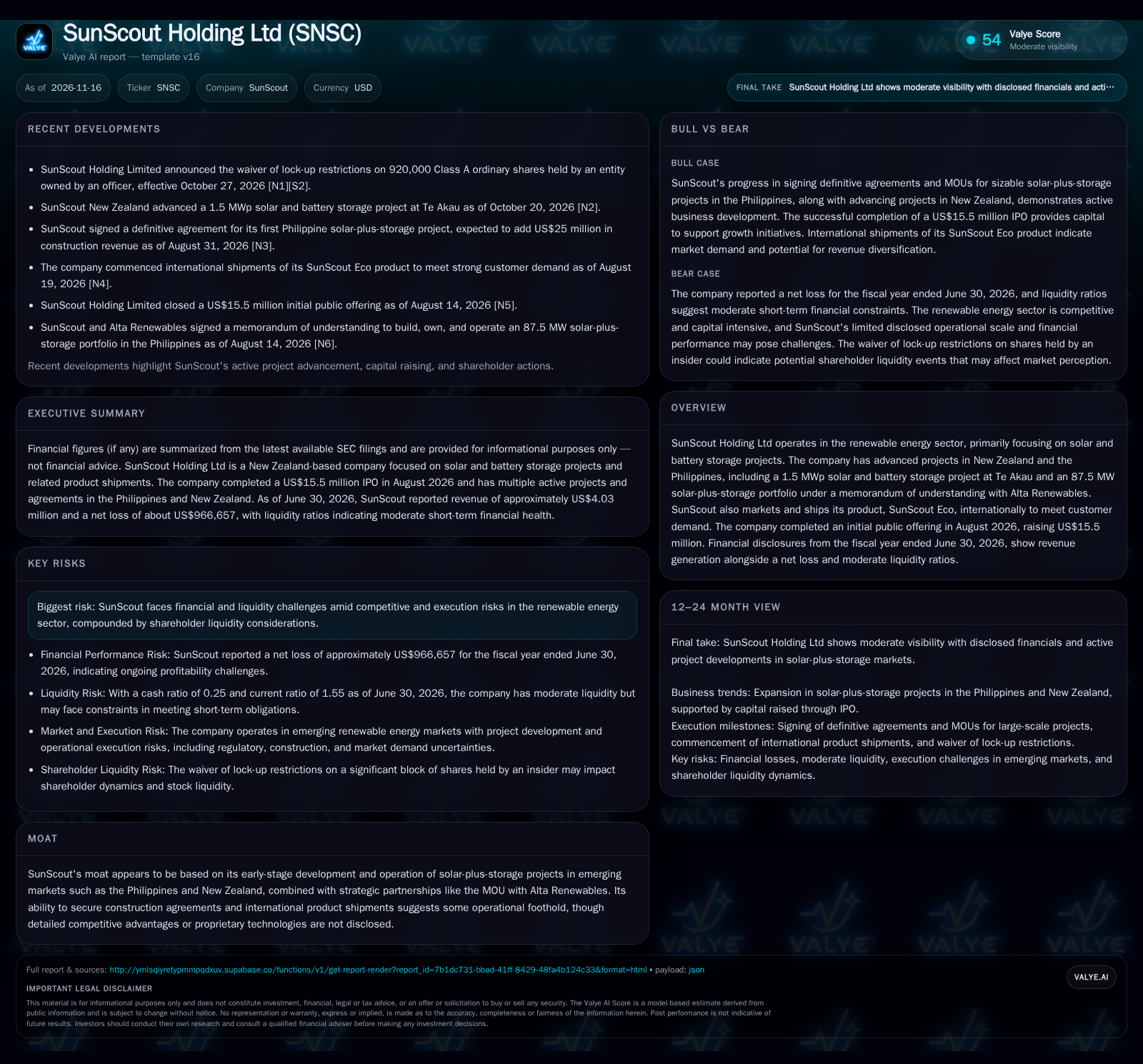
SunScout has secured its first major international solar-plus-storage project in the Philippines and completed a US$15.5 million IPO, signaling momentum in project development and capital access. Watch for progress on project delivery, margin evolution, and further commercial wins in emerging markets. [S1] [N3] [N5]
SunScout Holding Ltd’s recent moves—securing a US$25 million construction contract in the Philippines, closing a US$15.5 million IPO, and launching international shipments of its solar hardware—signal a company in transition from local operator to regional developer.
Recent Project Wins and Capital Raise Set the Stage for Regional Expansion
SunScout’s business model advanced materially in 2026 with two anchor developments: the company signed a definitive agreement for a solar-plus-storage project in the Philippines, projected to add roughly US$25 million in construction revenue, and raised US$15.5 million through its initial public offering. These events mark a step-change from SunScout’s modest FY26 revenue base of US$4.03 million and net loss of approximately US$966,657, suggesting a pivot from demonstration projects to larger-scale execution. SunScout’s concurrent international shipments of its SunScout Eco product and new project pipeline—including a memorandum of understanding for an 87.5 MW portfolio with Alta Renewables—signal an intent to build recurring business lines beyond one-off construction. However, reported liquidity position, with a cash ratio of 0.25 and a current ratio of 1.55 as of June 30, 2026, indicating only limited near-term financial cushioning as the company ramps up its commitments. [N3] [N5] [S1]
Solar-Plus-Storage Economics: Construction Revenue, Product Margins, and Capital Demands
SunScout’s revenue model appears to be a hybrid of project-based construction income and product sales. The US$25 million Philippine project is expected to generate construction revenue, which is typically recognized on a percentage-of-completion basis in the EPC (engineering, procurement, and construction) segment. Such projects can provide lumpy, high-dollar inflows but may have slim or volatile margins, especially in competitive and cost-sensitive emerging markets. The international shipments of SunScout Eco suggest an effort to build a hardware product line, which could offer higher gross margins if the company can scale manufacturing and distribution. However, the initial scale remains uncertain, and hardware revenues are often cyclical and exposed to price competition.
Operating leverage in renewables can be significant once a project pipeline is established, as fixed costs (engineering, project management, R&D) can be spread over a growing asset base. But the capital intensity is high: upfront cash outlays for equipment, permitting, and construction are substantial, and project timelines are long. SunScout’s recent IPO proceeds are likely earmarked for these working capital and project development needs. The company’s current cash and short-term assets, relative to its increased commitments, may necessitate further financing or careful working capital management if project execution lags or overruns occur. [S1] [N5] [N3]
Navigating a Crowded Field: Early Mover in Emerging Markets or Facing Global Solar Giants?
SunScout is targeting solar-plus-storage opportunities in the Philippines and New Zealand—markets that offer growth potential but also attract established global EPCs, regional utilities, and local developers. The company’s early-stage projects and partnerships, such as the MOU with Alta Renewables, may provide local market access and help overcome regulatory or logistical barriers. However, the lack of disclosed proprietary technology, long-term customer contracts, or recurring revenue mechanisms means SunScout may be vulnerable to price competition and substitution by larger, better-capitalized players.
In the solar EPC and battery storage value chain, differentiation often comes from project execution speed, local relationships, cost structure, and, in some cases, proprietary integration of storage or grid management software. SunScout’s ability to win its first major Philippine contract suggests some operational credibility, but it is not yet clear if this represents a repeatable advantage or a one-off win. The company’s product shipments could offer margin upside if it can carve out a niche in hardware, but this segment is also crowded and price-sensitive. The question is whether SunScout can build a durable pipeline and recurring business before competitors erode its early momentum. [N3] [N6] [N4]
If SunScout Converts Pipeline to Cash Flow: Pathways to Scale and Margin Expansion
The bull case hinges on SunScout successfully executing its Philippine construction contract—generating the expected US$25 million in revenue without major cost overruns—and leveraging this as a reference to win further EPC deals in the region. If the 87.5 MW MOU with Alta Renewables matures into signed contracts and on-time project delivery, SunScout could establish a recurring backlog, supporting both top-line growth and incremental operating leverage. International shipments of SunScout Eco, if scaled, could provide a second revenue stream with potentially higher margins and brand recognition.
Confirmation of this scenario would come from disclosed backlog growth, evidence of repeat project wins, margin expansion on both EPC and product sales, and a positive shift in operating cash flow. Additional signs would include the renewal or expansion of strategic partnerships, successful commissioning of the Te Akau project in New Zealand, and further international customer adoption of SunScout Eco. Falsification would involve project execution delays, cost overruns, or inability to convert MOUs into binding revenue-generating contracts. [N3] [N6] [N4]
Building a Foothold but Facing Execution and Funding Hurdles
The most plausible trajectory is that SunScout delivers its current Philippine construction project and advances the Te Akau New Zealand site, but experiences uneven project timing, modest profitability, and ongoing working capital strain. While the IPO proceeds provide a temporary buffer, the company may need to raise additional capital or secure project financing to support further growth, especially if the 87.5 MW MOU takes time to convert to revenue.
In this scenario, SunScout establishes a reputation as a credible regional developer but remains subscale relative to global competitors. Product shipments of SunScout Eco generate incremental revenue but do not move the needle on profitability until manufacturing and distribution scale up. Confirmation would come from on-budget project delivery, stable or improving gross margins, and the announcement of new project wins or hardware contracts. Falsification would involve missed milestones, persistent net losses, or evidence of financial distress—such as delayed supplier payments or the need for emergency financing. [S1] [N2] [N3]
Cash Burn, Project Delays, and Erosion of Early Momentum
The bear case features SunScout running into execution headwinds: project delays, cost overruns, or regulatory setbacks in the Philippines or New Zealand could impair the company’s ability to recognize revenue and collect cash. Should the MOU with Alta Renewables fail to convert into binding contracts, the pipeline would thin, reducing future visibility.
On the balance sheet, continued net losses and cash burn could pressure SunScout to seek dilutive financing or asset sales. The recent waiver of lock-up restrictions on 920,000 insider shares could introduce stock volatility and complicate further capital raises. Evidence of this scenario would include negative operating cash flow, missed project deadlines, declining cash balances, or loss of key partners. Conversely, timely execution or successful new awards would help refute the downside case. [S1] [N1]
Milestones That Will Define SunScout’s Trajectory in Solar-Plus-Storage
Progress on the Philippine solar-plus-storage project: on-time, on-budget delivery and revenue recognition would validate execution capabilities. [N3]
Conversion of the 87.5 MW Alta Renewables MOU into binding EPC contracts and eventual backlog disclosure, if provided. [N6]
Commissioning and operational performance of the Te Akau 1.5 MWp project in New Zealand, including any disclosed revenue or margin updates. [N2]
International SunScout Eco product shipment volumes, new customer wins, and any disclosed gross margin trends on hardware sales. [N4]
Net cash flow from operations and changes in cash and cash equivalents, as reported in future filings. [S1]
Gross margin evolution on both EPC projects and product sales, if disclosed; a useful metric would be project-level profitability.
Any further capital raises, debt issuances, or evidence of working capital stress, such as delayed payables or supplier disputes, if disclosed.
Stock trading dynamics following the waiver of lock-up restrictions on insider shares, and any related insider sales or market impact. [N1]
Disclaimer: This is research-only, informational analysis and not investment advice. It may include AI-generated interpretation and general industry context. Always verify important details using primary sources.

Comments