
Sensei Biotherapeutics Advances Clinical Pipeline and Navigates Strategic Leadership Transition with Strong Liquidity
Recent quarterly updates highlight clinical progress, acquisition integration, and governance restructuring as key inflection points for Sensei Biotherapeutics.
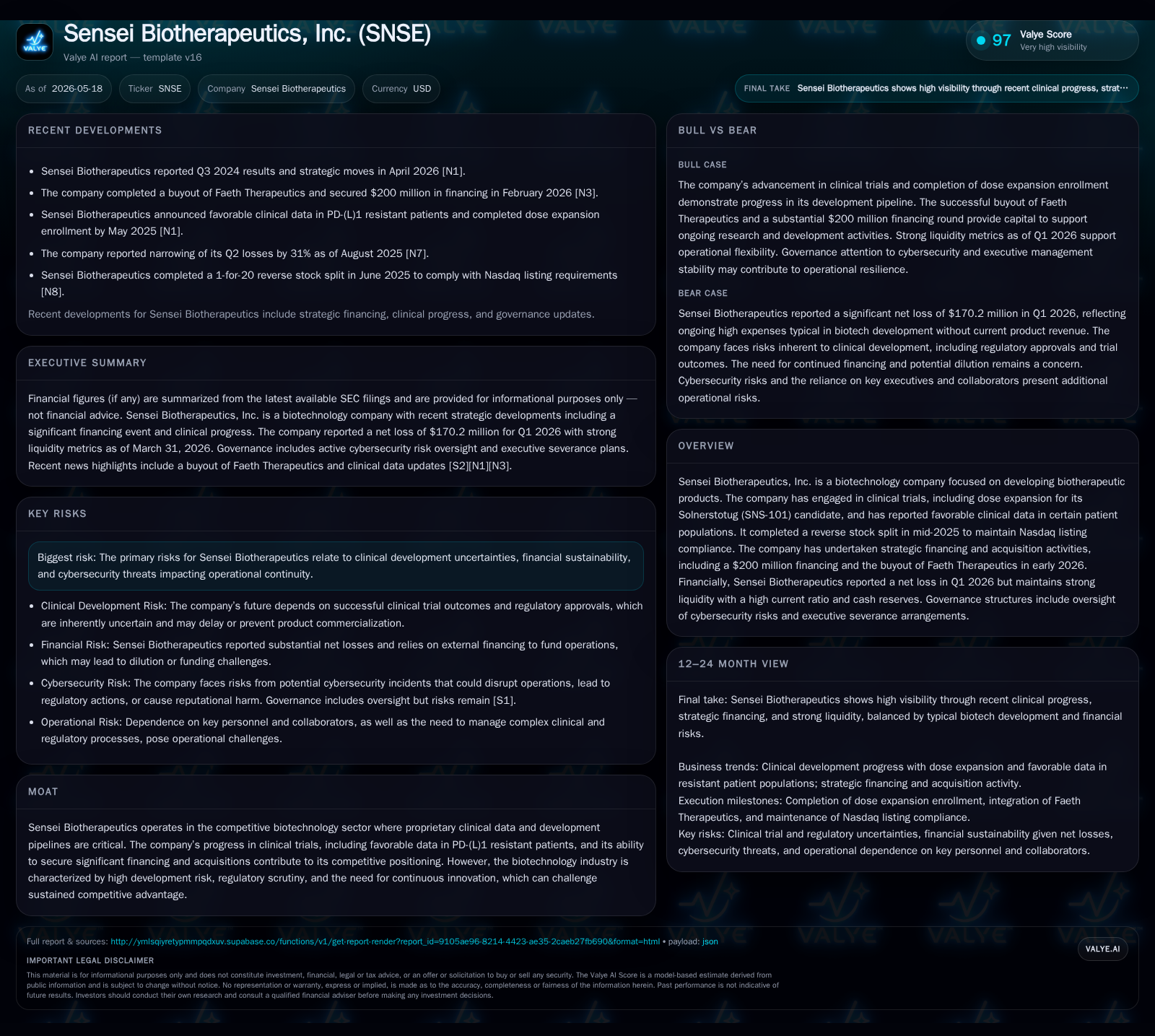
Sensei Biotherapeutics' Q1 2026 filing reveals continued clinical development progress, including dose expansion of its lead candidate Solnerstotug (SNS-101), underpinned by favorable data in resistant patient populations. The company completed a significant $200 million financing round and acquired Faeth Therapeutics, bolstering its biotechnology pipeline. Concurrently, Sensei is navigating notable leadership changes and governance adaptations while maintaining robust liquidity and operational focus amid inherent biotech sector risks.
Recent Operating Update
Sensei Biotherapeutics’ latest quarterly filing dated May 15, 2026 ([S2], [S3]) reveals continued operational execution centered on clinical development advancement and strategic corporate growth. The company remains focused on dose expansion studies for its lead therapeutic candidate, Solnerstotug (SNS-101), specifically targeting patients resistant to PD-(L)1 therapies—a critical unmet need in immuno-oncology. Favorable efficacy signals in these cohorts reinforce potential differentiation within a crowded checkpoint inhibitor adjunct space.
Capitalizing on this momentum, Sensei closed a $200 million financing round enabling increased R&D investments and operational scaling [S3]. This infusion supported the early-2026 acquisition of Faeth Therapeutics, expanding their pipeline breadth with complementary assets that may accelerate time-to-market or enrich future combination strategies. These developments affirm Sensei’s dual approach of internal innovation plus external augmentation to sustain a competitive development corridor.
Alongside these operational strides, leadership transitions are underway: Anand Parikh is expected to assume the CEO role post-annual meeting pending stockholder approval, succeeding Christopher Gerry who will continue as General Counsel. Further changes include appointment of Brian Stephenson as CFO replacing Josiah Craver. These moves signal a governance recalibration aiming to align executive capabilities with burgeoning commercialization challenges.[S9], [S10], [S11]
Business Model
Sensei Biotherapeutics operates as a clinical-stage biotechnology company primarily engaged in developing novel biotherapeutic candidates targeting oncology indications with some focus on immunotherapy-resistant tumor populations. Their revenue model is predominantly pre-commercial; thus, short- to medium-term top-line inflows derive from strategic financings, milestone-based collaborations (if any), or licensing activities rather than product sales.
Revenue drivers hinge on successful progression of clinical candidates through phased trials backed by proprietary scientific insights into immune evasion mechanisms. Investors indirectly fund pipeline advancement through equity injections evident in recent financing rounds. Success translates into value creation via licensing deals or eventual commercialization partnerships where upfront payments, royalties, or co-development fees could materialize.
R&D expenses dominate cost structure due to extensive clinical trial activities requiring significant resource allocation for protocol execution, patient recruitment across geographies, regulatory filings, and manufacturing scale-up readiness [S1]. Strategic acquisitions like Faeth Therapeutics potentially reduce time-to-market or broaden the technological moat by supplementing existing pipelines with differentiated modalities or biomarkers.
Industry Structure and Competitive Position
Within the biotech ecosystem focused on immuno-oncology and biotherapeutics development, Sensei competes against multiple established pharma companies as well as emerging biotech innovators probing checkpoint inhibitor resistance pathways. The industry demands sustained clinical innovation given high attrition rates in drug development and stringent regulatory oversight.
Sensei’s competitive edge partly stems from its targeted approach addressing PD-(L)1 resistance mechanisms—a segment receiving heightened attention due to limited effective treatment options post-resistance emergence. Furthermore, the company’s ability to secure substantial capital and execute accretive acquisitions signals solid investor confidence and strategic foresight relative to peers constrained by narrower pipelines or capital paucity.
Operational collaborations with CROs for trial management and integration of acquired assets enhance flexibility and strengthen platform capabilities. However, scale remains modest compared to large-cap pharmaceutical players which enjoy diversified approved portfolios providing more stable cash flows.
Growth Drivers
Clinical Development Progression
The foremost driver is advancing Solnerstotug (SNS-101) through expanded dose-finding cohorts demonstrating safety and preliminary efficacy in resistant patient populations. Successful outcomes here can de-risk subsequent pivotal trials attracting partner interest or accelerating regulatory dialogues.
Acquisition Integration & Pipeline Diversification
Incorporating Faeth Therapeutics’ technologies adds new molecular entities or platform technologies that can enhance overall therapeutic breadth. Leveraging combined R&D expertise facilitates more comprehensive pipeline strategies targeting multiple tumor types or resistance phenotypes.
Capital Infusion Enabling Scale-up
Recent $200 million financing provides operational runway essential for scaling ongoing trials while supporting infrastructure buildout including specialized manufacturing or biomarker development critical for next-phase clinical validation.
Regulatory Engagements & Milestones
Gaining FDA or equivalent approvals for trial expansions or design modifications serve as inflection points validating clinical hypotheses underpinning product candidates.
Risks / Watchpoints / Growth Constraints
Clinical Development Uncertainty
Outcome variability inherent in biotech R&D persists as a principal risk—trial failures can affect funding access and investor confidence materially.
Financial Sustainability & Burn Rate Management
Despite strong liquidity with over $150 million in cash ([F1]), continued net losses compound funding needs necessitating efficient capital deployment or future financings that could dilute ownership.
Cybersecurity Exposure
Given sensitive patient data processing and reliance on digital infrastructure for clinical operations, cybersecurity risks pose threats potentially affecting trial integrity or regulatory compliance [S1]
Leadership Transition Execution Risk
Shifts in senior management require smooth handoffs ensuring continuity of strategic vision without disruption to ongoing R&D programs or stakeholder communications.[S9]
Competitive Landscape Headwinds
Emerging competitor pipelines or rapid technological shifts could pressure market relevance if Sensei’s platforms do not demonstrably differentiate through superior efficacy or safety.
What to Watch Next
Milestones pivotal to Sensei's trajectory include:
- Interim readouts from Solnerstotug dose expansion cohorts evaluating response durability in PD-(L)1 resistant patients.
- Successful integration benchmarks related to Faeth Therapeutics’ technology portfolio enhancing pipeline robustness.
- Stockholder approval outcomes impacting leadership appointments signaling governance stability.
- Updates on cash burn relative to guidance illuminating financing runway sustainability.
- Any announcements regarding licensing deals or partnerships leveraging clinical data successes that might catalyze near-term revenue streams.
Monitoring patient enrollment speed in trials will serve as a proxy for operational efficiency while regulatory feedback will offer early directional cues on approval timelines. Additional clarity on management mandate after transition exercises could influence strategic pivoting or capital allocation decisions.
Financial Profile Snapshot
While pre-revenue from commercial products, Sensei showcased strong liquidity at quarter-end March 31, 2026 with cash and equivalents totaling $152.3 million and a current ratio north of 14 indicating ample short-term asset coverage over liabilities ([F1]). This positions the company comfortably to fund ongoing research activities without immediate refinancing pressure.
Reported net loss remains substantial driven by elevated R&D expenses typical for the stage; however, recent capital raise reduces near-term solvency concerns ([S2], [S3]). Total debt was minimal at last available measure indicating conservative balance-sheet leverage complemented by sizeable cash reserves ([F1]).
Such financial footing provides operational agility yet mandates disciplined expense control aligning burn rate with value-inflecting milestones to preserve shareholder value over coming quarters.
This analysis synthesizes publicly filed disclosures without rendering investment advice. Readers should consider the intrinsic volatility of biotechnology enterprises characterized by binary trial outcomes and evolving regulatory landscapes when evaluating risks associated with Sensei Biotherapeutics’ business model and prospects.
Disclaimer: This is research-only, informational analysis and not investment advice. It may include AI-generated interpretation and general industry context. Always verify important details using primary sources.

Comments