
Summit Networks’ Strategic Shift Toward Logistics Acquisitions in Asia
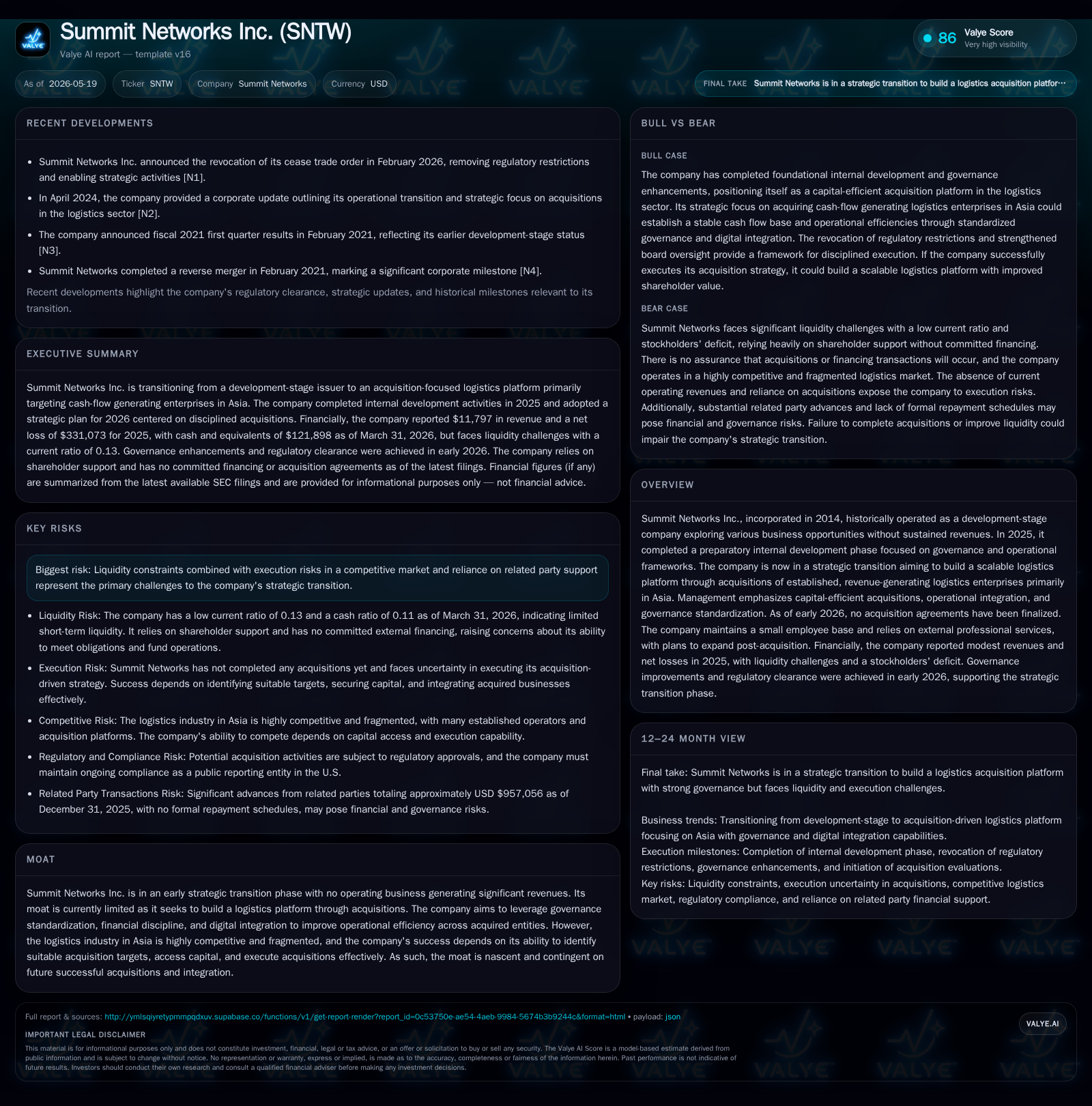
Summit Networks Inc. is transitioning from a development-stage entity to an acquisition-focused logistics platform targeting Asian markets, emphasizing governance improvements and disciplined execution amid liquidity pressures.
In its latest quarterly filings, Summit Networks reported progress in governance and organizational restructuring following regulatory clearance in early 2026, while actively preparing for acquisitions of cash-flow stable logistics businesses primarily in Asia. Despite no acquisitions finalized as of Q1 2026, management’s focus on capital-efficient buyouts supported by newly implemented digital workflows signals a strategic pivot away from previous exploratory stages. The company faces immediate challenges including significant liquidity constraints and reliance on shareholder support, making acquisition execution and integration critical milestones for validating its business model transformation.
Latest Quarterly Operating Update: Transition Progress and Challenges
Summit Networks Inc. disclosed in its May 19, 2026 Form 10-Q [S2] that since regulatory restrictions were lifted in February 2026, the company has embarked on an active phase of governance enhancements and preparatory activities aimed at executing its Board-approved acquisition strategy set out at the end of 2025 [S1]. These organizational upgrades are designed to support disciplined strategic execution focused on acquiring controlling interests in revenue-generating logistics companies primarily located across Asian markets.
However, as of the quarter ending March 31, 2026, Summit had not finalized any acquisition agreements nor secured committed external financing related to such deals [S2][S1]. The company continues operating with a minimal employee base supplemented by external professional services [S1]. Liquidity remains precarious: cash and equivalents stood at approximately $122K against current liabilities totaling over $1.1 million, resulting in a current ratio near 0.13 [F1]. This underscores heavy dependence on shareholder support to maintain working capital during this transition [S2][S1].
Business Model Evolution: From Development Stage to Acquisition Platform
Historically a development-stage issuer exploring various business initiatives without sustained revenues, Summit Networks completed a crucial internal capability-building phase in fiscal year 2025 [S1]. This preparatory stage entailed completing digitally enabled operational frameworks intended to underpin future post-acquisition integration and governance standardization within acquired entities [S1].
The strategic pivot formalized at year-end 2025 reorients the company away from organic growth or product distribution toward a capital-efficient buy-and-build model centered on acquiring controlling stakes in stable cash flow logistics operators primarily within Asia [S1][S10]. Revenue generation will derive predominantly from these acquired subsidiaries rather than internal operating businesses currently nonexistent at material scale. Post-acquisition value creation depends on driving operational efficiency improvements through standardized governance protocols and selective adoption of digital systems developed during the preparatory phase.
Industry Context: Competitive Dynamics and Logistics Fragmentation in Asia
The Asian logistics industry is characterized by high fragmentation with numerous regional operators competing across air, sea, road transport, warehousing, and supply-chain management services. Customer concentration risk varies widely among potential targets; many smaller players operate with thin margins under commoditized service models limiting pricing power [S1]. Regulatory scrutiny over cross-border acquisitions can be substantial given national security considerations around supply chains and foreign ownership restrictions
Integration challenges loom large given the operational diversity among target companies including variations in IT infrastructure maturity, corporate culture, and local compliance regimes. Switching costs for customers tend to be low unless bundled service solutions or long-term contracts are established post-acquisition. Therefore, any platform aiming for scalable growth must emphasize service differentiation through efficiency gains or technology-enabled offerings.
Strategic Growth Drivers: Acquisition Pipeline and Integration Framework
Summit's core growth vector relies on identifying cash-flow positive logistics enterprises suitable for controlling acquisitions that can fit into its envisioned platform model [S1]. Management has highlighted the importance of leveraging newly developed digital governance tools that promise operational improvements including streamlined reporting, compliance oversight, and cost management post-integration.
While no committed financing is currently secured for acquisitions, the company intends to pursue capital only linked directly to evaluated opportunities rather than generalized funding programs [S1][S2]. This approach reflects conservative financial discipline designed to preserve liquidity amid persistent balance sheet constraints. Expansion of qualified operational personnel is planned subsequent to transaction closings to manage acquired business operations effectively.
Key performance indicators likely to gauge progress include deal signing milestones, realized cash flow contributions from acquired entities after integration ramp-up phases, reduction in administrative overhead via governance standardization efforts, and adherence to cost-control targets post-deal close.
Risks and Constraints: Liquidity, Execution Risk, and Market Competition
Summit’s immediate risks center on liquidity strain underscored by a current ratio approximating 0.13 as of Q1 2026 quarter-end against more than $1 million current liabilities exceeding available liquid assets [F1][S2]. Stockholders' deficit near $892K at year-end 2025 highlights the extent of balance sheet leverage reliant principally on related party loans totaling nearly $957K USD-equivalent as bridging capital [S7][S9]. No external debt facilities or equity infusions have been formalized.
Strategic uncertainty remains high given zero acquisition agreements finalized despite proactive engagement with prospective targets. Success hinges heavily on management's ability to rapidly identify accretive deals amidst significant competitive pressure from incumbent regional operators and other investment platforms targeting similar logistics segments across Asia [S1]. The thin margins common in fragmented logistics markets constrain pricing flexibility which may cap transaction multiples payable or require operational turnaround efforts post-acquisition.
Integration complexity—spanning IT systems harmonization, cultural assimilation, regulatory approvals—is also nontrivial for multi-jurisdictional cross-border transactions within the sector. Failure to consummate acquisitions could stall Summit’s planned transition from a developmental entity into an operating platform.
What to Watch Next: Acquisition Milestones and Financial Health Indicators
Investors should focus closely on announcements concerning signed acquisition agreements or letters of intent indicative of material deal progression beyond preliminary evaluations [S2][S1]. Securing dedicated financing instruments linked directly to acquisitions would signal enhanced financial capacity crucial for closing transactions amid liquidity pressures.
Management communication regarding achievements in governance upgrade implementation—including compliance certifications or internal control attestations—and expansion of operational staff complement are important qualitative markers that organizational readiness is advancing toward active portfolio management.
Monitoring quarterly updates on liquidity shifts—especially changes in cash reserves relative to liabilities—and any debt repayment activity could also provide insights into sustainability before revenue generation from acquisitions commences.
Supporting Financial Overview: Liquidity and Capital Position
As per the latest Q1 2026 filing dated May 19, Summit Networks held approximately $122K in cash against current liabilities surpassing $1.1 million yielding a critically low current ratio near 0.13 [F1][S2]. Net debt calculated conservatively considering older available total debt figures stands roughly around $457K but exact updated debt metrics are unreported; nonetheless significant leverage remains evident given shareholder deficit exceeding $892K [F1][S1].
It does not offer investment advice but provides an informed lens into the company's evolving business landscape amid ongoing execution challenges inherent in platform-building within fragmented Asian logistics markets.
Disclaimer: This is research-only, informational analysis and not investment advice. It may include AI-generated interpretation and general industry context. Always verify important details using primary sources.

Comments