
DNA X, Inc. Restructures Post-Enterprise 5G Asset Sale With New Strategic Focus
Following the January 2026 divestiture of its enterprise 5G assets, DNA X pivots toward engineering services and subsidiary-led initiatives while managing liquidity headwinds.
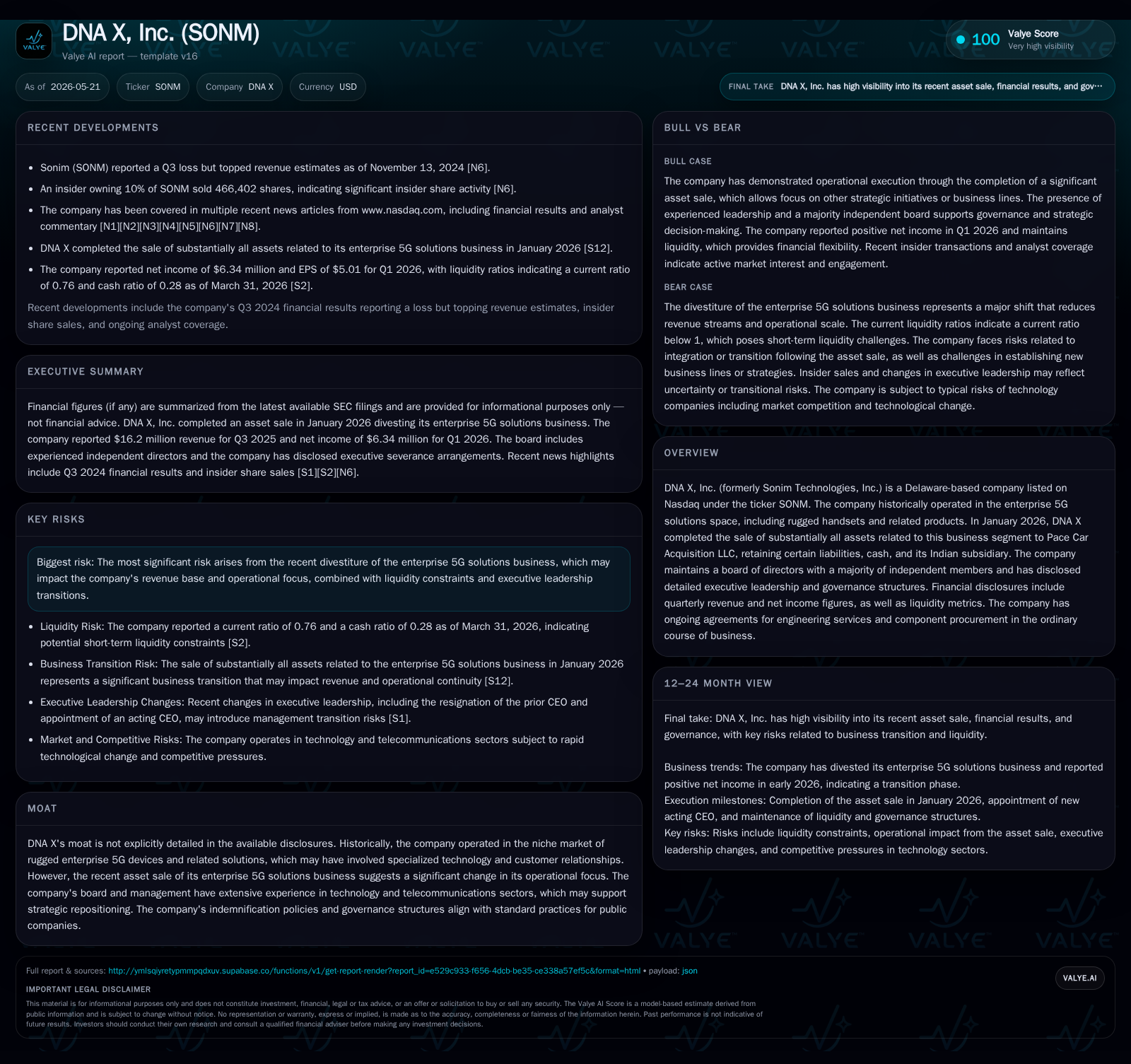
DNA X completed a transformative asset sale in January 2026, divesting its core enterprise 5G business to Pace Car Acquisition LLC. This shifts the company’s operational focus from rugged 5G hardware toward engineering services and its Indian subsidiary, creating a narrower but potentially more flexible business model. The recent quarterly filing reveals ongoing contracts that sustain revenue and a tightened liquidity profile reflecting retained liabilities and reduced scale. Risks center on revenue contraction and balance-sheet pressures amid executive transitions. Future performance hinges on successful execution of service contracts and strategic clarity in new growth avenues.
Latest Quarterly Operating Update: Asset Sale and Strategic Change
DNA X’s latest quarterly filing dated May 20, 2026, confirms the completed sale of substantially all assets related to its enterprise 5G solutions segment in January 2026 [S2]. This transaction notably included transfer of rugged handset manufacturing, smartphones, wireless internet devices, associated software, services, and related accessories to Pace Car Acquisition LLC. While relinquishing core operational assets, DNA X retained certain contractual liabilities, existing cash reserves post-closing estimated at approximately $6.2 million [S7], and crucially maintained ownership of an Indian subsidiary that was excluded from the asset sale.
Despite this large-scale divestiture representing a major operational reset, the company disclosed continuation of contracts for engineering services supporting ongoing customer needs within and potentially beyond the legacy telecom sector [S2]. This signals an intention to maintain cash flow continuity despite the smaller organizational footprint. Alongside this shift in business composition, leadership changes occurred with resignation of key executives including the Chief Commercial Officer early in 2026 and appointment of Scott Walker—an investor with substantial blockchain and digital asset experience—to the board [S29],[S27]. These developments likely reflect a strategic pivot and governance repositioning concurrent with rebranding efforts (including the name change from Sonim Technologies to DNA X) [S10].
Business Model Evolution: From Enterprise 5G to New Operational Foundations
Traditionally, DNA X derived revenue primarily from designing, manufacturing, and selling ruggedized enterprise communication devices catered towards industrial and public safety sectors [S1]. This involved product sales emphasizing hardware durability integrated with advanced wireless connectivity technologies such as enterprise-grade 5G solutions. Additionally, ancillary revenues arose from associated software licenses and professional services linked to device deployments.
Post-divestiture, the revenue mechanics pivot toward income generated through engineering service agreements that involve providing technical support, custom development, or component procurement facilitation. The Indian subsidiary appears positioned as a critical operational node handling outsourcing or regional service delivery functions—a relatively capital-light business contrasted with prior manufacturing intensity [S1],[S2]. This transition implies altered customer relationships where clients pay for service expertise rather than physical product acquisition; revenue drivers now depend on contract volume, renewal rates, service mix complexity, and project scope rather than unit shipments.
While this reduces exposure to supply chain volatility inherent in hardware production (especially semiconductor sourcing), it also constrains scalable upside from volume-driven product sales. Margins may benefit from lower fixed cost absorption but depend heavily on managing engineering staffing costs and contract utilization efficiency.
Competitive and Industry Context: Peer Landscape and Market Positioning
The enterprise-grade rugged handset market historically served by DNA X operated within a competitive niche marked by specialized product features—such as durability certifications (MIL-STD ratings), extended battery life mandates, and reliable connectivity under adverse conditions—targeting sectors like public safety agencies, construction firms, utilities, and logistics companies.
With the divestiture executed early this year removing most direct participation in hardware manufacturing and distribution channels [S2], DNA X relinquishes its former niche competitive advantages such as proprietary rugged device IP ownership or established brand equity among end users. Competitors retaining integrated manufacturing capabilities or broader telecom portfolios maintain stronger pricing power supported by end-to-end ecosystem control.
Remaining operations focusing on engineering services face a distinct peer set comprising specialized contractors or technology support entities servicing telecom OEMs or network providers. Here differentiation depends less on product innovation and more on depth of technical expertise, client trust relationships established through long-term engagements, agility in adapting to evolving client demands (e.g., network migration to cloud-native infrastructures), and cost competitiveness driven by offshore resources [S1]. Regulatory barriers attenuate—service providers typically operate with fewer compliance burdens relative to hardware manufacturers.
Governance enhancements with Board composition reflect attempts to reposition strategically amidst these structural shifts; inclusion of digitally savvy members may facilitate entry into adjacent markets like blockchain-enabled trading platforms [S27], signaling potential strategic diversification beyond historical telecom focus.
Growth Drivers: Potential Paths in Engineering Services and Subsidiary Operations
Growth prospects for DNA X now predominantly hinge upon expanding existing engineering services contracts while leveraging its retained Indian subsidiary’s capabilities [S2],[S3]. Key catalysts include renewing agreements with prior equipment buyers or telecom operators needing ongoing product lifecycle support amid rising demand for network modernization.
Further opportunities could materialize from scaling technology consulting offerings aligned with next-generation network rollouts such as private LTE/5G deployments or edge computing integration—areas requiring agile development teams capable of rapid iteration. The presence of experienced leadership familiar with blockchain ecosystems might open adjacent innovation pathways linked to smart contracts or decentralized finance infrastructure development.
However, these avenues require effective contract pipeline management plus demonstrated ability to execute competitively against established service firms. Limited internal capital availability post-sale suggests growth is contingent on efficient resource deployment rather than large-scale investments.
Risks and Constraints: Liquidity Pressure, Revenue Impact, and Leadership Transition
The divestiture markedly reduces DNA X’s historical revenue base concentrated in enterprise 5G hardware sales which exposes it to near-term contraction risk until alternative income sources stabilize,[S2]. Concurrently, retained liabilities linked to indemnification under the asset purchase agreement impose ongoing contingent obligations that complicate financial resilience [S7].
Liquidity metrics reinforce these risks: as of March 31, 2026, cash & equivalents stood at $1.195 million while total debt was roughly $1.2 million yielding an almost neutral net debt position [F1]
Recent executive departures—including commercial leadership—may impact momentum in contract acquisition or client relationship management during this restructuring phase [S29]. Moreover, Nasdaq’s scrutiny over stockholder equity minimum requirements had prompted prior compliance concerns necessitating remedial actions post-sale [S21],[S13], reflecting underlying financial fragility.
Outlook and Monitoring: Upcoming Milestones and Critical Execution Markers
Key indicators to observe going forward include timely renewal or expansion of existing engineering contracts documented in quarterly earnings releases [S2],[S3]. Signs of top-line stabilization beyond mere cost containment will be vital for validating viability of the new operating model.
Monitoring subsidiary operational performance metrics—such as capacity utilization rates or regional customer acquisition—will offer insights into incremental growth potential outside legacy businesses [S27]. Board announcements may foreshadow strategic pivot announcements especially if digital asset initiatives gain traction
Additionally,fresh disclosures on any shifts in working capital dynamics or refinancings given current liquidity headwinds will serve as alerts regarding financial health sustainability.
Financial Profile Summary: Current Balance Sheet and Liquidity Status
As supported by latest quarter-end data through March 31, 2026 [F1], DNA X retains approximately $1.195 million in cash alongside roughly $1.2 million total debt resulting in virtually net-zero leverage on this metric—a notable improvement relative to prior periods impacted by higher indebtedness associated with pre-sale operations.
This constrained liquidity environment underscores pressure points that must be managed prudently alongside organizational restructuring risks described earlier; effective cash flow generation through continuing contracts will be critical near term while the company adjusts its cost structure.
The analysis herein synthesizes recent official regulatory filings up through May 20-21, 2026 ([S1],[S2],[S3]) complemented by companyfacts snapshot data ([F1]) along with contextual industry perspectives uniquely relevant given DNA X's operational transformation post-divestiture without extrapolating unsupported projections or market share claims.
This overview is provided strictly for informational purposes without investment research views or price forecasts.
Disclaimer: This is research-only, informational analysis and not investment advice. It may include AI-generated interpretation and general industry context. Always verify important details using primary sources.

Comments