
Shorepower Technologies: Network Scale, Liquidity Strain, and the Long Game in Heavy-Duty Electrification
The next phase depends on converting grant-funded upgrades into sustainable revenue, outpacing rivals, and closing its funding gap.
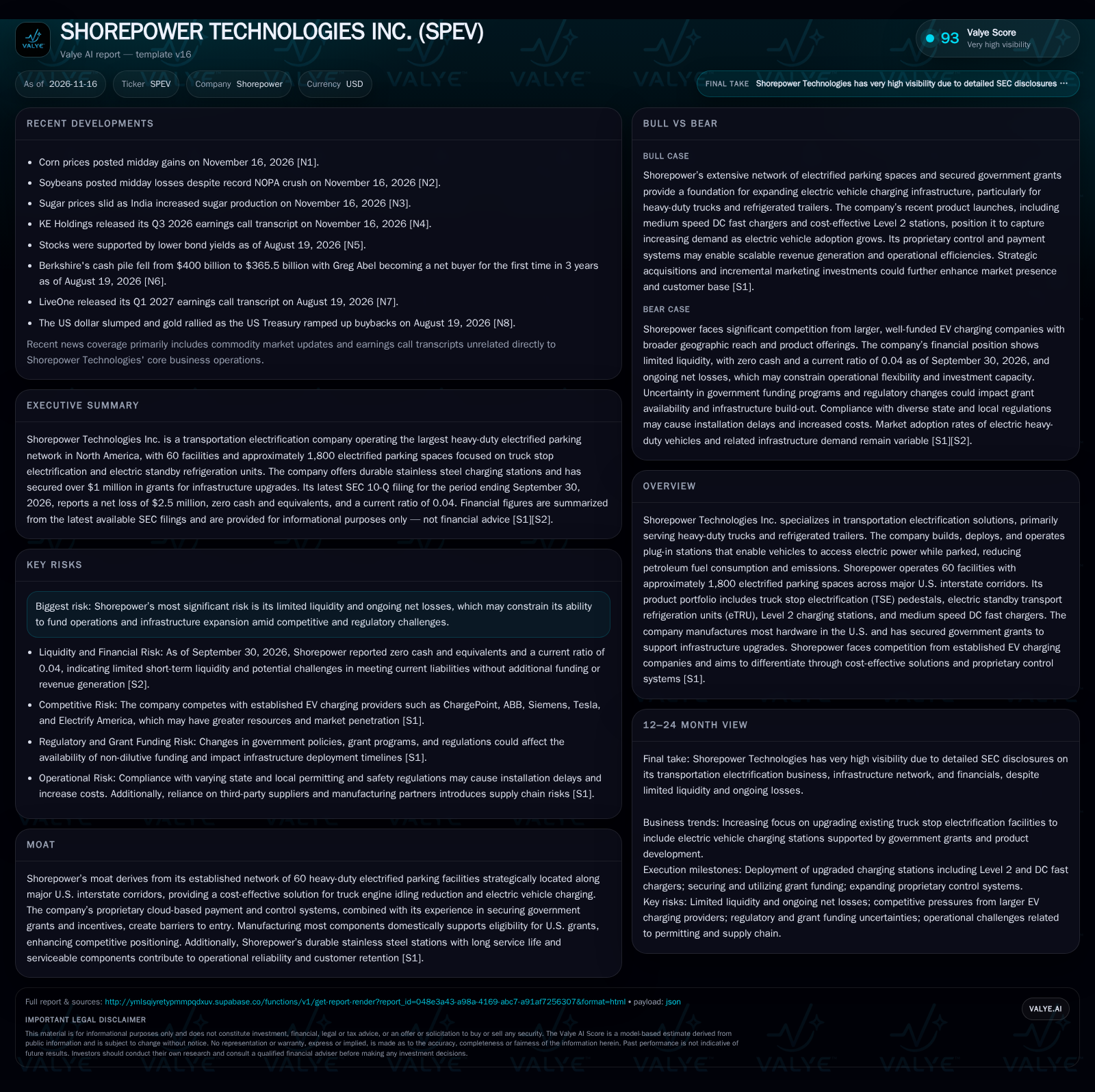
Shorepower Technologies operates a unique, grant-supported network for heavy-duty vehicle electrification, but ongoing net losses and a near-absent cash position highlight acute funding risks. Its ability to execute infrastructure upgrades and transition from government-supported buildout to recurring, self-sustaining revenue will determine whether it becomes a pivotal player or is sidelined by more capitalized competitors [S1] [S2].
Shorepower Technologies sits at the intersection of infrastructure, electrification, and heavy-duty trucking—a sector poised for transformation as emission mandates tighten and electric vehicle adoption creeps into the commercial fleet. With the largest network of electrified parking spaces for trucks and refrigerated trailers in North America, Shorepower has a tangible footprint and a pipeline of government grants to upgrade sites. But this operational scale is counterweighted by an acute liquidity crunch and persistent losses, raising the stakes for execution in an environment crowded with better-capitalized competitors. The company’s near-term narrative hinges on its ability to convert grant-funded upgrades into recurring, defensible revenue before its funding gap becomes existential.
Grant Funding and Liquidity Crunch Define Shorepower’s Immediate Outlook
As of September 30, 2026, Shorepower Technologies reported zero cash and equivalents, current assets of $150,461, and current liabilities of $3,501,033, resulting in a current ratio of just 0.04. The company also posted a net loss of $2,502,395 for the period, with basic and diluted EPS at -$0.33 [S2]. This acute liquidity shortfall puts pressure on the company’s operational flexibility and its ability to meet near-term obligations. Counterbalancing this, Shorepower has secured approximately $1,000,000 in grant funding—primarily from state sources such as Washington, Tennessee, North Carolina, Oregon, and California—to support infrastructure upgrades, with total project values exceeding $1,500,000 [S1]. The company’s 60-site network of truck stop electrification facilities, with 1,800 electrified parking spaces, remains its core asset and differentiator [S1]. These facts collectively set the stage for a race between grant-driven infrastructure upgrades and the company’s ability to stabilize its financial position and generate recurring revenue.
How Shorepower Could Capture Value: Revenue Streams, Cost Structure, and the Role of Grants
Shorepower aims to monetize its network by charging for plug-in access at truck stops and refrigerated trailer parking, leveraging both hourly and subscription-style models, though specific commercial mechanics are not disclosed. The company’s value proposition centers on enabling truckers to avoid diesel idling, offering both cost savings and regulatory compliance benefits. Revenue could be generated from usage fees, software subscriptions for access/control, and potentially from value-added services such as fleet analytics or partnerships with logistics firms.
The fixed-cost base includes hardware manufacturing (primarily in Oregon and Michigan), installation, and ongoing maintenance. Variable costs are likely dominated by electricity provision, customer support, and transaction processing. Shorepower’s government grant funding offsets a portion of capital outlays for infrastructure upgrades, but the need for matching funds or upfront expenditure means the company must bridge the gap between project costs and grant proceeds. With net losses and no cash on hand, Shorepower faces a high hurdle: unless it can quickly ramp up utilization and pricing at upgraded sites, it risks being unable to cover fixed overhead, let alone generate positive cash flow.
Operating leverage is theoretically favorable: once infrastructure is in place, incremental users add revenue at low marginal cost. However, utilization rates, pricing power, and the pace of heavy-duty EV adoption remain uncertain. The transition from grant-subsidized buildout to self-sustaining operations is a critical inflection point.
Competing Against Scale: Shorepower’s Niche, Rivals, and the Threat of Commoditization
Shorepower’s competitive edge lies in its first-mover status and heavy-duty truck stop footprint along major interstate corridors—a segment less saturated than passenger EV charging. Its proprietary cloud-based payment and control systems, combined with domestically manufactured, durable hardware, offer some differentiation, particularly in grant eligibility and long-term reliability [S1]. However, these advantages are counteracted by the presence of large, well-capitalized competitors such as ChargePoint, ABB, Siemens, Tesla, and Electrify America, which have broader networks, diversified product portfolios, and substantial funding [S1].
The risk is that, as electrification accelerates, larger players may expand into heavy-duty segments, leveraging economies of scale, strong brand recognition, and integrated software ecosystems. If charging hardware and access become commoditized, Shorepower’s ability to compete on price or feature set could erode. The company’s focus on cost-effective solutions and back-office systems may help retain customers in the near term, but long-term defensibility will depend on network effects, customer loyalty, and the ability to innovate faster than larger rivals.
Turning Grant Dollars into Sustainable Revenue: What a Win Looks Like
In a favorable scenario, Shorepower rapidly deploys grant-funded upgrades, expanding its network of electrified parking spaces and EV charging points. Adoption of electric heavy-duty trucks and refrigerated trailers accelerates, driving higher utilization of its facilities. The company successfully integrates cellular-based control modules across 300+ potential charging points, enabling dynamic pricing, remote management, and value-added software subscriptions.
If Shorepower can demonstrate high utilization rates, reliable uptime, and strong customer retention, it may build a defensible installed base before larger competitors focus on this segment. Recurring revenue from usage and software services could begin to cover fixed costs, and the company could leverage its track record to secure additional grants or private capital. Evidence supporting this scenario would include rapid project completion, upward-trending site utilization, revenue per site growth, and announcements of new fleet or logistics partnerships.
Execution Bottlenecks and Gradual Uptake: Navigating the Funding Gap
The most plausible near-term outcome is a gradual rollout of grant-funded upgrades, punctuated by installation and permitting delays. Heavy-duty EV adoption continues to grow, but at a measured pace, resulting in moderate utilization of Shorepower’s network. Pricing remains competitive, limiting near-term margin expansion.
Shorepower may need to seek bridge financing—whether through equity, debt, or additional grants—to cover the shortfall between project costs and revenue generation. Operating losses persist, but a slow improvement in cash flow could be seen if grant milestones are met and utilization ticks upward. The company’s competitive position remains precarious: its niche focus and proprietary systems help maintain relevance, but it faces ongoing risk from the encroachment of larger networks and the possibility of hardware commoditization.
Confirmation of this scenario would come from steady, but not explosive, growth in electrified parking usage, incremental revenue increases, and periodic funding events to shore up liquidity.
Liquidity Squeeze and Competitive Encroachment: A Path to Marginalization
In the downside scenario, Shorepower’s acute liquidity crisis becomes existential. Delays in grant disbursement, permitting, or construction prevent timely upgrades, while fixed costs continue to accrue. Utilization of existing facilities remains low due to slow fleet electrification or customer churn to larger, better-integrated networks.
Unable to secure additional funding, the company is forced to curtail operations, sell assets, or seek a distressed sale to a competitor. The heavy-duty EV charging space attracts intensified competition as mainstream players expand, further eroding Shorepower’s value proposition. Falsifying this scenario would require clear evidence of bridge financing, robust site usage growth, or successful execution of upgrades despite cash constraints.
Milestones That Will Reveal Shorepower’s Staying Power in Heavy-Duty EV Infrastructure
Grant-funded project execution: Timelines for site upgrades, installation milestones, and grant drawdowns will be pivotal in testing whether Shorepower can convert awarded funds into operational assets.
Utilization rates for electrified parking and charging stations: If disclosed, trends in average daily connections, revenue per space, and occupancy during peak hours would provide insight into market adoption and network value.
Recurring revenue generation: A useful metric would be the proportion of revenue derived from usage fees and software subscriptions versus one-time project or grant-related income.
Liquidity events: Announcements of bridge financing, new grant awards, or equity/debt raises will be critical to assessing Shorepower’s ability to remain a going concern.
Competitive responses: Monitoring for new heavy-duty charging deployments by large EV charging companies, or for strategic partnerships that could shift customer loyalty.
Cost structure evolution: Updates on hardware, installation, and maintenance costs, especially as the company scales or faces inflationary pressures.
Regulatory and permitting developments: Any changes in state or federal grant programs, permitting timelines, or electrification mandates that could accelerate or delay infrastructure buildout.
Disclaimer: This is research-only, informational analysis and not investment advice. It may include AI-generated interpretation and general industry context. Always verify important details using primary sources.

Comments