
SportsQuest, Inc.: Franchise Consulting Ambitions Collide with Financial Constraints and Industry Competition
SportsQuest, Inc.
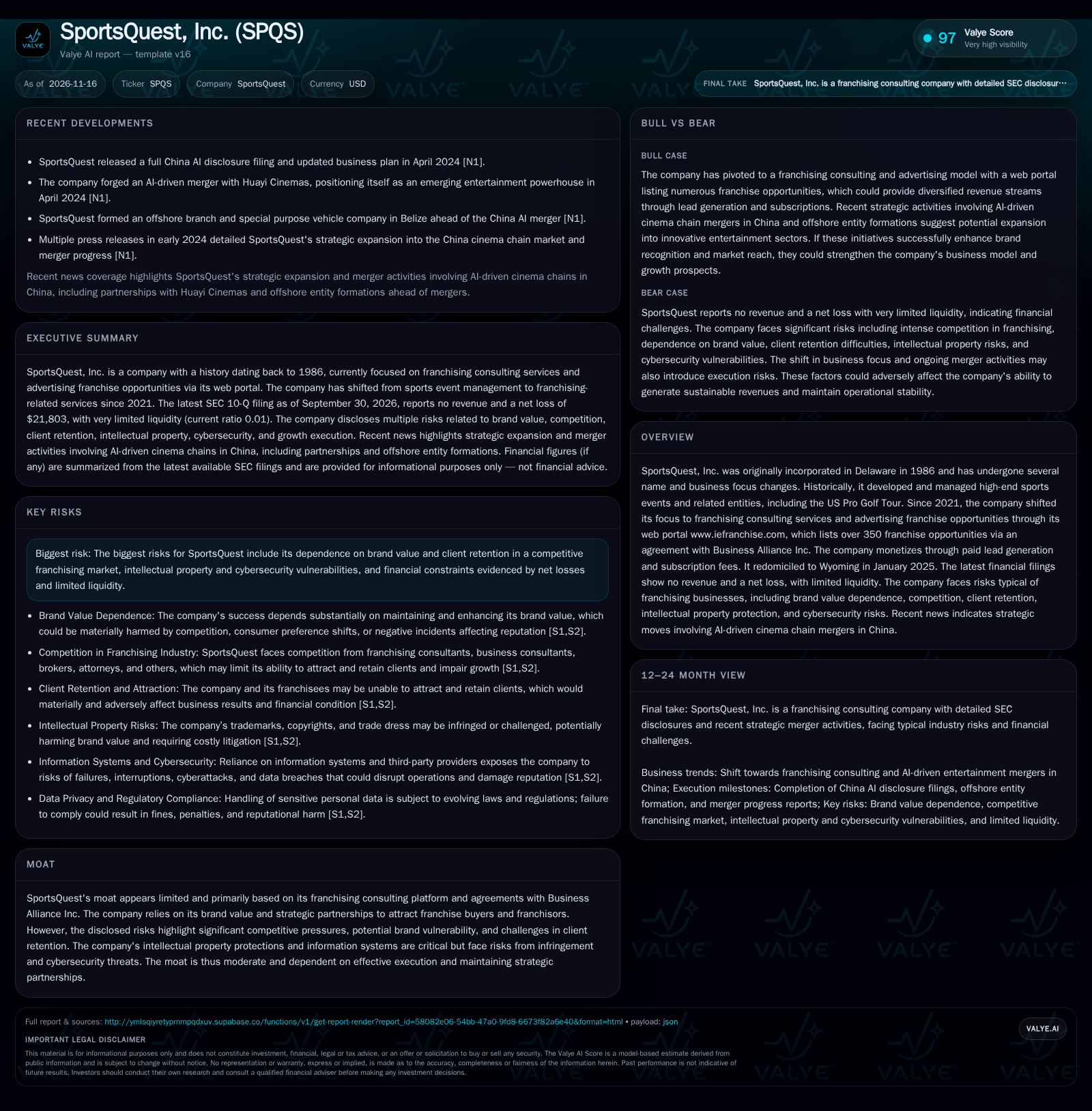
SportsQuest, Inc. has shifted from sports event management to franchise consulting and advertising, operating a web portal listing over 350 franchise opportunities. The business model relies on paid lead generation and subscription fees, but faces substantial competitive, execution, and financial risks. The key question is whether SportsQuest can convert its digital platform and partnerships into a defensible and profitable business before its limited resources are exhausted. [S1] [S2]
SportsQuest, Inc. embodies a classic pivot: once a sports event and tour operator, it now seeks relevance in the crowded franchise consulting and advertising market. Its platform, IEFranchise, aggregates hundreds of franchise opportunities, aiming to monetize via lead generation and subscription fees. Yet, the company’s latest filings reveal zero revenue, a net loss, and a cash position that falls far short of its liabilities. The critical question is whether this digital brokerage model can achieve traction—and generate enough revenue—before financial constraints force further retrenchment or a strategic reset.
Zero Revenue and Acute Liquidity Deficit Define the Immediate Landscape
As of September 30, 2026, SportsQuest reported no revenue and a net loss of $21,803 for the quarter, with basic and diluted EPS at -$0.000054 per share. The company’s balance sheet is highly stressed: current assets stood at $4,814 versus current liabilities of $548,880, resulting in a current ratio of just 0.01 and a cash ratio of 0. The company reported cash and liquidity metrics for the period; these figures do not by themselves establish operating runway, investment capacity, financial flexibility, or financing capacity. The company is not currently involved in material legal proceedings, but its existential threat is financial, not legal. [S2]
Digital Lead Generation Economics: Theoretical Appeal, Practical Hurdles
SportsQuest’s business model is built around its IEFranchise portal, which lists over 350 franchise opportunities via a third-party agreement. The model aspires to generate revenue through paid leads (where franchisors or brokers pay for introductions to potential franchisees) or through subscription fees for enhanced listings. In theory, this approach offers high operating leverage—incremental leads or subscriptions could scale with minimal additional cost, driving attractive margins once fixed costs are covered.
However, the practical economics are daunting. Lead generation in franchising is a commoditized, highly competitive market, often dominated by entrenched platforms with network effects and strong SEO presence. Barriers to entry are low, and larger competitors benefit from greater marketing budgets, existing franchisor relationships, and more robust digital infrastructure. Without evidence of differentiated technology, proprietary data, or exclusive listings, SportsQuest’s pricing power and ability to capture high-quality leads could be limited. The lack of current revenue also suggests that either customer acquisition has not ramped, conversion rates are low, or the monetization model is not resonating with franchisors or franchisees.
Crowded Consulting Landscape and the Challenge of Standing Out
SportsQuest faces competition not only from other franchise consultants and lead-generation platforms, but also from business brokers, attorneys, and accounting firms that provide overlapping services. Many of these competitors have established brands, deeper pockets, and broader service offerings. In digital franchising, the leading platforms often benefit from superior web traffic, stronger content, and greater visibility in search rankings. The company’s agreement with Business Alliance Inc. allows it to list a wide array of opportunities, but unless these listings are exclusive, they are likely duplicated across multiple platforms, diluting any potential edge.
Switching costs for franchisors are low—they can list on multiple sites simultaneously—and franchise buyers typically comparison-shop across several platforms. The company’s disclosed risks also highlight vulnerability to brand erosion, client churn, and technological or cybersecurity incidents. Without a compelling differentiator—such as exclusive partnerships, proprietary data, or a unique user experience—SportsQuest’s platform is at risk of being viewed as a commodity in a market that rewards scale and reputation.
What Would It Take for SportsQuest to Break Out?
For SportsQuest to defy its current trajectory, several pieces must fall into place. The platform would need to rapidly gain traction with both franchisors and franchise seekers, leading to a meaningful ramp in paid leads or subscription revenue. This could occur if the company successfully leverages its Business Alliance Inc. relationship to secure exclusive or high-demand opportunities, or if it deploys superior digital marketing to draw in a critical mass of quality leads.
A potential upside catalyst could also stem from adjacent strategic moves—such as the reported exploration of AI-driven cinema chain mergers in China—if these efforts translate into new, differentiated offerings or partnerships that feed back into the core franchise consulting business. Evidence confirming this scenario would include a return to positive revenue growth, publicized exclusive agreements, or material press coverage of new verticals. Conversely, continued absence of revenue or customer traction would quickly falsify the upside.
Most Likely Outcome: Ongoing Struggle for Market Share and Relevance
The most plausible near-term scenario is that SportsQuest continues to operate its portal without significant market penetration or revenue growth. Without a clear competitive advantage or marketing breakthrough, the business is likely to experience ongoing net losses and may be forced to seek external financing, restructure, or further pivot its business model.
Confirmation of this base case would be persistence of zero or minimal revenue, continued net losses, and stagnant or shrinking listings activity. A reversal would require concrete evidence of customer wins, revenue inflection, or operational breakeven.
Liquidity Exhaustion and the Prospect of Forced Retrenchment
If SportsQuest is unable to generate revenue or secure new capital, its acute liquidity deficit could rapidly lead to operational shutdown, involuntary restructuring, or distressed asset sales. With a current ratio of 0.01 and no reported cash, even minor expenses or unanticipated shocks—such as a legal dispute, data breach, or regulatory penalty—could be existential. The company’s ability to retain key partners, maintain its web platform, or fulfill obligations to clients would be severely compromised.
Evidence confirming the downside would include further deterioration in the balance sheet, layoffs, missed payments, delistings, or public disclosure of going-concern warnings. A rapid, unexpected turnaround in revenue or a credible capital raise would be required to avert this scenario.
Milestones That Will Determine Whether SportsQuest Can Survive the Pivot
Any material, recurring revenue from paid lead generation or subscription services—if disclosed—would signal initial market validation.
Announcements of exclusive partnerships or proprietary franchise listings would suggest a plausible route to differentiation and pricing power.
Evidence of customer acquisition cost (CAC) trends, conversion rates, or retention metrics—if disclosed—would clarify the efficiency and sustainability of its marketing spend.
Balance sheet changes, especially new capital infusions or reductions in short-term liabilities, would indicate whether the company can buy time to execute its strategy.
User growth or engagement statistics for the IEFranchise portal—such as monthly active users or lead submissions—would help test the thesis of digital traction.
Any regulatory or cybersecurity incidents affecting the portal or client data would test operational resilience and reputational risk.
Publicly announced deals connected to AI-driven entertainment or cinema verticals could indicate progress on strategic expansion beyond the core franchise portal.
Disclaimer: This is research-only, informational analysis and not investment advice. It may include AI-generated interpretation and general industry context. Always verify important details using primary sources.

Comments