
ARS Pharmaceuticals Accelerates Neffy Adoption with Expanding U.S. Commercial Footprint
ARS Pharmaceuticals reports accelerating U.S. prescription growth and expanded insurance coverage for its needle-free epinephrine spray, reinforcing its commercial momentum.
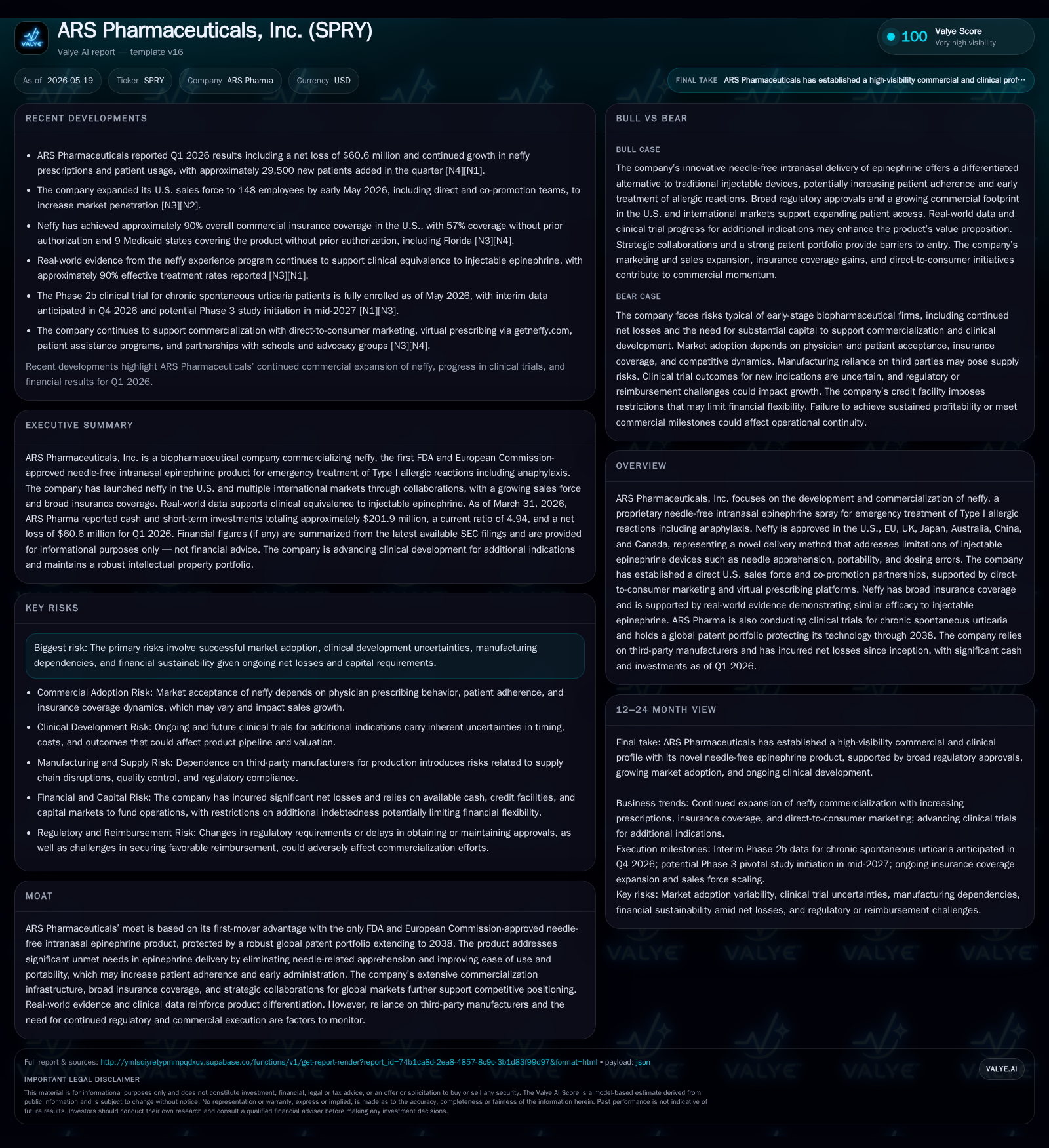
ARS Pharmaceuticals’ Q1 2026 update highlights robust uptake of neffy, with over 28,000 healthcare providers having prescribed the product and approximately 120,000 patients currently using it in the U.S. The company continues to expand its sales force and insurance networks, supporting broader access and adoption of its proprietary needle-free intranasal epinephrine spray. Despite operational progress, financial sustainability remains a watchpoint amid ongoing net losses and reliance on third-party manufacturing. Upcoming catalysts include further sales force expansion and clinical trial readouts for pipeline indications.
Recent Quarterly Operating Highlights and Market Penetration
ARS Pharmaceuticals’ Q1 2026 Form 10-Q reveals accelerating commercial traction for neffy, its proprietary needle-free intranasal epinephrine spray [S2]. Over 28,000 healthcare providers have prescribed neffy in the United States since launch, with approximately half returning as repeat prescribers—a positive signal of physician acceptance [S2]. Patient usage rose sequentially by about 29,500 during Q1 to roughly 120,000 active users pointing to expanding patient adoption [S2], [N3]. This growth coincides with a substantial broadening of insurance coverage networks facilitating payer access which materially reduces cost barriers for patients [S2].
Concurrently, ARS expanded its U.S. commercial field organization to approximately 106 employees at quarter end spanning sales representatives, key account managers, area sales managers, and national directors plus an additional roughly 70 co-promotion reps deployed by ALK targeting up to 9,000 pediatricians and similar prescribers [S1]. The company plans to increase its internal team to approximately 150 reps starting mid-2026 aiming specifically at around 20,000 high-prescribing physicians who historically account for over half of all epinephrine prescriptions nationally [S1]. This focused scaling targets high-volume prescribers such as allergists and pediatricians for efficient market penetration.
Business Model Overview and Neffy’s Differentiated Value Proposition
ARS generates revenue primarily through direct net product sales of neffy in the U.S., supplemented by milestone payments and royalties from international licensees [S1], [S2]. Neffy delivers epinephrine via a patented intranasal formulation combining epinephrine with Intravail™, an absorption enhancer that enables safe systemic delivery at low doses equivalent to injectables but without needles or injections [S1]. This "no needle" administration addresses unmet needs including needle phobia, injection-related dosing errors, and portability issues that hinder patient adherence with autoinjectors.
Neffy holds regulatory approvals across major markets including the U.S., European Union (EURneffy), UK, Japan, Australia, China, and Canada—reflecting broad international acceptance of this novel delivery method [S1]. The company estimates the current U.S. addressable market based on active autoinjector users at roughly $1.8 billion in annual net sales at target gross-to-net yield levels [S1], reflecting prescription volume multiplied by average realized pricing after payer discounts.
Competitive Landscape and Industry Dynamics
Injectable autoinjectors like EpiPen dominate epinephrine delivery with entrenched clinical use. Neffy is distinguished as the first new delivery method approved in over three decades [S1]. A robust patent portfolio protects composition and device intellectual property globally through at least 2038, limiting generic competition risk [S1].
Market penetration challenges remain given physician conservatism toward novel emergency treatments and payers’ willingness to reimburse newer alternatives. ARS’s hybrid commercialization model combining direct U.S. sales with co-promotion partners such as ALK enhances reach across specialty segments [S1]. Real-world evidence programs demonstrating comparable clinical efficacy versus injectables further support ARS’s competitive positioning.
Growth Drivers Supporting Uptake
Key growth drivers include provider education through experiential programs engaging over 2,800 healthcare professionals using neffy during allergen challenge rescue therapy [S1], extensive non-personal promotion campaigns including medical society partnerships and conferences [S1], and expansion of the direct sales force targeting core high-volume prescribers representing over half of national prescriptions [S1]. Broader payer coverage reduces out-of-pocket barriers enhancing patient access while telehealth prescribing platforms combined with direct-to-consumer marketing lower acquisition friction points [N3]. Additionally, ongoing Phase II clinical trials target chronic spontaneous urticaria as a potential label expansion beyond acute allergy emergencies [S1].
Risks and Operational Watchpoints
Operational risks include dependence on third-party contract manufacturers whose capacity constraints or disruptions could impact supply continuity—critical for emergency-use products [S2]. Clinical development beyond approved indications carries inherent uncertainties regarding timing and outcomes affecting pipeline prospects.
Commercial execution risks involve managing rapid sales force scaling amid competitive pricing pressures within evolving reimbursement frameworks intensified by recent governmental scrutiny on pharmaceutical pricing transparency [S1]. Patent infringement litigation from generic entrants poses financial exposure and potential distraction risks [S1]. Sustained net losses necessitate vigilant liquidity management given ARS’s leverage position.
Near-Term Catalysts: What Investors Should Monitor Next
Investors should monitor quarterly prescription growth trends to validate sustained momentum post-Q1 gains [N3], developments in payer contracting expanding formulary inclusions which could boost volumes, effectiveness of sales force ramp-up from ~106 to ~150 reps starting mid-2026 [S1], and progress updates on clinical trials targeting chronic spontaneous urticaria. Additional real-world evidence affirming efficacy equivalence may also influence physician adoption positively.
Financial Position and Capital Structure Overview
As of March 31, 2026, ARS held $24.3 million in cash and equivalents against total debt of approximately $96.5 million resulting in net debt near $72.2 million; the current ratio stood at a healthy approximately 4.94x indicating solid short-term liquidity buffers despite ongoing operating losses [F1], [S2]. Selling general & administrative expenses rose significantly to $72.2 million in Q1 from $41.1 million year-over-year due mainly to increased marketing spend aligned with sales force expansion plans [S14]. Interest expense was $2.4 million reflecting financing costs associated with term loans raised last year providing up to $250 million capacity subject to revenue-based tranche conditions which mitigate near-term funding risk but maintain leverage considerations [S6], [S15].
Operating losses remained substantial at $60.6 million net loss in Q1 compared to $33.9 million prior year period reflecting upfront commercialization expenses layered over growing revenues ($22.7 million total including $17.5 million product revenue) [S14]. ARS projects existing cash resources combined with commercial revenues will be sufficient to fund operations through at least three years barring unforeseen circumstances or accelerated R&D spending [S10].
This analysis integrates detailed SEC filings alongside investor communications to assess ARS Pharmaceuticals’ operational progress navigating a pioneering but capital-intensive commercial launch cycle amidst structural market opportunities tempered by competitive dynamics and execution risks. Readers should consider multiple information sources when evaluating evolving corporate scenarios.
Disclaimer: This is research-only, informational analysis and not investment advice. It may include AI-generated interpretation and general industry context. Always verify important details using primary sources.

Comments