
Specificity, Inc. Rebuilds After Financial Disclosure Delays and Errors
Following a material restatement, Specificity refocuses on expanding its proprietary SMB-focused digital marketing platform amid ongoing liquidity challenges.
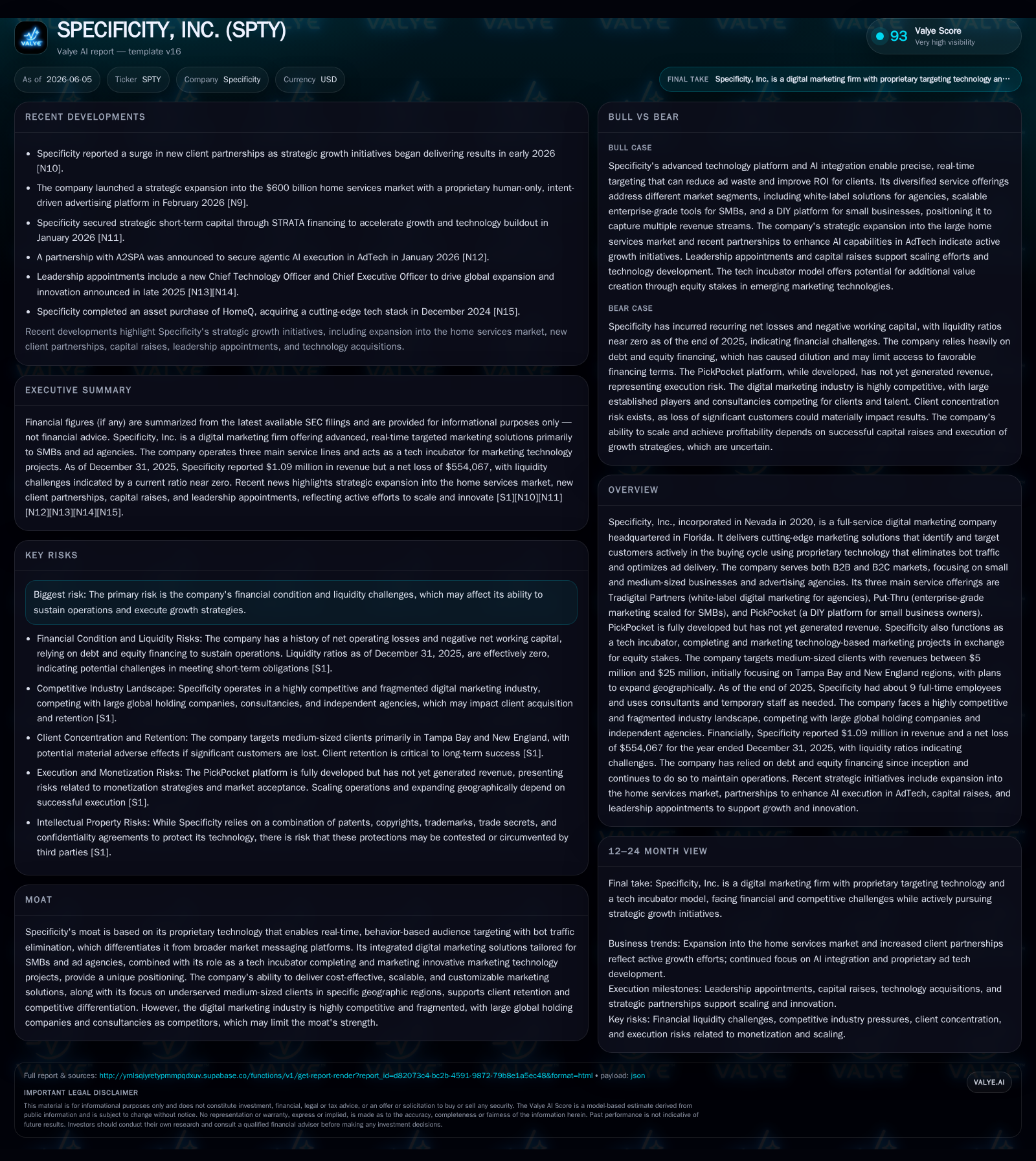
Specificity, Inc. disclosed significant errors in its 2025 financial reporting leading to a restatement and delayed filings, raising concerns about reporting reliability and investor confidence. The company offers differentiated real-time behavior-based digital marketing solutions tailored to SMBs and agencies through three core platforms—Tradigital Partners, Put-Thru, and PickPocket—with proprietary bot traffic elimination technology. Despite a strong technology moat in targeting precision, Specificity faces intense competition from large global holding companies and consultancies in a fragmented market, while navigating liquidity constraints and operational scale-up risks. Growth hinges on scaling client acquisition through automation-enabled onboarding, strong retention in medium-sized niche markets, and execution of its tech incubator model.
Material Disclosure Correction Highlights Reporting Execution Gaps
In May 2026, Specificity filed a Form 8-K disclosing material errors in its annual financial statements for fiscal year ended December 31, 2025. The root cause was traced to management’s failure to obtain and review certain bank and credit card statements linked to accounts opened in mid-December 2025 [S3][S4]. This oversight led to an understatement of expenses by approximately $83,422, revenues by $2,500, liabilities by $121,122, overstatement of additional paid-in capital by $40,000, and a slight understatement of cash by $202 [S3]. As a result of these inaccuracies, the company delayed its quarterly report for Q1 2026 and filed a Notice of Late Filing with the SEC. Although the errors are isolated around the December account openings with no material impact on quarterly operating results throughout 2025 [S4], this episode raised concerns regarding internal control robustness.
The disclosure also surfaced four critical continuing material weaknesses in internal controls related to segregation of duties given limited personnel resources, inadequate document retention policies affecting timely financial close processes, heavy reliance on external consultants for GAAP compliance lacking fully autonomous control systems, and absence of an independent audit committee or board oversight [S14][S16]. While an external consultant was engaged in July 2024 to implement remediation measures including centralized financial repositories and monthly transaction reviews [S16], full remediation remains underway without guaranteed completion timelines. These control gaps underscore potential recurring challenges in accurate financial reporting which could undermine investor confidence.
Business Model: Proprietary Tech-Driven Solutions Serving SMBs and Agencies
Specificity operates as a full-service digital marketing firm deploying proprietary behavioral targeting technology designed to address the unique advertising needs of small and medium-sized businesses (SMBs) alongside B2B and B2C customers [S1][S20]. Central to its value proposition is a patented system that integrates BiToS (Behavioral Technology Operating System) with Mobile Advertising Identifiers (MAIDs) to build high-intent audiences in real time while eliminating bot traffic—a persistent source of inefficiency in digital ad spend [S1][S21]. Coupled with AI integration for ad sequencing, saturation modeling, CRM linkage for seamless campaign management, and comprehensive analytics reporting, Specificity delivers cost-efficient marketing tailored for client ROI.
Its primary revenue streams flow from three platforms within one segment:
- Tradigital Partners: A white-label digital marketing service enabling advertising agencies lacking dedicated digital capabilities to offer behaviorally targeted campaigns under their brand without infrastructure investments. This offering provides scalability with customization options supporting diverse agency client bases [S20].
- Put-Thru: An enterprise-grade yet SMB-scaled digital marketing technology stack providing behavior-based omnichannel ad tools at accessible price points. Its design addresses the gap where traditional enterprise platforms are too costly or complex for SMBs while maintaining effectiveness seen at larger scales [S20].
- PickPocket: A fully developed DIY platform empowering small business owners (annual revenues $0.5M-$5M) to autonomously create mobile-optimized campaigns directly targeting competitor audiences via behavior-based identification. However, PickPocket has yet to produce revenue offering future monetization potential via subscription or performance pricing models [S21][S27].
Additionally, Specificity functions as a tech incubator by completing development projects for third parties using internal resources—including designers and programmers—in exchange for equity stakes. This model aims to reduce customer acquisition costs by spinning off innovative projects once market fit is achieved [S21].
Industry Context: Competing Against Large Firms with Unique SMB Focus
The digital marketing sector Specificity competes within is highly fragmented yet dominated by large multinational holding companies (Omnicom Group Inc., Interpublic Group Inc., WPP plc) along with consultancies like Accenture that bundle tech-driven services [S12]. These incumbents leverage scale advantages across media buying powerhouses and technology investments but often overlook or inadequately serve mid-market SMB clients due to cost or complexity thresholds.
Specificity’s moat rests largely on its proprietary real-time audience targeting enhanced by bot traffic elimination, which narrows exposure compared to generalized messaging platforms employed by global agencies. However, this technological differentiator is not impervious; competitive pressure arises from increasing regulation on data privacy (GDPR, CCPA), evolving consumer tracking restrictions imposed by major social platforms reducing granularity accessible for targeting [S15]. Furthermore, the company’s limited operational scale restricts its ability to compete on breadth of service offerings or pricing flexibility against larger firms that use deep pockets to subsidize client acquisition.
Thus Specificity occupies a niche focusing heavily on medium-sized clients ($5M-$25M revenues) located initially in geography-specific markets like Tampa Bay and New England where they possess domain expertise [S21][S22]. Their targeting precision caters well to clients equipped with internal analytics capabilities who demand measurable ROI—a factor bolstering retention when coupled with automated onboarding reducing sales cycle times.
Growth Drivers: Target Market Segmentation, Automation, and Vertical Integration
Specificity’s near-term growth strategy centers on expanding presence within defined SMB verticals showing average digital spending around $5,100 per month—a threshold enabling profitability after sales expenses—primarily across Tampa Bay and New England markets before scaling geographically [S8][S21]. They plan capital deployment towards business development initiatives including expanding sales teams specialized in targeted vertical outreach integrated with automated training programs reducing ramp-up durations for client onboarding [S1].
Automation plays a pivotal role in compressing sales cycle length by simplifying complex campaign setups into streamlined workflows minimizing dependence on scarce human resources—a key efficiency lever given the company’s small employee base (~9 full-time as of year-end 2025) [S24][S19]. Progressively improving tool integration such as CRM synchronization ensures campaigns are launched faster while preserving customization needed for diverse client needs.
Client retention features centrally as a foundation for longer-term revenue stability because high churn would inflate costs disproportionately relative to company size [S1]. The company’s emphasis on technologically advanced behavior-based targeting arguably reduces churn risk relative to generic messaging solutions because it delivers more measurable impact aligned with client KPIs focused on customer acquisition costs.
Vertical integration via the tech incubator model supplements organic growth by creating new proprietary tools internally or through partnerships where Specificity earns equity stakes instead of pure service fees. This strategy aims at building an innovative pipeline fueling future expansion while benefiting from lower acquisition costs compared to traditional client sourcing methods.
Risks & Constraints: Financial Health, Reporting Reliability, Competitive Pressure
Financially Specificity faces significant headwinds highlighted by recurring operating losses totaling $554K for FY2025 despite generating approximately $1.09 million in revenues [F1][S12]. Cash reserves are critically low at roughly $2K year-end 2025 against current liabilities exceeding $1.26 million resulting in a zero current ratio indicating severe working capital deficits [F1]. Best-effort total debt stands near $117K yielding net debt roughly $115K once offset against minimal cash holdings [F1]. These metrics point towards very constrained operational liquidity reliant chiefly upon intermittent equity financing mechanisms such as their existing $5 million Strata Purchase Agreement [S11][S17].
Compounding financial pressure are unresolved material weaknesses in internal controls which impair efficient accounting processes limiting reliable financial insight needed for proactive decision making as well as complying robustly with SEC filing obligations [S14][S16]. The reported delays in delivering timely quarterly reports risk regulatory sanctions or market loss of confidence if the issues persist uncured.
On the competitive front regulatory uncertainty introducing stricter data privacy laws worldwide poses elevated compliance costs while potentially curtailing behaviorally-targeted ad effectiveness requiring continuous investment ahead of tech platform changes [S15]. The fragmented nature of the digital marketing space means smaller players like Specificity must carve defensible niches lest they become subsumed or marginalized amid price wars initiated by global incumbents who leverage vast resources.
Outlook & What to Watch: Milestones in Client Acquisition and Regulatory Filings
Key operational signposts include prompt SEC filing of amended FY25 Form 10-K/A as well as submission timelines for Q1 2026 Form 10-Q currently pending following restatement adjustments [S3][S4][S7]. Progress against remediation plans targeting internal control deficiencies will be telling regarding management’s ability to restore transparency credibility [S16].
Execution tracking should focus sharply on expansion velocity within primary markets using automation-enhanced sales developments alongside hiring critical expertise able to maintain compliance standards while supporting service innovation. Monitoring new client bookings particularly from Tradigital Partners’ partnerships synergy effects or Put-Thru’s penetration into underserviced SMB pockets will reveal traction dynamics important since PickPocket has yet to contribute revenue but represents growth optionality once commercialized fully.
Additionally observing capital raise success beyond short-term Strata funding commitments will clue viability continuity given dire cash constraints acting as an existential risk factor flagged by auditors’ going concern opinion explicitly captured within the latest annual report [S12][F1]
Financial Summary: Loss Trends and Liquidity Challenges
Specificity reported total revenues of approximately $1.09 million against a net loss exceeding half a million dollars ($554K) during fiscal year ended December 31, 2025 [F1]. Cash consumption echoed operating losses with nearly $150K used in operating activities underscoring limited cash flow conversion ability without fresh financing sources [S12]. Balance sheet fragility is evidenced by current assets around $5.7K confronted by outsized current liabilities topping nearly $1.27 million producing effectively zero working capital buffer reflecting acute dependence on external injections [F1]. Total debt reported was moderate at about $117K but combined with negligible cash positions yields a strained net debt stance restricting maneuvering room absent successful equity infusions under existing investment agreements outlined previously [F1][S17].
This precarious financial posture alongside ongoing reporting deficiencies heightens uncertainty about Specificity’s immediate sustainability making accomplished operational execution essential not only commercially but also administratively to avoid material adverse consequences including delisting risks or insolvency filings flagged within their legal disclosures [S7].[F1]
This analysis is based solely on information publicly disclosed through SEC filings dated through June 5th, 2026 without attempting forward-looking investment advice or nonpublic insights.
Disclaimer: This is research-only, informational analysis and not investment advice. It may include AI-generated interpretation and general industry context. Always verify important details using primary sources.

Comments