
Star Gold Corp.: Exploration Ambition, Structural Hurdles, and the Search for Value Creation
Star Gold Corp.
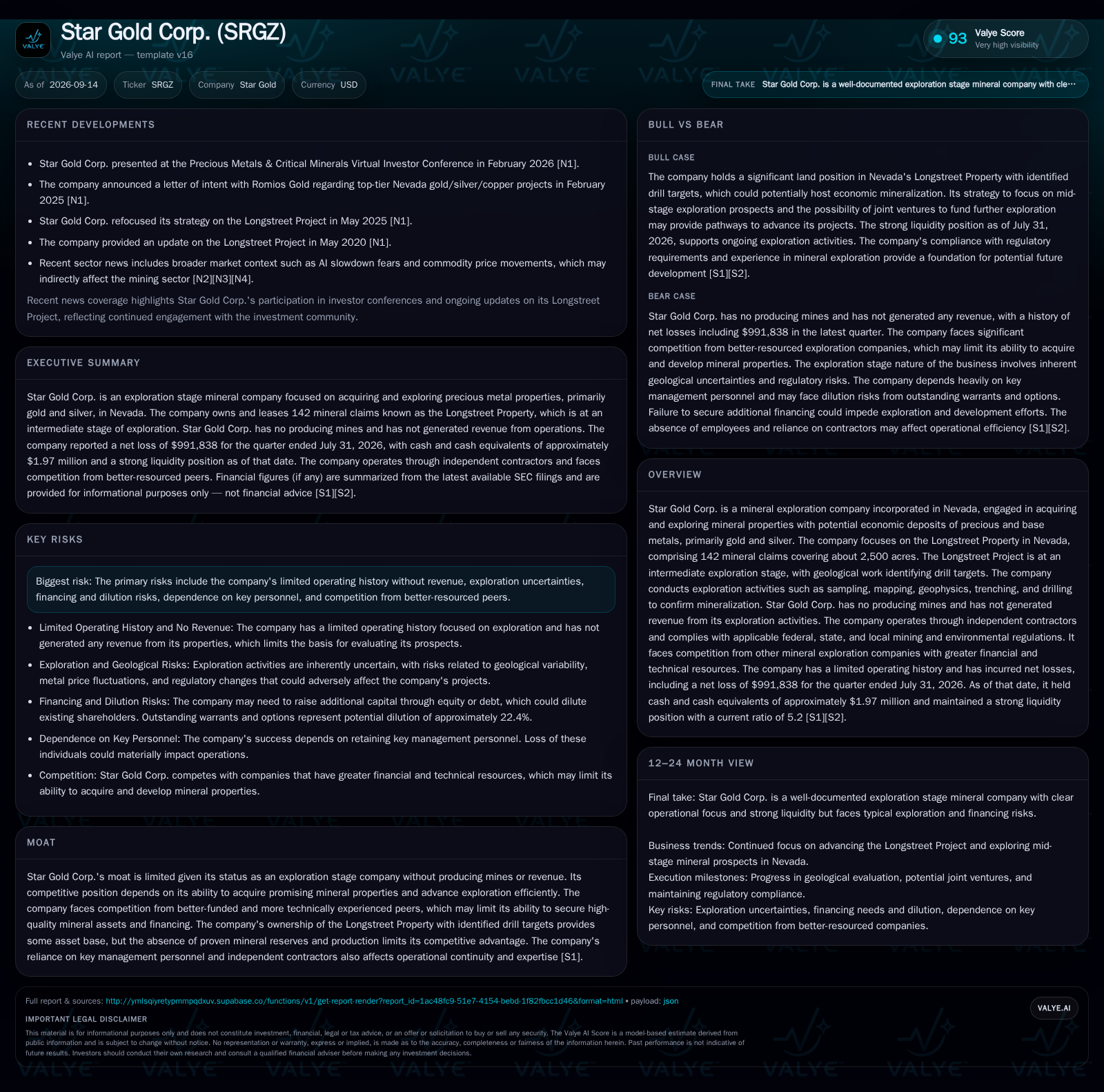
Star Gold Corp. controls the 2,500-acre Longstreet Property in Nevada and is advancing mid-stage gold and silver exploration but has yet to generate revenue or prove reserves. The company reported a net loss of nearly $1 million last quarter, holds $1.97 million in cash, and faces the dual challenge of funding further exploration while competing with better-capitalized peers. The absence of producing assets and reliance on contractors heightens execution risk, making progress on drill targets and potential joint ventures pivotal for future value creation. [S1] [S2]
Yet, with no producing mines, no revenue, and continued net losses, the company’s future hinges on its ability to convert geological promise into tangible value—whether through further exploration success, strategic partnerships, or asset monetization.
Where Star Gold Stands: Assets, Losses, and Liquidity in 2026
Star Gold Corp. currently owns and leases 142 mineral claims at the Longstreet Property in Nevada, covering approximately 2,500 acres, with exploration at an intermediate stage and defined drill targets based on geological work [S1]. The company has not generated any revenue and reported a net loss of $991,838 for the quarter ended July 31, 2026 [S2]. As of that date, it held $1,965,745 in cash and cash equivalents, giving it a current ratio of 5.2 and a cash ratio of 4.71 [S2]. Outstanding warrants and options could dilute existing shareholders by about 22.4% if exercised [S1]. These facts highlight a company with some runway to advance its exploration agenda but no established path to cash flow, with dilution risk looming if further funding is required.
Exploration Economics: Optionality, Cash Burn, and Capital Intensity
Star Gold’s business model is classic early-stage exploration: the company invests in land acquisition, geological fieldwork, sampling, mapping, trenching, and drilling, with the aim of discovering and delineating economically viable gold and silver deposits. This model is inherently capital consumptive—expenses are front-loaded, and there is no operating revenue until a deposit is proven and developed into a producing mine. Variable costs are tied to the intensity of exploration and drilling campaigns, while fixed costs are kept low due to the use of independent contractors and the absence of full-time employees [S1].
The company’s cash burn is primarily a function of exploration activity, regulatory compliance, and corporate overhead. With $1.97 million in cash, Star Gold has the capacity to fund near-term exploration but will likely require additional capital to advance Longstreet to a resource estimate, feasibility study, or production decision. Funding alternatives typically include equity issuance (raising dilution risk), joint ventures (sharing upside and control), or strategic asset sales. The 3% Net Smelter Royalty (NSR) and annual $12,000 advance royalty payment further reduce potential future margins if production is achieved, but are not currently cash drains given the absence of revenue [S1].
The capital intensity of early-stage exploration inherently imposes a high-risk, high-reward dynamic on Star Gold’s business model. The timing and scale of exploration expenditures must be carefully balanced against available liquidity and market conditions. The company reported cash and liquidity metrics for the period; these figures do not by themselves establish operating runway, investment capacity, financial flexibility, or financing capacity. Conversely, a more conservative spending approach preserves potential financial flexibility but may delay critical milestones and reduce the company’s ability to maintain investor interest and competitive positioning. Thus, the management’s strategic decisions regarding exploration cadence and capital allocation are crucial determinants of the company’s ability to sustain operations while maximizing optionality.
Contested Ground: Star Gold’s Place in the Nevada Exploration Ecosystem
Star Gold operates in Nevada, one of the world’s most competitive and geologically prospective gold jurisdictions. Its main advantage is control over a contiguous block of mineral claims with drill-ready targets, providing a platform for discovery-driven value creation [S1]. However, the company faces intense competition from exploration and development companies with far greater financial resources, established technical teams, and more advanced projects.
Switching costs for investors and partners are low—exploration assets compete on geological prospectivity, permitting status, and perceived upside. The absence of proven reserves, production, or proprietary technology means Star Gold’s moat is thin; its ability to attract capital or partners will depend on delivering compelling drill results, maintaining regulatory compliance, and demonstrating operational progress. In this environment, even promising assets can languish without the capital and technical horsepower to advance them through the exploration-development-production pipeline.
Discovery and De-Risking: How a Drilling Breakthrough Could Transform the Narrative
The most favorable scenario for Star Gold would be successful drilling at Longstreet that confirms significant and economically viable gold or silver mineralization. Positive drill results could support a maiden resource estimate, de-risking the project and making it a more attractive target for joint ventures or outright acquisition by larger mining companies. This could unlock value for shareholders well in excess of the company’s current cash-adjusted valuation.
Confirmation of this scenario would require the company to announce high-grade, continuous mineralization across multiple drill holes, ideally supported by independent geological reports. Evidence of interest from potential partners, the securing of a joint venture on favorable terms, or a strategic investment from a larger mining company would further validate the upside case. Conversely, drilling that fails to extend known mineralization or returns uneconomic grades would quickly undermine this trajectory.
Incremental Progress Amid Constraints: The Most Likely Trajectory
Absent a major discovery, the most plausible outcome is that Star Gold continues incremental exploration work at Longstreet, advancing targets and seeking to improve the geological understanding of the property.
In this scenario, news flow would likely center on periodic exploration updates, modest advances in geological modeling, and efforts to engage potential partners. Dilution risk remains significant if equity financing is required, and operational progress could be slow unless a breakthrough is achieved. Confirmation would come from steady but unspectacular technical progress, continued compliance with permitting and regulatory requirements, and ongoing but non-transformative exploration activity.
Dilution, Stagnation, and Asset Attrition: When Optionality Fades
The adverse scenario for Star Gold is a combination of disappointing exploration results, ongoing cash burn, and an inability to secure additional funding or partners. If geological work fails to identify compelling mineralization, the company may be forced to curtail exploration, sell assets at distressed valuations, or accept highly dilutive financings to maintain operations. The risk of shareholder dilution is amplified by the outstanding warrants and options, which could be exercised at lower prices if the share price declines.
Evidence of this downside would include negative or inconclusive drill results, a rapid depletion of cash reserves, a lack of material updates on exploration progress, or announcements of highly dilutive capital raises. Loss of key management personnel or regulatory setbacks could further exacerbate the company’s challenges, making it increasingly difficult to realize value from its asset base.
Milestones and Metrics to Gauge Star Gold’s Exploration Value and Trajectory
Drill results from the Longstreet Property, specifically grade, continuity, and tonnage—these will be the primary drivers of perceived asset value if disclosed.
Announcements of maiden resource estimates or independent technical reports, which would signal de-risking of the project and support for future development or partnership discussions.
Evidence of joint venture agreements or strategic partnerships to fund further exploration or development, which would reduce dilution risk and validate the project's potential.
Company disclosures regarding additional equity or debt financing, including the terms, size, and resulting dilution—critical for assessing the sustainability of exploration activity.
Changes in management or board composition, especially the retention or departure of key personnel such as Lindsay Gorrill, Gerry Pascale, or Tom Power.
Regulatory or permitting developments affecting the Longstreet Property, as changes could accelerate or impede exploration progress.
Updates on outstanding warrants and options, including exercise activity and the impact on share count and dilution.
Disclaimer: This is research-only, informational analysis and not investment advice. It may include AI-generated interpretation and general industry context. Always verify important details using primary sources.

Comments