
Sarepta Therapeutics Faces Strategic Reset After Sharp Revenue Decline and Elevated Losses in 2025
The biotechnology company’s pivot follows significant product safety challenges and evolving regulatory scrutiny, casting uncertainty on near-term growth.
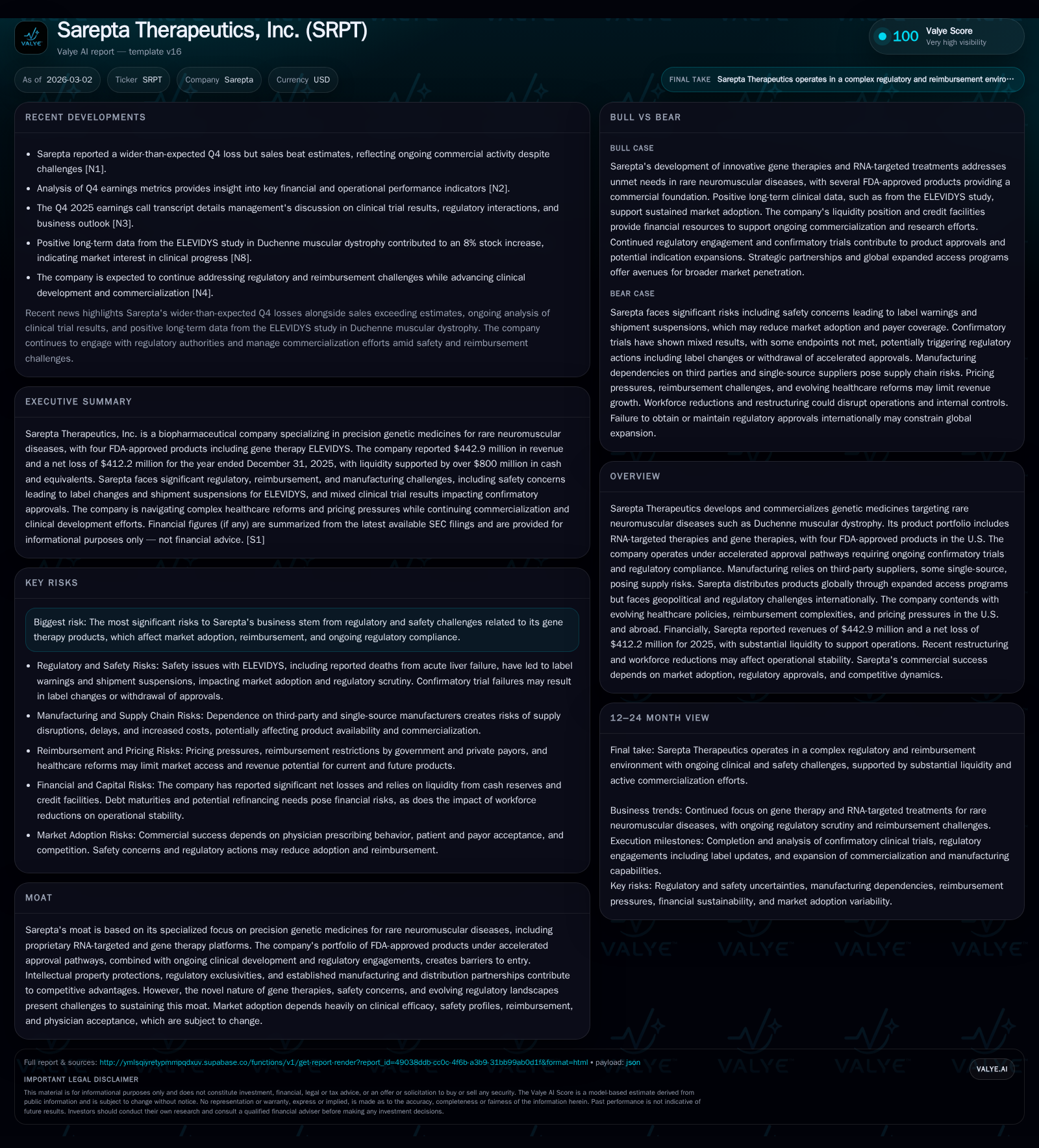
Sarepta Therapeutics, a pioneer in genetic medicines for rare neuromuscular diseases, experienced a pronounced revenue drop in 2025 to $443 million, down nearly 77% year-over-year, alongside an operating loss of $700 million and net loss exceeding $412 million [F1]. This reversal from prior growth years stems largely from safety concerns around its ELEVIDYS gene therapy and complications related to regulatory approvals and reimbursements [S1][S2][N7]. The company is executing a major restructuring plan including workforce cuts and portfolio reprioritization to reduce expenses while investing selectively to validate long-term clinical benefits [S4][N6]. Sarepta’s sustainability depends on resolving confirmatory trial outcomes under FDA accelerated approval pathways and navigating intensifying healthcare pricing pressures and regulatory complexities [S4][S8].
Historical Performance Highlights
Until 2024, Sarepta Therapeutics had demonstrated impressive top-line growth driven by commercialization of FDA-approved RNA-targeted therapies and advancing gene therapy pipelines for rare neuromuscular diseases such as Duchenne muscular dystrophy (DMD). Revenue rose steadily from $933 million in 2022 to $1.24 billion in 2023, then sharply jumped to nearly $1.9 billion in 2024. This expansion was accompanied by a swing from operating losses of over $536 million in 2022 to operating income of $218 million in 2024, reflecting scaling commercial execution and licensing milestone revenues.[F1]
However, financial results for 2025 reveal a sudden reversal. Revenue collapsed by roughly 77% year-over-year to $443 million, while operating income collapsed into a loss of nearly $700 million. Net income followed suit with a loss of $412 million after posting a profit the prior year.[F1] Operating cash flow remained negative at about -$205 million annually through this period, highlighting ongoing funding needs for research development commercialization despite robust liquidity.[F1]
Historical performance (annual)
| FY | Rev ($mm) | Net ($mm) | CFO ($mm) | OpInc ($mm) | Rev YoY | Net YoY |
|---|---|---|---|---|---|---|
| 2025 | 443 | -412 | -205 | -700 | -76.7% | -275.2% |
| 2024 | 1902 | 235 | -206 | 218 | +53.0% | +143.9% |
| 2023 | 1243 | -536 | -501 | -268 | +33.3% | +23.8% |
| 2022 | 933 | -703 | -325 | -536 |
Source: SEC companyfacts cache [F1].
Capital returns and efficiency (annual)
| FY | FCF ($mm) | ROE% |
|---|---|---|
| 2025 | -307 | -36.1 |
| 2024 | -343 | 15.4 |
| 2023 | -577 | -62.4 |
| 2022 | -356 | -182.7 |
Source: SEC companyfacts cache [F1].
Note: Revenue YoY figures reflect annual percentage change from prior year.
Drivers Behind the Performance Shift
Regulatory Impact and Safety Concerns
A pivotal factor underlying the sharp decline in sales and rising losses throughout 2025 is the impact of safety events tied to Sarepta’s leading gene therapy candidate ELEVIDYS for DMD. In response to acute liver failure events resulting in patient deaths among non-ambulatory populations treated with ELEVIDYS, the FDA mandated boxed warnings and other labeling changes.[N12][S25] These developments have not only curtailed market uptake but also complicated reimbursement discussions.
Because ELEVIDYS was granted accelerated approval by the FDA contingent upon completion of confirmatory trials (notably EMBARK), ongoing data readouts are critical. While these trials have recently reported positive three-year functional results suggesting disease progression slowing[N6], uncertainty persists around full traditional approval conversion.
Operational Restructuring
In July 2025, Sarepta announced a strategic restructuring plan aimed at recalibrating its cost base amid these challenges.[S4] The plan entailed about a one-third reduction in workforce (~36%) alongside prioritization of key pipeline assets. Though intended to bring annual cost savings particularly within research & development plus selling/general administration expenses, this transition may face implementation hurdles and disruption risks.
Manufacturing Constraints
Supply chain dependencies include critical third-party manufacturers providing specialized materials essential to production.[S1] Some suppliers operate as single sources heightening operational risks around supply continuity which could affect both clinical trial supplies and commercial product availability.
Healthcare Policy Shifts & Pricing Pressures
The broader U.S. healthcare environment presents notable challenges relating to pricing controls especially under government payor programs like Medicaid Drug Rebate and PHS’ Section 340B discount program.[S12] Ongoing legislative proposals aiming at drug price transparency or reimbursement caps could pressure margins further if enacted widely.
Additionally, recent judicial rulings altering federal agency deference (such as the Loper Bright decision impacting FDA/CMS rulemaking interpretations) add regulatory unpredictability that may complicate compliance efforts.[S8]
Future Growth Outlook
Growth prospects rest heavily upon several key milestones:
- Confirmatory Trial Outcomes: Successful completion of EMBARK could underpin transition from accelerated approval for ELEVIDYS to full traditional FDA approval—removing substantial regulatory risk.
- Safety Profile Management: Addressing adverse event concerns effectively through label modifications or new risk management strategies will guide physician adoption.
- Pipeline Advancement: Diversification into additional RNA-targeted therapies or gene therapies beyond DMD could broaden potential revenue sources.
- Global Expansion: Navigating geopolitical and regulatory environments abroad via expanded access programs requires careful management against local hurdles.[N2][S1]
Conversely, unresolved safety issues or delays in confirmatory data acceptance present major downside risks. Persistent pricing constraints or reimbursement denials could cap sales upside even if clinical validation is achieved.[S9][S11]
Capital Allocation & Financial Position
As of December 31, 2025, Sarepta held $801 million in cash and equivalents supplemented by investments totaling approximately $139 million plus restricted cash totaling roughly $13 million.[F1] This strong liquidity buffer supports near-term operational continuity despite negative free cash flows.
The company has access to an additional unsecured revolving credit facility totaling up to $600 million providing flexibility for capital expenditure or working capital needs.[S14] However, this debt bears variable interest rates exposing Sarepta to potential increased financing costs should rates climb.
Share repurchase activity is minimal with about $25 million spent as buybacks during FY25 compared with sporadic historical purchases.[F1]
Return metrics remain subdued amid losses; approximate return on equity stood near negative 36% owing primarily to net losses outpacing equity growth.[F1]
Competitive Position & Moat Considerations
Sarepta’s moat resides principally in its precision genetic medicine focus targeting rare neuromuscular diseases using proprietary RNA-targeted platforms alongside innovative gene therapies.
While intellectual property protections provide some insulation, intense industry patent litigation risks persist given biosimilar entrants and competitor innovations.[S17][S24] Further complicating its defense is the evolving regulatory landscape with heightened scrutiny on post-market surveillance of accelerated approval drugs.
Adoption remains sensitive not only to clinical efficacy but also tolerability/safety perceptions plus payor acceptance amidst growing emphasis on cost-effectiveness assessments across healthcare systems globally.
What To Monitor Going Forward (Analysis)
- Release timing and detailed results from ongoing EMBARK Phase III studies evaluating ELEVIDYS efficacy/safety trajectories over longer periods.
- FDA’s stance concerning confirmed benefit versus risk profile potentially impacting marketing exclusivity or warnings.
- Progress on execution of restructuring initiatives including headcount reductions delivery versus anticipated savings realized.
- Legislative/regulatory developments pertaining to drug pricing policies both domestically (Medicaid/Medicare reforms) and internationally affecting coverage/reimbursement landscapes.
- Legal proceedings status linked to intellectual property disputes that might threaten product exclusivity or result in costly settlements.
- Manufacturing supplier continuity given reliance on single-source vendors for some components crucial for clinical supplies/commercial scale production effectiveness.
Summary
The trajectory of Sarepta Therapeutics reflects the high-risk/high-reward dynamics endemic within pioneering genetic medicine firms focused on rare diseases. After years of rapid revenue growth supported by novel RNA-targeted therapies transitioning toward broader gene therapy deployment, the sharp setbacks seen during fiscal year 2025 serve as a reality check underscoring regulatory vigilance around safety profiles especially under accelerated approval frameworks.
Significant efforts underway aiming at cost rationalization alongside reinforcement of clinical evidence promise eventual stabilization yet multiple variables remain uncertain. Near-term performance hinges critically on managing ELEVIDYS-related challenges amid industry-wide pressures emanating from evolving healthcare policy landscapes emphasizing affordability alongside innovation sustainability.
This analysis synthesizes publicly available information without offering investment advice or recommendations. It reflects conditions disclosed through March 2, 2026. Due diligence into emerging developments beyond this date is advised for interested parties.
Disclaimer: This is research-only, informational analysis and not investment advice. It may include AI-generated interpretation and general industry context. Always verify important details using primary sources.

Comments