
Sono Group’s Strategic Pivot from Solar Vehicles to Digital Asset Treasury
Sono Group completes exit from legacy solar operations and adopts a digital asset treasury strategy, reshaping its operational and financial outlook.
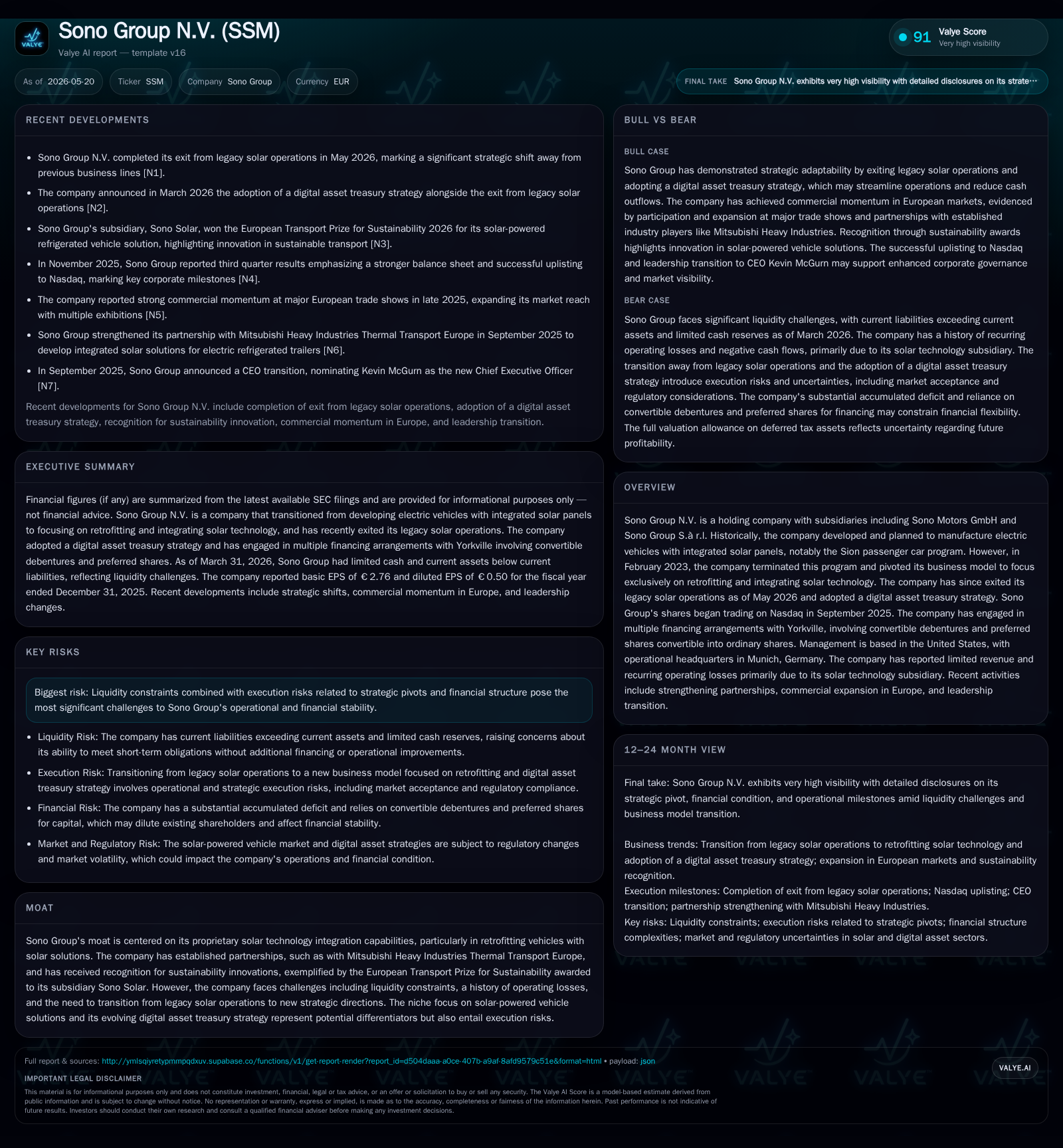
In its Q1 2026 filing, Sono Group N.V. disclosed the termination of funding to its subsidiary Sono Motors GmbH, marking a decisive exit from unprofitable legacy solar vehicle operations. Concurrently, the company adopted a digital asset treasury strategy focused primarily on Bitcoin allocation to generate cash flow and optimize liquidity management. This strategic pivot refocuses Sono’s business model on solar retrofit integration services supplemented by innovative treasury practices. However, liquidity constraints and significant dilution risks from convertible securities remain prominent challenges. Future milestones include shareholder approvals for treasury engagement and progress in commercializing retrofit offerings.
Recent Quarterly Update Clarifies Company’s New Direction
Sono Group’s latest quarterly report filed May 19, 2026 ([S2]) marks a pivotal moment in its turnaround narrative. The supervisory board formally terminated all ongoing and future capital support for its sole operational subsidiary, Sono Motors GmbH, thereby ceasing the Sion electric vehicle project that had persisted despite years of operational losses. This decisive action follows a March 2026 8-K filing ([S3]) which details the immediate exit from legacy solar operations conducted through Sono Motors GmbH due to its historical unprofitability causing continual financial strain.
With these decisions implemented, Sono Group has shut down costly legacy ventures burdening liquidity, realigning its operational focus exclusively on retrofitting existing vehicles with proprietary solar integration technologies. Parallelly, management ratified the incorporation of a digital asset treasury strategy designed to deploy capital into Bitcoin and other cryptocurrencies governed by an ISDA Master Agreement framework ([S1][S6]). This approach inaugurates a significant shift toward leveraging volatile yet potentially high-yield digital assets as the fulcrum of corporate treasury management.
The immediate impact is a much leaner operational structure prioritizing cash conservation while positioning the Company’s balance sheet for diversification beyond traditional manufacturing losses—critical given the constrained cash balance ($237k as of March 31, 2026) highlighted in [F1]
Evolution of Sono Group’s Business Model and Product Quality
Historically conceived as an innovator in electric vehicles integrated with surface solar panels—the flagship being the Sion car—Sono Group abandoned this ambitious hardware manufacturing trajectory in early 2023 after insolvency proceedings affected Sono Motors GmbH ([S21]). The subsequent revival effort involved debt restructuring with Yorkville's convertible debenture financing but without returning to profitable vehicle production.
The Company reoriented toward offering B2B services centered on retrofitting existing fleets or infrastructure with efficient solar technology modules. This new paradigm leans heavily on proprietary integration know-how rather than direct manufacturing of solar panels or complete EVs. Its partnership ecosystem includes recognized entities such as Mitsubishi Heavy Industries Thermal Transport Europe ([N1]), underscoring credible collaboration in sustainable transport innovation.
This service-based pivot aligns Sono Group more firmly within energy transition value chains where demand for sustainability upgrades grows among commercial vehicle operators seeking carbon footprint reductions without wholesale fleet replacement. Product quality is tethered to specialized integration competence—the key competitive barrier—as opposed to mass scale hardware production capacity.
Competitive Environment and Industry Structural Dynamics
Within the renewable automotive ecosystem, Sono occupies a distinctive niche focusing on retrofitting solutions integrating solar energy generation into transportation assets. While mainstream OEMs continue incrementally exploring integrated renewable technologies, few specialize exclusively in retrofit markets—a sector shaped by regulatory incentives favoring greenhouse gas emissions reduction and tightening ESG standards across industries.
Switching costs for customers may be moderate; however, proprietary tech integration knowledge establishes moderate stickiness by limiting alternative vendors able to deliver comparable turnkey retrofits efficiently ([S1]). Cost pressures persist industry-wide given competitive hardware pricing and ongoing technological advances in battery storage and photovoltaics.
Moreover, Sono’s concurrent foray into digital asset treasury places it apart from pure-play manufacturers or retrofit specialists—entering an emerging intersection between renewable tech firms managing their own liquidity through cryptocurrencies against traditional cash reserves.
Emerging Growth Opportunities from Solar Retrofitting and Digital Assets
Demand-side growth drivers hinge strongly on rising corporate climate commitments emphasizing fleet decarbonization without asset replacement cost surges. Large transport companies may adopt retrofit upgrades as scalable sustainability measures responsive to evolving regulatory regimes.
Improved margins could stem from economies of scale as retrofit projects aggregate or from proprietary technology enhancements boosting installation efficiency or output performance ([S3]). Geographic expansion might follow as regulations tighten globally.
On the financial front, Sono's Treasury Strategy involving Bitcoin holdings under an institutional ISDA agreement with Blockchain.com ([S25]) offers alternative revenue streams through covered-call yield strategies while hedging volatility risks inherent in cryptocurrency markets. This approach could stabilize cash flows providing runway amid operating losses.
Near-term KPIs include observed contraction of legacy losses following shutdowns, timing ramp-up of sales/order intake for retrofit services, progression in digital asset purchase volumes within approved policy limits ([S3]).
Risks and Challenges in Execution and Financial Structure
Sono faces considerable execution risk given capital scarcity; at Q1-end 2026 it reported only $237k cash equivalents ([F1]) against ongoing net operating losses that totaled approximately $2 million during that quarter ([F1]). Current liabilities outpace current assets (0.74 current ratio) indicating working capital tension ([F1]).
Financial leverage is elevated due to reliance on Yorkville's convertible debentures and preferred shares; this setup carries substantial dilution risk since future conversions could markedly increase share count undermining existing shareholders' voting power ([S1]). The supervisory board authorization permitting issuance or subscription rights for over 105 million new ordinary shares further accentuates this risk.
Further operational hazards concern potential unforeseen costs tied to exiting legacy businesses including legal fees ([S3]) and uncertainties surrounding sustaining compliance with Nasdaq listing standards given shrinking operational scale or prospects.
Customer acquisition might also be pressured by competition offering more integrated hardware-software ecosystem solutions or OEM-led green fleet initiatives challenging Sono's retrofit differentiation.
Catalysts and Key Milestones to Monitor Going Forward
Critical near-term corporate actions include scheduled extraordinary general meeting votes aimed at ratifying active engagement in the Treasury Strategy ([S3], anticipated Proxy Statement filings). Monitoring developments around digital asset acquisition volume thresholds will provide insights into balance sheet transformation pace.
Commercially significant indicators comprise announcements of retrofit contract awards reflecting market acceptance; growth benchmarks should emerge relative to backlog expansions or delivery milestones revealing traction beyond pilot phases ([N1]).
Additionally, disclosures regarding actualized expenditure related to legacy business wind-down—including legal or advisory costs—will inform assessments of transition execution efficacy ( [S3]).
Equity issuance events tied either to debt conversions or new financings will materially affect capitalization structure hence warrant attention for dilution impacts ([S1], [F1]).
Brief Financial Position Review Supporting Operational Narrative
Sono’s Q1 2026 results spotlight constrained liquidity with cash & equivalents standing at $237k alongside persistent operating losses (~$2 million net income loss) reflecting ongoing restructuring burdens ([F1], [S2]). Historical revenue remains minimal (circa €42k at end-2023), evidencing limited commercial scale so far.
The current ratio below unity (0.74) illustrates working capital shortfall necessitating urgent financing or operational pivots for survival ([F1]). Convertible debenture maturity dates within the next twelve months impose refinancing imperatives unless conversion occurs earlier ([S14],[S23]).
Management’s repositioning around digital asset-backed treasury combined with halted cash-consuming legacy programs appears essential to sustain operations beyond near term though accompanied by heightened uncertainty about going concern status acknowledged in filings ([S14],[S23]).
This analysis is based solely on disclosed SEC filings and publicly available information as of May 2026. It does not constitute investment advice or research views but aims to evaluate Sono Group's transformational trajectory amid strategic pivots under substantial financial constraints.
Disclaimer: This is research-only, informational analysis and not investment advice. It may include AI-generated interpretation and general industry context. Always verify important details using primary sources.

Comments