
Starco Brands Advances Vertical Integration Strategy Amid Liquidity Pressures
Latest filings reveal Starco Brands progressing its vertical integration through manufacturing acquisition while confronting liquidity and legal uncertainties.
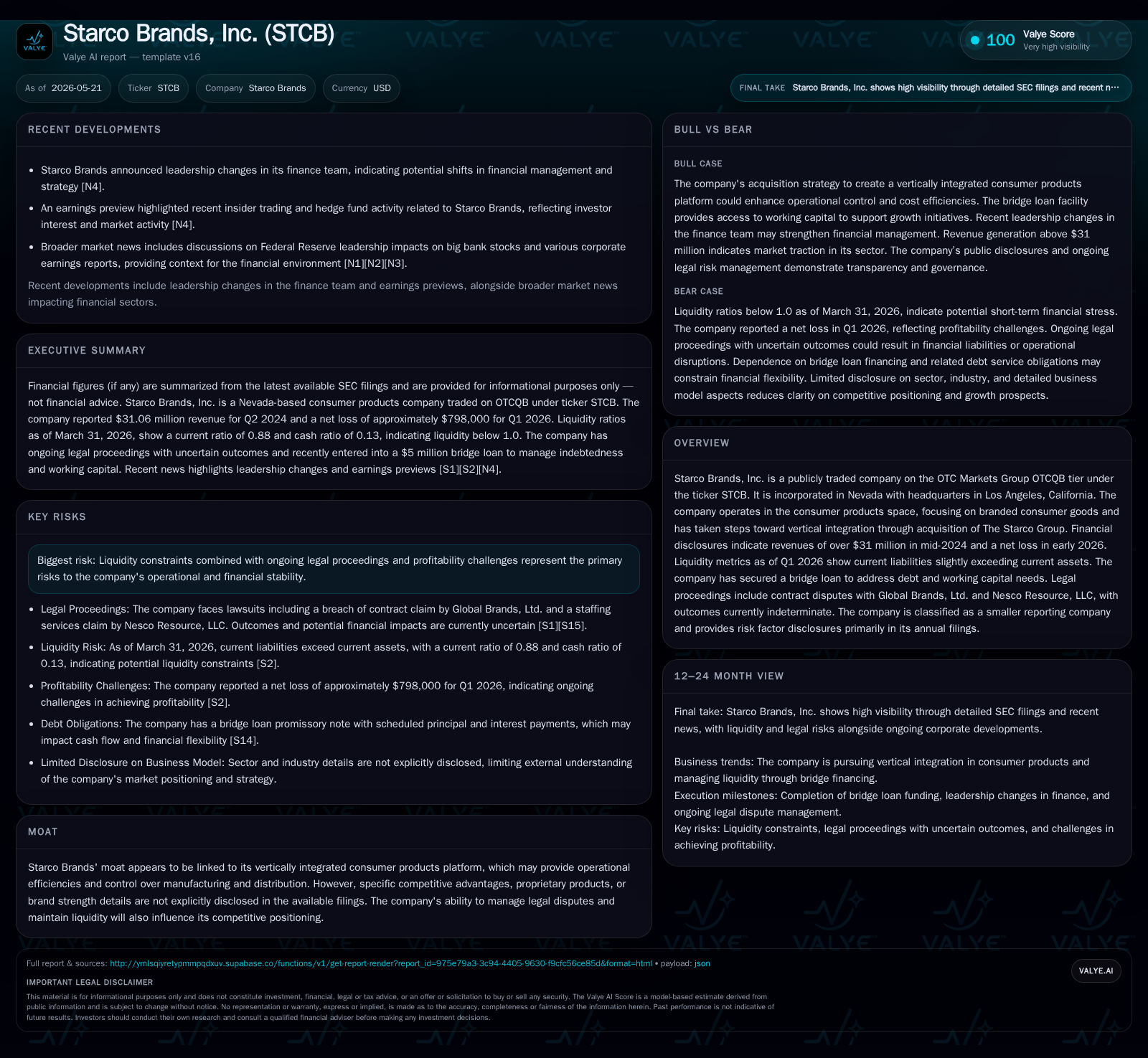
Starco Brands' most recent 10-Q filing in May 2026 highlights an absence of ongoing legal proceedings contrasted with persistent liquidity pressures evidenced by a current ratio below one. The company's strategic acquisition of The Starco Group marks a critical pivot toward vertical integration in the consumer goods sector, aiming to capture operational efficiencies and margin improvements. Nonetheless, risks remain elevated due to prior contract disputes and dependence on bridge loan financing. Monitoring integration execution and liquidity stabilization will be key to assessing Starco's trajectory.
Latest Quarterly Performance and Operational Highlights
Starco Brands' latest quarterly report dated May 20, 2026 (Form 10-Q) discloses that there are currently no active legal proceedings against the company [S2]. This marks a notable shift from the prior annual filing where litigation with Global Brands Ltd. over UK distribution agreements and Nesco Resource LLC over staffing services were unresolved threats [S1]. While these matters remain latent risks without active litigation status, this cessation in reported proceedings may reflect ongoing negotiations or temporary dormancy.
Additionally, governance saw a material change in April 2026 with director Bharat Vasan resigning effective April 27 [S3], a departure noted as unrelated to disagreements but relevant for board dynamics during this liquidity-challenged phase.
Financials show current assets at approximately $12.3 million lagging behind current liabilities near $13.9 million as of March-end 2026 [F1], resulting in a subpar current ratio around 0.88—indicative of limited near-term financial flexibility. Despite securing a sizable bridge loan ($4.5 million initial draw; up to $5 million total) from The Starco Group at year-end 2025 aimed at refinancing prior debt and bolstering working capital [S19], the company’s short-term solvency profile still reflects pressure points.
Business Model: Integrated Consumer Products Platform
Starco Brands generates revenue through consumer-branded goods distributed largely in North America, focusing on products partially owned or controlled via the acquisition of The Starco Group contract manufacturer finalized in mid-2025 [S4]. This represents a strategic pivot toward vertical integration designed to enhance product quality control, reduce supplier dependencies, and accelerate innovation cycles by internalizing manufacturing functions previously outsourced.
Revenue mechanics involve direct sales of branded products to wholesalers and retailers who pay for inventory under varying contractual terms influenced by volume purchases and promotional allowances. Vertical integration could enable incremental margin retention by lowering cost of goods sold (COGS) through scale efficiencies within The Starco Group’s manufacturing operations.
The acquisition also anticipates better synchronization between production scheduling and market demand signals—critical in consumer packaged goods sectors where shelf life and rapid go-to-market speed impact customer retention and revenue durability.
Competitive Position and Industry Context
Operating within the branded consumer goods sector exposes Starco Brands to competitive pressures from established incumbents with wide distribution networks and recognizable brands. However, Starco’s ownership of its manufacturing segment through The Starco Group affords it unique operational leverage compared to similarly sized OTC peers that typically rely entirely on third-party suppliers.
Switching costs for retail customers can be moderate depending on product category; hence consistent product quality and reliable delivery schedules are essential competitive differentiators. Regulatory compliance around food safety or labeling (as applicable) poses industry-wide barriers but also raises the entry cost for new competitors.
While explicit peer comparisons are limited due to disclosure constraints, vertical integration is relatively uncommon among smaller OTC consumer product companies—potentially positioning Starco as more resilient to supply-chain disruptions if it successfully leverages this advantage.
Growth Drivers: Vertical Integration and Brand Expansion
Starco's pathway for growth centers on operational synergies arising from its vertically integrated structure acquired via The Starco Group [S4]. By internalizing manufacturing processes, Starco aims to enhance gross margin profiles by minimizing outsourcing costs, reducing lead times, and improving quality consistency—the latter aiding brand equity development.
Expanding brand footprint remains a priority with ongoing efforts likely focused on increasing retail penetration domestically while exploring selective international markets as hinted by prior UK-related disputes [S1]. Growth volume is expected to be influenced by capacity utilization improvements within the newly integrated production facilities.
However, profitability gains face headwinds considering cumulative operating losses exceed $18 million through FY2025 [F1]—suggesting that scale realization is still underway amid investments required for integration.
Risks Including Liquidity Constraints and Legal Proceedings
Key vulnerabilities for Starco include its less-than-ideal liquidity position marked by a current ratio below one [F1], signaling continued risk around meeting short-term obligations without additional capital infusions or operational improvements.
Legal risks remain embedded although not actively litigated per latest disclosures; prior contract disputes carry potential contingent liabilities with outcomes uncertain [S1]. These unresolved issues represent latent risk factors that could unexpectedly impact financial condition if reopened or settled unfavorably.
Bridge loan dependency introduces refinancing risk given heightened interest rates tied to Prime plus margins nearing high single digits [S19], while operational cash flow deficits constrain autonomous deleveraging capacity.
Management turnover such as the recent director resignation may also weigh on corporate governance stability at this sensitive juncture [S3].
Key Upcoming Milestones and Monitoring Points
Critical near-term milestones include any further public updates on resolution or settlement status of the prior legal disputes as annual reports have indicated indefinite outcomes previously [S1]. Additionally, execution success on integrating The Starco Group’s manufacturing platform into overall operations should manifest through margin progression or improved working capital metrics.
Continued board composition changes warrant scrutiny since they affect oversight amid liquidity pressures.
Quarterly results following May 2026 will provide timely indicators regarding operating cost trends and whether efficiency strategies tied to vertical integration mature sufficiently to offset prior loss trends [S2]
Tracking improvements in the current ratio above the critical threshold near or above one would represent a key positive signal for financial health moving forward.
Concise Financial Overview: Liquidity, Debt, and Profitability Status
As of December 31, 2025, Starco held roughly $1.8 million in cash assets juxtaposed against total debt around $3.47 million recorded at September-end same year [F1]. Subtracting cash from debt implies net debt near $1.65 million—a manageable figure if operating cash flows improve—but currently burdensome amidst suboptimal revenue-to-loss ratios: revenues exceeded $31 million reported mid-2024 while net losses have ballooned past $20 million by end FY2025 [F1].
The secured bridge loan facility arranged in late 2025 provides crucial working capital relief but carries terms featuring interest rates pegged at Prime plus an additional margin with accelerated repayment schedules beginning January 2027 [S19]. Maintaining serviceability against these obligations depends heavily on revenue growth acceleration coupled with efficient cost control post-integration.
In sum, Starco Brands today operates under tangible liquidity stress amidst strategic repositioning driven by vertical integration initiatives whose payoff remains under watchful assessment.
Financial position in context
As of 2025-12-31, companyfacts shows $1818406 in cash and equivalents [F1]. Current assets of $12mm and current liabilities of $14mm imply a current ratio near 0.88x for 2026-03-31 [F1].
This analysis is intended solely for informational purposes without providing investment advice or research views. Readers should consult additional sources when evaluating Starco Brands' securities or business prospects.
Disclaimer: This is research-only, informational analysis and not investment advice. It may include AI-generated interpretation and general industry context. Always verify important details using primary sources.

Comments