
STRATTEC SECURITY CORP: Navigating Automotive Industry Cycles with Diversified Product Lines and Customer Concentration Risks
STRATTEC SECURITY CORP leverages its specialized automotive security components and long-standing OEM relationships to maintain operational resilience amid cyclical demand and foreign exchange headwinds. Its potential financial flexibility via a recent share buyback contrasts with volume-sensitive earnings, highlighting a nuanced outlook.
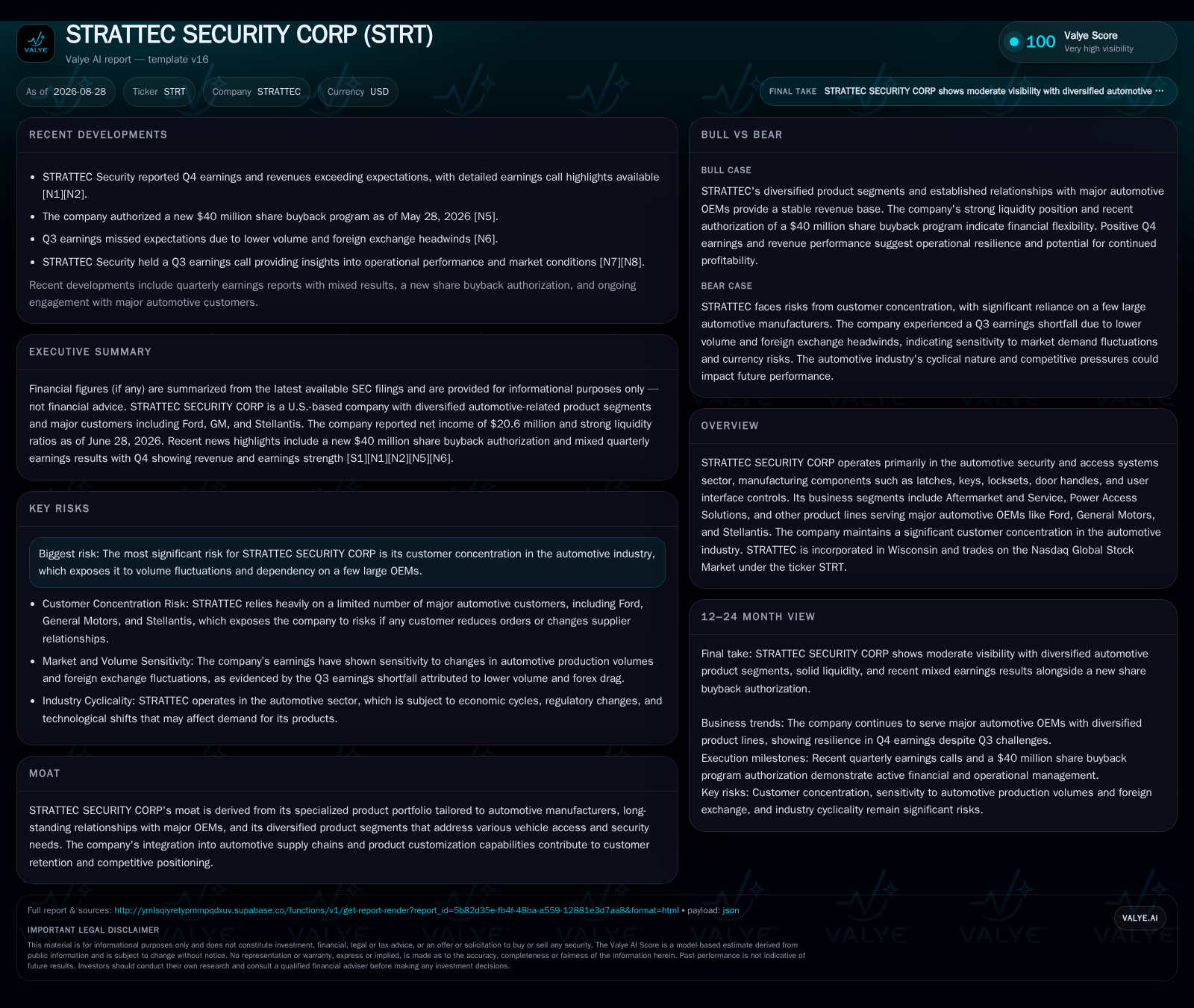
STRATTEC SECURITY CORP, a U.S.-based automotive security component supplier, reported $20.6 million net income for fiscal 2026 with reported liquidity position and a $40 million share buyback authorization. Its business model depends on major OEMs like Ford and GM, exposing it to volume and currency risks. While Q4 results surpassed expectations, Q3 earnings suffered from lower volumes and forex headwinds. The company’s diversified product segments and embedded OEM relationships create potential operating leverage, but customer concentration and cyclicality remain key vulnerabilities. Monitoring volume trends, contract renewals, and currency impacts will be critical to assessing STRATTEC’s near-term trajectory.
STRATTEC SECURITY CORP’s latest fiscal year results reveal a company balancing solid financial footing against the inherent cyclicality and concentration risks of the automotive supply sector. Reporting $20.6 million net income and maintaining over $108 million in cash, the company’s liquidity positions it well for operational investments and shareholder returns, evidenced by a $40 million share repurchase plan. However, sensitivity to automotive production volumes and currency fluctuations emerged clearly through a Q3 earnings miss, underscoring the challenges of serving a limited number of major OEM customers. STRATTEC’s diversified product portfolio in vehicle security and access components provides a foundation for resilience, yet the evolving competitive and technological landscape in automotive manufacturing will test its adaptability and margin sustainability going forward.
Latest Operating Snapshot
For the fiscal year ended June 28, 2026, STRATTEC SECURITY CORP reported net income of $20.598 million with basic earnings per share of $5.07 and diluted EPS of $5.00 [S1]. This level of profitability reflects ongoing demand from key automotive OEMs despite noted headwinds. The company also held $108.243 million in cash and cash equivalents, underpinning a reported liquidity position position with a current ratio of 2.9 and cash ratio just over 1.0 as of that date [S1].
Recent quarterly performance was mixed: Q3 earnings missed analyst expectations due primarily to lower automotive production volumes and adverse foreign exchange impacts, signaling sensitivity to external macro factors [N6]. However, Q4 results reversed this trend, beating revenue and earnings estimates, indicating operational resilience and possible improvement in order flow or pricing [N1][N2]. Additionally, the company authorized a new $40 million share buyback program in late May 2026, signaling confidence in cash flow generation and potential financial flexibility [N5].
Business Model and Unit Economics
STRATTEC’s business model centers on manufacturing automotive security and access components—such as latches, keys, locksets, door handles, and user interface controls—primarily for a handful of large OEM customers including Ford, General Motors, and Stellantis [S1]. Revenue generation depends on contract volumes and pricing negotiated within OEM supply chains, which in turn are influenced by automotive production volumes, model refresh cycles, and technology adoption. Pricing dynamics involve a combination of volume-based agreements and potential mix shifts as new product features or technologies are integrated.
From a cost structure standpoint, the business likely exhibits significant fixed costs typical of manufacturing operations, including tooling, facilities, and labor, combined with variable costs of materials and direct labor. This mix suggests operating leverage when volumes increase, but also vulnerability to volume declines as seen in Q3 2026. Capital intensity is moderate, driven by precision manufacturing and quality control requirements. Operating leverage may emerge if STRATTEC can sustain or grow volumes with relatively stable fixed overhead, but margin compression could occur if volumes decline or if pricing pressure mounts from OEMs or competitors.
Moat, Competition and Counterforces
STRATTEC’s moat is primarily built on its specialized product portfolio tailored to automotive security and access needs, coupled with long-standing OEM relationships that embed it into complex vehicle manufacturing supply chains [S1]. These relationships create switching frictions, as OEMs require validated suppliers that meet stringent quality, safety, and integration standards. The company’s diversified segments—ranging from aftermarket parts to power access solutions—help spread risk and enable cross-selling opportunities, enhancing customer stickiness.
However, the automotive supplier space is intensely competitive, with peers and new entrants vying on cost, innovation, and technology integration. Major automotive suppliers with broader platforms or stronger R&D capabilities could pressure pricing or displace STRATTEC in certain product categories. Additionally, shifts toward electrification, autonomous driving, and digital vehicle access technologies may require STRATTEC to innovate or risk obsolescence. Currency fluctuations and OEM production cuts are counterforces that can quickly erode revenue visibility and margins.
Bull Case
In an optimistic scenario, STRATTEC leverages its entrenched OEM relationships and diversified product portfolio to capitalize on stable or growing automotive production volumes. Continued demand for vehicle security and access components, especially amid evolving regulatory and safety requirements, could drive volume growth and improve pricing power. The company’s reported liquidity position and recent $40 million share buyback program reflect financial discipline and confidence in cash flow generation, potentially leading to enhanced shareholder returns and investment capacity for innovation.
Confirmation of this scenario would include sustained volume recovery across key customers, stable or expanding operating margins, and successful new product integration responding to automotive trends such as electrification or connected vehicles. Conversely, failure to regain volume momentum or margin pressure from competitive dynamics would falsify this view.
Base Case
The base case envisions STRATTEC maintaining its current market position, serving major OEMs with moderate volume growth tempered by cyclical automotive production fluctuations and periodic foreign exchange headwinds. Revenue and earnings could track closely to industry production trends, with operating leverage providing some margin expansion during volume upcycles but limited by competitive pressures and cost inflation.
In this scenario, STRATTEC’s diversified product lines and OEM embeddedness stabilize its revenue base but do not materially alter its risk profile from customer concentration or cyclicality. The share buyback program continues to deploy excess cash opportunistically. Key falsification would be a sustained decline in OEM orders or loss of major contracts that materially impair scale or margins.
Bear Case
Downside risks crystallize if automotive production volumes contract sharply due to economic downturns, shifts in OEM supplier strategies, or accelerated technology substitution. STRATTEC’s heavy customer concentration means any significant order cuts by Ford, GM, or Stellantis could disproportionately reduce revenue and compress operating margins. Additionally, sustained foreign exchange volatility could further erode reported earnings by impacting cost competitiveness and pricing.
This scenario could be confirmed by consecutive quarters of volume declines, OEM contract losses, or margin deterioration despite cost controls. A lack of strategic adaptation to emerging automotive technologies or failure to diversify the customer base would exacerbate vulnerability. Conversely, signs of contract renewals or product innovation mitigating these risks would weaken the bear thesis.
What Matters Next
Critical near-term metrics include automotive OEM production volumes, particularly for Ford, GM, and Stellantis, as these directly influence order quantities and revenue. Monitoring the mix of products sold—whether higher-margin power access solutions or aftermarket parts—is important to assess margin trajectory. Currency exchange rates remain a key external factor affecting profitability given prior forex headwinds.
Other important indicators are contract renewal status and any new OEM partnerships that would signal customer diversification or competitive positioning. Operational KPIs such as manufacturing efficiency, defect rates, or R&D investment levels would offer insight into STRATTEC’s capacity to innovate and maintain quality standards. Lastly, cash flow generation and share buyback execution will reveal management’s confidence and potential financial flexibility.
Disclaimer: This is research-only, informational analysis and not investment advice. It may include AI-generated interpretation and general industry context. Always verify important details using primary sources.

Comments