
Stereotaxis, Inc.: Growth Levers, Recurring Revenue Ambitions, and the Realities of Medical Robotics Economics
The company relies on a mix of initial system sales and recurring disposable/device revenue, with complex accounting tied to multi-element contracts.
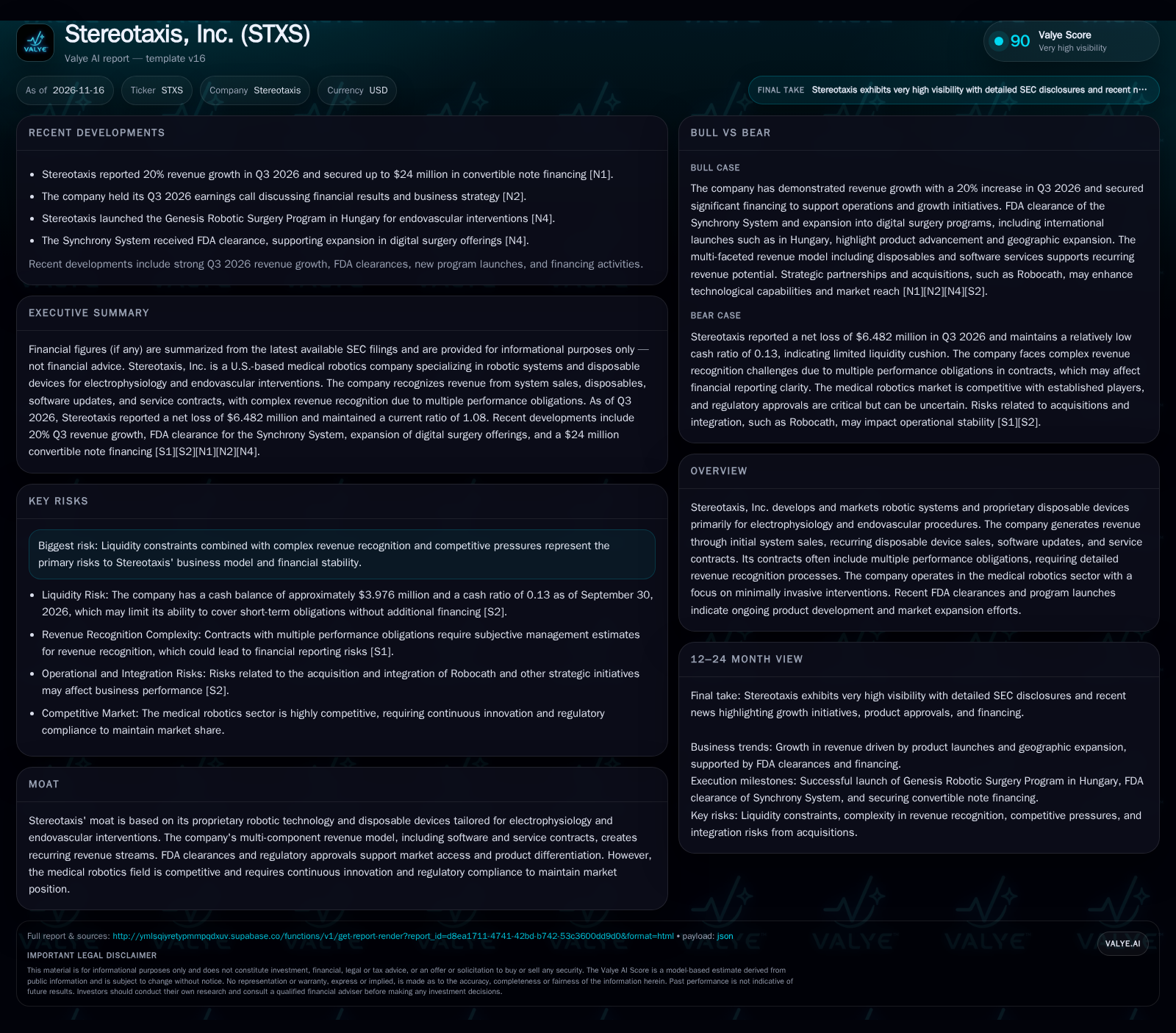
The company relies on a mix of initial system sales and recurring disposable/device revenue, with complex accounting tied to multi-element contracts. Key watchpoints include integration of recent acquisitions, regulatory progress, and the ability to convert innovation into recurring, profitable growth amid industry competition and liquidity pressures. [N1] [S2]
The company’s mix of upfront system sales and recurring device/software revenue offers a potential pathway to durable growth, but success hinges on effective integration of acquisitions, continued regulatory progress, and the ability to fend off entrenched competitors—all while managing liquidity and the complexities of multi-element contracts. The months ahead will test whether Stereotaxis can translate its technology and strategic moves into lasting financial sustainability.
Recent Growth, Financing, and Ongoing Losses: The Current Operating Picture
Stereotaxis reported 20% year-over-year revenue growth in Q3 2026, a notable acceleration after periods of more sluggish topline performance. This uptick comes alongside the announcement of up to $24 million in convertible note financing, providing a near-term funding bridge but also raising the risk of future dilution. These figures underscore the company’s ongoing struggle to achieve profitability and highlight its vulnerability to any operational or market disruptions. Integration risks related to the Robocath acquisition and the complexity of revenue recognition further complicate the near-term outlook. [N1] [S2]
How Stereotaxis Hopes to Turn Robotics Innovation into Recurring Cash Flow
Stereotaxis’s business model is structured around two primary revenue streams: initial sales of robotic systems for electrophysiology and endovascular procedures, and recurring revenue from proprietary disposable devices, software updates, and service contracts. The economics of this model are attractive in theory—capital equipment sales drive initial adoption, while disposables and services generate ongoing revenue as installed systems are used for patient procedures.
However, actual realization of these economics is complex. System sales are lumpy and subject to long hospital sales cycles, procurement hurdles, and regulatory delays. Recurring revenue depends on procedure volume, customer retention, and the ability to continually innovate disposables and digital offerings. Fixed costs for R&D, regulatory compliance, and sales infrastructure are significant, and the company’s recent net losses suggest that current volume and margin on both systems and disposables are insufficient to cover these outlays. The need for external financing highlights the capital intensity and working capital demands of the business. If Stereotaxis can grow its installed base and deepen utilization, operating leverage could eventually turn recurring revenue into sustainable cash flow—but this remains unproven.
A critical factor influencing the transition from capital sales to recurring revenue is the installed base growth rate relative to market saturation. If the addressable market is limited or adoption is slow, the installed base may plateau before economies of scale can be realized, constraining margin expansion. Conversely, if the company can penetrate new clinical specialties or geographic regions effectively, it may unlock incremental recurring revenue streams. Additionally, the pricing strategy for disposables and software updates must balance competitive pressures with margin preservation; aggressive discounting to drive utilization could undermine long-term profitability despite higher procedure volumes.
Another dimension is the lifecycle management of disposables and software offerings. Sustaining recurring revenue depends on continual innovation that meets evolving clinical needs and regulatory standards. However, frequent product iterations can increase R&D and regulatory compliance costs, potentially offsetting revenue gains. The company must also manage inventory and supply chain complexities inherent in disposable products, where forecasting demand is challenging due to variable procedure volumes and hospital purchasing behaviors. Effective alignment of product development with customer feedback and market trends will be essential to optimize the balance between innovation costs and revenue growth.
Defending a Niche in a Crowded and Evolving Medical Robotics Market
Stereotaxis competes in the medical robotics and minimally invasive intervention space, where barriers to entry are high but so is the intensity of competition. The company’s proprietary robotic systems and associated disposables provide some degree of differentiation, particularly in electrophysiology procedures where magnetic navigation may offer clinical and workflow advantages over manual techniques or alternative robotic platforms.
However, the broader sector includes large, well-capitalized players with extensive product portfolios and established hospital relationships. These competitors can exert pricing pressure, accelerate innovation cycles, and bundle solutions in ways that challenge smaller firms. Technology substitution—such as advances in manual catheter navigation, alternative robotics, or digital-only navigation tools—remains an ongoing threat. Stereotaxis’s ability to maintain a competitive moat will depend on sustained innovation, securing regulatory approvals, and demonstrating both clinical and economic value to hospital systems. The integration of Robocath could expand the addressable market and product breadth, but also introduces execution and integration risk.
The competitive landscape is further complicated by the pace of technological advancement and the emergence of alternative treatment modalities. Competitors with broader portfolios may leverage cross-selling opportunities and integrated solutions that reduce the appeal of standalone robotic systems. Moreover, reimbursement dynamics can influence hospital purchasing decisions; if payers do not recognize added value or cost savings from robotic procedures, adoption may lag. Stereotaxis’s ability to demonstrate clear clinical outcomes and cost-effectiveness relative to alternatives will be pivotal in maintaining its niche. Strategic partnerships or collaborations could also provide access to complementary technologies or distribution channels, enhancing resilience against competitive threats.
A Virtuous Cycle: Installed Base Growth, High Device Utilization, and Margin Expansion
The most compelling upside scenario for Stereotaxis is one in which recent revenue growth is not a one-off, but rather the beginning of a sustained acceleration. If the company can successfully integrate Robocath and leverage new product launches like the Genesis Robotic Surgery Program, it could expand its installed base across more geographies and clinical specialties.
In this scenario, a growing number of hospitals adopt Stereotaxis systems, leading to higher recurring revenue from disposables and software as procedure volumes rise. Improved utilization drives operating leverage, allowing fixed R&D and sales costs to be spread over a larger revenue base, and potentially moving the company toward profitability. Confirmation of this scenario would require consecutive quarters of strong system placements, increasing disposable sales per installed system, and evidence of stable or improving gross margins. Regulatory wins and customer testimonials validating clinical efficacy would further strengthen the case.
Incremental Progress, Persistent Losses, and the Search for Sustainable Scale
The most plausible near-term trajectory for Stereotaxis is a pattern of modest revenue growth punctuated by continued operating losses and periodic capital raises. While recent topline momentum and new product launches suggest some commercial traction, the medical robotics market remains slow to adopt new platforms, and hospital budgets are constrained.
The company may see incremental gains in installed base and recurring revenue, but these are likely offset by ongoing R&D, sales, and integration costs—especially as it seeks to digest the Robocath acquisition. Evidence for this scenario would be continued quarterly losses, stable or only gradually improving gross margins, and ongoing disclosures of financing activities. A major shift would require either a step-change in recurring revenue per system or a significant reduction in cash burn.
Liquidity Squeeze and Market Share Erosion: When Growth Isn’t Enough
Stereotaxis faces the risk that revenue growth stalls or reverses, either due to competitive encroachment, slower-than-expected adoption of its platforms, or integration hiccups with Robocath.
Erosion of recurring revenue—whether from customer churn, lower-than-expected procedure volumes, or pricing pressure—could further weaken the company’s economics. Confirming evidence would include missed system sales targets, declining disposable revenue per installed base, regulatory setbacks, or unexpected customer losses. A critical warning sign would be the need for emergency financing or the inability to meet short-term obligations without dilutive measures.
Milestones That Will Reveal If Stereotaxis Can Deliver on Its Robotics Ambitions
Quarterly revenue growth segmented between system sales and recurring disposable/software revenue, to test the durability of both adoption and utilization trends (if disclosed).
Gross margin progression, especially as new products and the Robocath portfolio are integrated, to assess operating leverage and pricing power.
Cash burn rate and runway updates, including the impact of new financing, as a direct measure of liquidity risk and the urgency for profitability.
System placement and installed base growth, particularly in new geographies or clinical specialties, as a leading indicator of future recurring revenue.
Utilization rates—i.e., procedures per installed system and disposable pull-through—which would clarify the stickiness and economic value of the platform (if disclosed).
Regulatory milestones for new products or indications, especially FDA clearances that could open new market segments.
Integration progress and synergy realization from the Robocath acquisition, with updates on portfolio expansion and cross-selling traction.
Competitive developments, such as major new product launches or pricing actions from larger medical robotics players, that could pressure Stereotaxis’s market position.
Disclaimer: This is research-only, informational analysis and not investment advice. It may include AI-generated interpretation and general industry context. Always verify important details using primary sources.

Comments