
Sunbelt Rentals’ Earnings Slide Highlights Capital Allocation Challenges
Recent revenue softness paired with a hefty debt profile complicates Sunbelt Rentals' ability to invest in growth and generate returns.
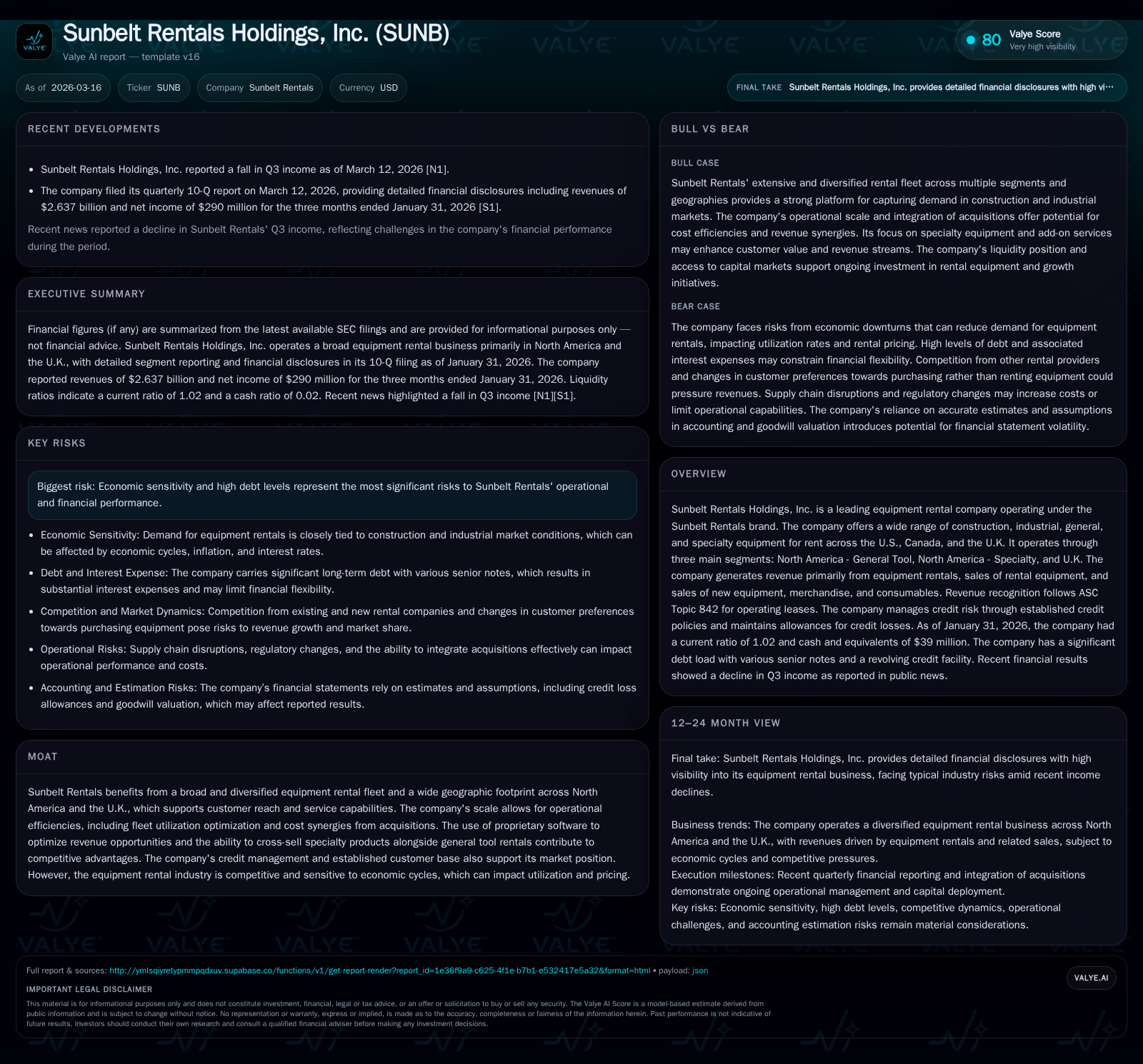
Sunbelt Rentals reported a decline in quarterly net income despite robust top-line scale, reflecting pressures from economic uncertainty and pricing challenges. The company carries over $7.6 billion in debt, limiting financial flexibility amid a rental market facing cautious demand. While segments show geographic and operational diversity, margins have compressed with fleet utilization under strain. Capital allocation remains focused on fleet investment and prudent debt management, but returns reflect the tension between growth initiatives and financial leverage. Key indicators like utilization rates, rental pricing, and credit loss provisions will be critical to monitor moving forward.
Historical Growth and Profit Drivers: Fleet Expansion and Market Mix
Sunbelt Rentals leverages an extensive equipment rental fleet across construction, industrial, general tool, and specialty categories that have driven consistent revenue growth historically. The company's broad rental offerings manifest in a recent quarterly revenue of approximately $2.637 billion ending January 31, 2026, with operating income tallying $492 million; however, net income softened to around $290 million indicating margin pressure [F1]. This sizable revenue base reflects organic scaling combined with strategic bolt-on acquisitions enhancing both general tool categories and lower-penetration specialty products.
Revenue composition under ASC Topic 842 recognizes most equipment rentals as operating leases that contribute predictably when fleet utilization remains healthy. Positive contributions from the expanding specialty segment complement the larger general tool footprint predominantly in North America, while U.K operations add geographic diversity. Over recent years reflected in annual reports, Sunbelt showed expansion driven by market mix balancing established product lines with strategic niche growth areas [S2][S12].
Historical performance (annual)
| FY |
|---|
| 2026 |
Source: SEC companyfacts cache [F1].
Table note: Quarterly figures are presented given lack of full-year data for 2026; CF figures annualized where appropriate.
Segment Performance and Geographic Revenue Distribution
Sunbelt operates three main segments: North America - General Tool primarily renting conventional construction machinery across the U.S. and Canada; North America - Specialty focusing on less commoditized equipment such as power & HVAC systems, scaffolding, pumps, climate control among others; and U.K., which mirrors similar product breadth adapted for local market conditions [S12].
The General Tool segment anchors the revenue base due to its broader market adoption and steady rental penetration. The Specialty segment benefits from being an additive sale alongside general tool rentals by offering complementary products to boost re-rent revenues per customer visit—a key competitive edge using cross-selling strategies supported by proprietary software tools for optimized inventory deployment [valye_report_excerpt.moat].
Yet recent quarterly results reflect uneven pressures: economic uncertainties weigh on project starts especially impacting utilization rates—a critical KPI in the rental industry—as well as pricing power on rental rates and ancillary fees like loss damage waiver charges [N1][S9]. The U.K. segment faces discrete macroeconomic factors adding operational complexity including regulatory shifts impacting fleet deployment timing.
Emerging Headwinds: Income Declines Amid Economic Uncertainty
Despite Sunbelt’s large-scale operational footprint fostering strong top-line momentum, Q3 earnings data disclosed a noticeable dip in net income relative to historical trends [N1]. Management commentary attributes this partly to softening demand linked to broader economic uncertainty affecting end markets such as construction activity levels.
Utilization—a measure of how effectively the rental fleet is employed—is pivotal for translating fleet capacity into revenue gains; recent softness signals caution among customers which compresses margin potential even while fixed costs persist. Rents for high-value assets face intensifying competitive pressure leading to limited price increases or discounting in some cases.
Credit risk management also plays a notable role amid these dynamics; Sunbelt maintains allowances for credit losses calibrated by historical default rates plus forward-looking adjustments considering economic conditions [S2][S16]. Loss damage waiver fees provide incremental revenue streams but fluctuate based on contractual terms and customer acceptance.
Capital Structure Snapshot: Managing Significant Long-Term Debt
Sunbelt's capital structure is characterized by a considerable leverage profile totaling approximately $7.64 billion in debt as of January 31, 2026 [S4]. The debt stack includes multiple senior notes spanning maturities from near-term August 2026 (1.5% coupon) to longer-term obligations extending through April 2034 with coupons ranging roughly from 4% to nearly 6% depending on series [S6]. These senior notes constitute short- and long-term portions accordingly—with $549 million classified as short-term due to imminent maturity risk.
A secured revolving credit facility provides liquidity flexibility with commitments up to $4.75 billion though only about $1.49 billion was drawn at period-end [S13]. Interest expenses remain substantial relative to operating income given this debt layering.
Covenants tied to fixed-charge ratios are currently not tested due to ample availability under borrowing bases yet impose practical limits on dividends or share repurchases unless specific conditions are met—impacting capital allocation decisions going forward [S13].
Returns, Cash Flows, and Dividends: Balancing Growth Investment and Shareholder Returns
Sunbelt generates annual cash flows from operations around $2.83 billion before accounting for outflows such as capex focusing heavily on fleet renewal which runs upward of $1.7 billion annually resulting in free cash flows close to $2.76 billion after capital investments [F1]. This cash generation supports ongoing acquisitions ($163 million spent in recent nine months), covered dividends paid ($305 million declared), and active share repurchases totaling over $331 million repurchased recently demonstrating commitment to shareholder distributions balanced against maintaining operational investment [S14][S17].
Return on equity registers modestly at roughly 3.8%, constrained by heavy interest burdens from debt servicing coupled with earnings pressure tied to utilization declines and pricing challenges discussed earlier [F1]. Stock-based compensation expenses have increased reflecting talent retention efforts essential for integrating acquisitions and maintaining operational excellence.
| Metric | Value (USD Millions) |
|---|---|
| Cash Flow from Operations (Annualized) | 2834 |
| Capital Expenditures (Annualized) | -- |
| Free Cash Flow | ~2760 |
| Dividends Paid | 305 |
| Share Repurchases | >331 |
| Return on Equity (%) | ~3.8 |
Outlook and Key Performance Indicators to Monitor
No formal forward guidance appears explicitly communicated post-Q3 release although investors should focus on metrics central within the rental industry space including:
- Fleet Utilization Rate: Critical lever for scaling revenue without commensurate asset additions.
- Rental Pricing Trends: Pricing power underpins margin sustainability amid competitive markets.
- Credit Loss Allowance Movements: Important signal for evolving counterparty risk amid economic fluctuation.
- Acquisition Pipeline Execution: Ability to integrate bolt-ons efficiently expands footprint.
- Capex Efficiency: Correlation between equipment spend and resultant rental yield accentuates sustainable growth potential. Proprietary software tools used by Sunbelt underpin optimization efforts across these KPIs providing actionable insights into inventory positioning accuracy thereby supporting incremental re-rent incomes systematically [valye_report_excerpt.moat][S7].
Strategic Levers: Fleet Utilization, Software Tools, and Acquisition Integration
Sunbelt’s competitive moat rests substantially upon its size advantage that enhances fleet utilization optimization achieved via proprietary software enabling dynamic allocation of equipment capital across regions aligning supply precisely with shifting customer demand patterns—the cornerstone mechanism tying scale advantages into cash flow resilience [valye_report_excerpt.moat].
Moreover, integration of recent acquisitions fosters cost synergies primarily through consolidating back-office functions and enhancing service cluster effectiveness creating semi-fixed cost leverage while expanding presence into specialty niches improves cross-selling opportunities further solidifying client relationships [S7]. This multi-pronged approach offsets some cyclical volatility risks albeit not eliminating them entirely given prevailing macroeconomic headwinds applied pressure noted during latest reporting periods.
This analysis synthesizes publicly available financial data reported through SEC filings alongside market disclosures without issuing investment recommendations or price targets. Figures cited originate solely from documented sources ensuring factual rigor specific to Sunbelt Rentals Holdings Inc.'s recent operational environment as of early 2026.
Disclaimer: This is research-only, informational analysis and not investment advice. It may include AI-generated interpretation and general industry context. Always verify important details using primary sources.

Comments