
From SPAC IPO to Fusion Frontier: Evaluating Spring Valley Acquisition's Strategic Path
Assessing Spring Valley Acquisition Corp. III's current position and strategic trajectory as it progresses toward a landmark fusion energy business combination.
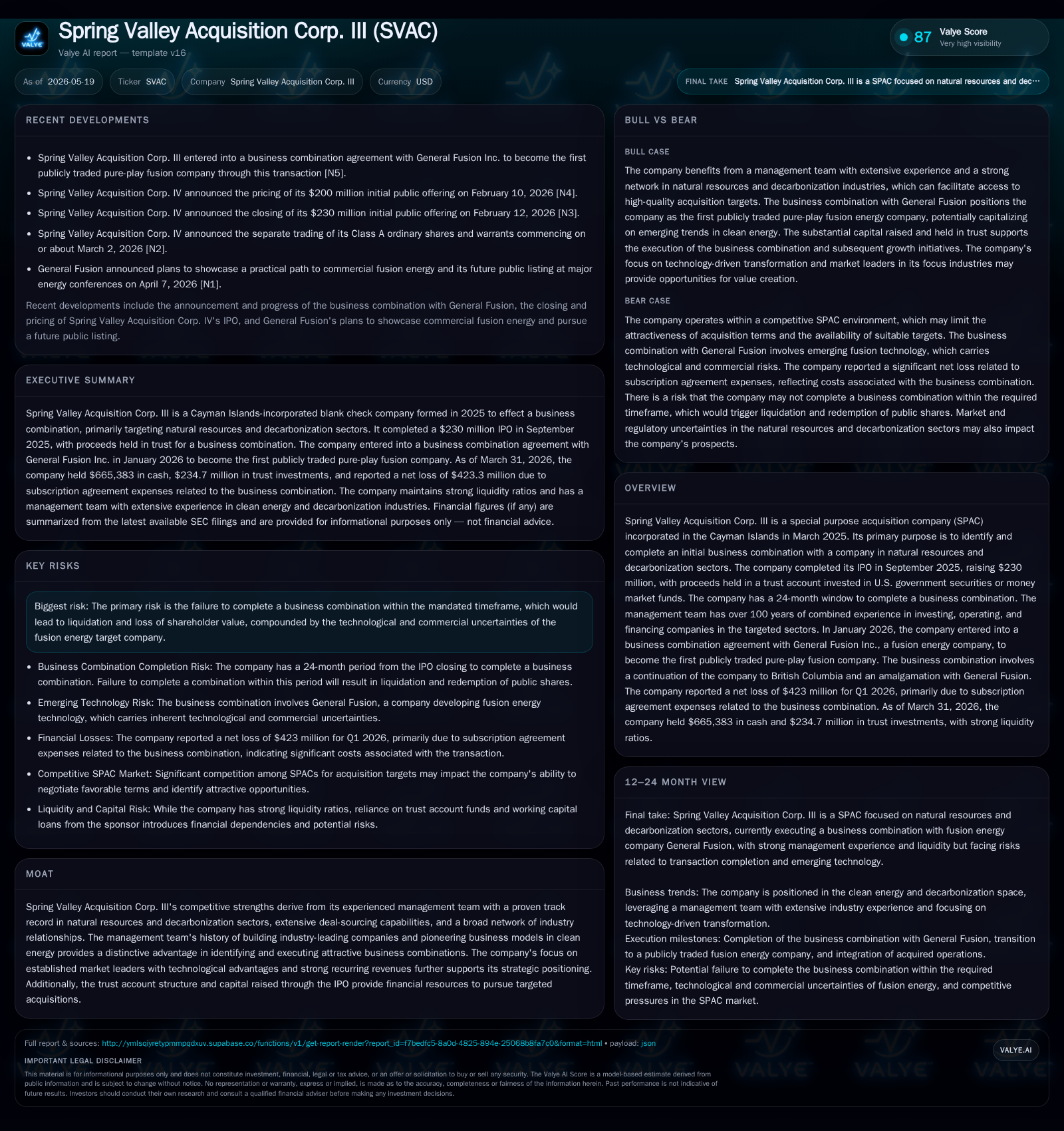
Spring Valley Acquisition Corp. III (SVAC) has positioned itself to be the first publicly traded pure-play fusion energy company through its planned business combination with General Fusion Inc. The latest quarterly filing underlines a strong liquidity position, with $230 million held in trust and approximately $665k in cash equivalents outside the trust, but also highlights going concern considerations requiring potential additional capital. SVAC’s management expertise and the prospective merger place it at a unique nexus of natural resources, decarbonization, and fusion innovation sectors. The primary growth drivers hinge on execution of the business combination and successful commercialization milestones of fusion technology, while timeline constraints and technological uncertainties represent key risks.
III’s (SVAC) May 15, 2026 Form 10-Q reveals a solid liquidity position anchored by proceeds from its September 2025 Initial Public Offering (IPO), where $230 million was placed in a trust account invested primarily in short-term U.S. government treasury bills or money market funds [S2]. As of March 31, 2026, SVAC held approximately $665,000 in cash and equivalents outside the trust account with total current assets near $828,000 against current liabilities around $102,000—resulting in a strong current ratio of 8.15 [F1]. This liquidity buffer supports near-term operational funding needs.
No working capital loans were outstanding at quarter-end, reflecting prudent capital management since IPO proceeds remain primary funding source [S2]. Nonetheless, management disclosed under ASC 205-40 going concern guidance that additional capital may be required through loans or investments from sponsors or third parties to support expenses prior to closing its initial business combination [S2]. This is a common consideration for SPACs navigating transaction timing and costs.
SPAC Business Model and Fusion Sector Focus
Incorporated as a Cayman Islands exempted company in March 2025, SVAC is a special purpose acquisition company formed to complete one or more mergers within natural resources and decarbonization industries [S1]. Its focus sharpened on fusion energy following the January 2026 announcement of an agreement to combine with General Fusion Inc., positioning SVAC as potentially the first publicly traded pure-play commercial fusion energy company [S1], [S3].
The SPAC model relies on raising cash via an IPO—in SVAC’s case $230 million—with proceeds held in escrow-like trust accounts until deployed in approved business combinations [S2], [F1]. Units issued included Class A ordinary shares bundled with partial redeemable warrants exercisable at $11.50 per share [S1]. Management retains discretion to structure deal consideration using cash, equity issuance, debt instruments, or combinations thereof at transaction close.
Experienced management brings decades of combined investing and operational expertise within target sectors. Their domain knowledge enhances deal sourcing capabilities and positions them to add strategic value during integration post-merger [S1].
Industry Context: Natural Resources, Decarbonization, and Fusion Energy
Fusion energy is an emerging pillar in global efforts to drastically reduce carbon emissions associated with electricity generation [N1]. Unlike conventional nuclear fission—which faces challenges related to radioactive waste and public acceptance—fusion promises cleaner baseload power if technical hurdles can be overcome. SVAC’s alignment with General Fusion stakes out leadership within this nascent yet strategically critical segment.
The natural resources sector intersects here as materials like lithium or uranium underpin various decarbonization technologies including batteries and nuclear plants—a core part of SVAC’s investment thesis [S1]. By focusing capital deployment towards advanced fusion innovation—a frontier domain bridging physics breakthroughs with scalable energy production—SVAC situates itself at a transformative juncture for sustainable resource utilization.
Competitive and Structural Positioning
SVAC differentiates itself among SPAC peers through concentrated focus on high-tech clean energy businesses situated at the intersection of natural resources and climate technologies. The management team’s long track record provides intangible advantages in sourcing proprietary deals beyond what generalist SPACs typically access [S1]. Operational insight further allows active strategic contribution pre- and post-business combination.
The trust account mechanism protects investor capital until definitive deals close under regulatory oversight—a standard SPAC feature—but SVAC must manage public market skepticism often associated with complex tech mergers whose asset revenues remain prospective. Effective communication will be key as it transitions into an operating entity focused on long-dated R&D typical in fusion energy.
Growth Drivers: Business Combination Execution and Fusion Commercialization
The primary growth inflection for SVAC lies in converting from a pure SPAC shell into a publicly traded company owning operational fusion assets. Key catalysts include successfully closing the General Fusion merger while advancing technological validation milestones that could unlock subsequent financing rounds or customer contracts [S3], [N1].
Notably, General Fusion plans pilot reactor demonstrations at major energy conferences showcasing their magnetized target fusion approach—events that can provide tangible evidence of practicability and generate investor interest [N1].
Growth also depends on navigating evolving regulatory frameworks applicable both to public companies and emerging nuclear technologies; SVAC’s management experience offers competitive advantage in facilitating this transition. Additional capital deployment may finance scale-up activities beyond initial commitments enhancing operational capacity.
Risks and Watchpoints: Timing Constraints, Technological Uncertainty, Capital Requirements
SVAC faces execution risk imposed by the mandated 24-month window post-IPO to consummate a business combination or face liquidation—a compressed timeline uncommon in traditional venture contexts [S1]. Failure to complete risks shareholder dilution or loss.
Technologically, commercial fusion remains speculative despite notable research progress; scaling prototypes into reliable power plants involves uncertain risks typical of deep tech ventures [S1]. Regulatory hurdles concerning nuclear safety may delay commercialization.
Financially, although initial proceeds provide runway, going concern disclosures indicate potential need for further capital injections via sponsor support or third-party investments prior to closing [S2]. Convertible working capital loans up to $1.5 million remain available offering contingency financial flexibility if needed [S2]. Warrants issued during IPO could dilute equity upon exercise but provide potential infusions mitigating funding gaps.
Key Milestones Ahead
Investors should monitor timely closing of the amended Business Combination Agreement with General Fusion detailed in recent Form 8-K filings alongside any regulatory approval developments or shareholder voting outcomes necessary for transaction completion [S3]
General Fusion’s progress toward pilot project demonstrations at upcoming international energy conferences will serve as critical performance indicators potentially catalyzing momentum technologically and commercially [N1].
Ongoing SEC filings will clarify terms binding both parties; sponsor communications regarding supplemental financing intentions will shed light on liquidity status heading into final stages.
Financial Summary: Liquidity Position and Capital Structure
As of March 31, 2026, SVAC reported approximately $665k cash equivalents outside its trust account alongside total current assets near $828k against modest current liabilities around $102k—yielding an unusually high current ratio above eight—indicating strong short-term solvency absent reliance on working capital loans [F1], [S2].
The Company repaid prior unsecured promissory notes following IPO closing eliminating outstanding debt burdens; however convertible working capital loan facilities remain available up to $1.5 million with lender option to convert portions into warrants providing optionality if additional funding becomes necessary [S2]
Capital structure comprises IPO-issued units containing Class A shares coupled with fractional warrants exercisable above transaction pricing typical for SPACs granting future equity subscription rights without immediate dilution unless exercised post-business combination close [S1], [S2].
Overall financial strength complements operational readiness but remains contingent on successful strategic execution transforming latent economic value into sustainable revenues upon completing its initial business combination.
This analysis synthesizes information from recent SEC disclosures including Forms 10-Q dated May 15, 2026 (primary anchor), Form 8-K filings describing updated agreements around the business combination dated May 18, 2026, along with background context from earlier Form 10-K annual reports filed March 6, 2026. It does not constitute investment advice but clarifies core strategic dynamics shaping Spring Valley Acquisition Corp. III's evolution toward becoming an influential player in public fusion energy markets.
Disclaimer: This is research-only, informational analysis and not investment advice. It may include AI-generated interpretation and general industry context. Always verify important details using primary sources.

Comments